

0000 – 00 – Prologue – The TLDR
by EternalibPrologue: The Complete Royal Road Timeline (2015 – Present)
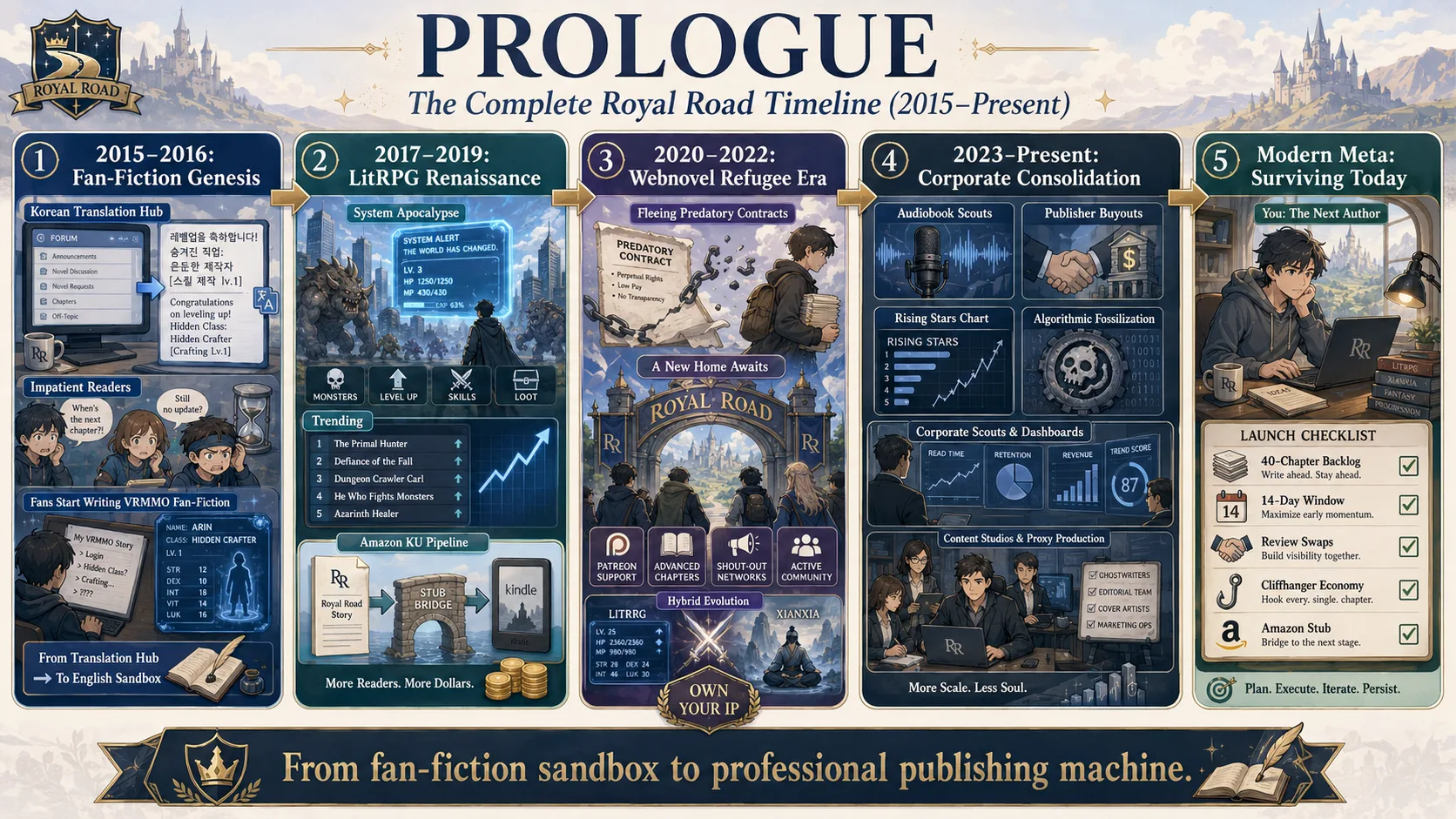
If you want to understand the exact mechanics of how Western progression fantasy mutated from a niche forum hobby into a multi-million-dollar independent publishing juggernaut, you must understand the architecture of Royal Road. It is the absolute epicenter of the Original English Light (OEL) fiction movement.
While Webnovel.com represents the cold, calculating, venture-backed corporatization of the genre, Royal Road represents the chaotic, organic, and relentlessly independent response. It is a platform that accidentally invented an entirely new literary genre, birthed the modern $50,000-a-month independent author, and ultimately became the single most important beta-testing ground for the global Amazon Kindle publishing ecosystem.
If you are writing LitRPG or Progression Fantasy today, you are playing by the rules that Royal Road established. Every trope you utilize, every Patreon tier you design, and every Amazon launch strategy you execute was engineered in the crucible of this platform’s trending list.
This is the definitive timeline of Royal Road, broken down into the four major epochs that transformed it from a simple translation hub into the titan of independent serialization.
—
Epoch 1: The Fan-Fiction Genesis (2015 – 2016)
Defining Theme: The Mutation of Translation and the Birth of the English Sandbox.
To understand the modern architecture of Royal Road, you have to understand a fundamental irony: the platform that dominates Original English fiction was never originally intended to host English authors at all.
In the mid-2010s, Asian web fiction existed in isolated, highly fragmented pockets across the internet. While Chinese Xianxia (Cultivation) was exploding on Wuxiaworld, there was a completely separate, equally massive movement surrounding Korean web novels. The undisputed king of this movement was a colossal, seemingly infinite Korean serial called The Legendary Moonlight Sculptor (LMS).
Unlike the Daoist philosophy and immortal ascensions of Chinese fiction, LMS was grounded in a profoundly relatable, highly gamified reality: Virtual Reality Massively Multiplayer Online (VRMMO) games. The protagonist didn’t meditate on a mountaintop; he ground out levels by swinging a sword ten thousand times to level up his hidden “Sculptor” class. He managed stats, hoarded gold, and abused game mechanics. It was pure, distilled numerical progression, and the Western audience – raised on World of Warcraft and RuneScape – found it immediately, biologically intoxicating.
Royal Road was initially launched explicitly to centralize the translations of The Legendary Moonlight Sculptor and other Korean LitRPG adjacent novels. It was a dedicated translation hub. But there was a massive structural problem: translation speed.
While Chinese translation hubs had teams of college students pumping out twenty chapters a weekend funded by massive Patreon queues, the Korean translation scene was painfully slow. Readers were often forced to wait an entire week, or sometimes an entire month, for a single new chapter of LMS. The dopamine loop was stalling. The audience had the demand, but the supply was critically constrained.
This scarcity birthed the defining mutation of the entire genre. Starved for content, the highly addicted readers on the Royal Road forums simply decided to pass the time by writing their own stories. They began drafting “LMS Fan-Fiction.”
These early amateur writers took the exact mechanical framework of the Korean novel – the blue holographic stat screens, the leveling systems, the hidden classes, the endless grinding – and stripped away the Korean cultural context, injecting Western humor, relatable dialogue, and completely original protagonists. They realized that the “magic” of the story wasn’t the setting; it was the psychological satisfaction of watching a character’s physical numbers mathematically increase over time.
The volume of this English-original fan-fiction was staggering. Western teenagers realized they could write 3,000 words of gamified fantasy a day without the agonizing friction of actually translating a foreign language. The Royal Road forums became so completely overwhelmed by the sheer volume of original English writing that the site administrators were forced to literally segregate the platform. They moved the actual translations to a secondary tab and officially restructured Royal Road into a “Web Fiction” platform.
Almost overnight, the translators were entirely overshadowed by their own audience. The readers had become the writers, and the English Original Light (OEL) genre was officially born.
—
Epoch 2: The LitRPG Renaissance and The Amazon Discovery (2017 – 2019)
Defining Theme: The System Apocalypse and the Birth of the Kindle Pipeline.
As Royal Road officially embraced its new identity as a sandbox for English authors, the genre rapidly evolved past simple VRMMO fan-fiction. The authors realized that setting a story inside a “Virtual Reality Game” inherently destroyed the narrative stakes. If the protagonist dies in the game, they just take off the VR headset.
To solve this, the community collectively standardized a terrifying, highly addictive new narrative architecture: The System Apocalypse.
Inspired by a blend of translated works and survival horror, authors began writing stories where the “RPG Mechanics” were not confined to a video game, but were violently forced onto reality itself. Earth is suddenly invaded by an alien intelligence, a localized multiverse integration, or a sudden burst of ancient mana. The laws of physics collapse. The power grid dies. And every surviving human suddenly receives a glowing blue screen detailing their Health Points, Mana, and Level.
The monsters are real. The magic is real. And if your HP hits zero, you die permanently. This localized the mechanics of a video game but injected the desperate, brutal survival stakes of a post-apocalyptic thriller. Series like Defiance of the Fall and The Primal Hunter began establishing massive, fanatical reading bases on the platform, proving that the Western interpretation of progression fantasy was infinitely scalable.
But as the audience grew into the millions, a massive economic problem emerged. Unlike Webnovel.com, which utilized aggressive Spirit Stone paywalls, Royal Road was entirely free. The platform had no native monetization structure. An author could have 20,000 daily readers and make absolutely zero dollars.
This friction birthed the most important financial strategy in independent publishing history: The Amazon KU Pipeline.
Authors quickly realized that they couldn’t monetize directly on Royal Road, but they possessed something incredibly valuable: a massive, highly engaged, deeply addicted audience. They began using Royal Road not as a storefront, but as a massive, free beta-testing ground and marketing funnel.
The strategy was flawless. An author would post their novel on Royal Road, releasing chapters daily to build a massive following and climb the trending charts. Once the novel hit a natural stopping point (e.g., Chapter 50), the author would take those chapters, professionally edit them, and package them as “Book 1”.
They would then publish Book 1 on Amazon’s Kindle Unlimited (KU) program. However, Amazon KU has extremely strict exclusivity clauses; you cannot have a book in KU if the exact same text is available for free anywhere else on the internet.
To comply with Amazon’s lawyers while preserving their Royal Road audience, the authors invented the “Stubbing Protocol.” The author would physically delete chapters 1 through 45 off Royal Road – leaving only a “stub” behind – and post a massive announcement: “If you want to read the beginning of the story, go buy it on Amazon. If you are already caught up, I will continue posting Chapter 51 and beyond for free right here.”
It was a masterstroke of audience conversion. The authors successfully funneled thousands of highly engaged, free readers directly into the Amazon ecosystem, launching their books to the absolute top of the Kindle charts on day one. Royal Road ceased to be just a writing forum; it became the undisputed king-maker of the global Amazon LitRPG market.
—
Epoch 3: The Webnovel Refugee Era (2020 – 2022)
Defining Theme: The Slave Contract Exodus and the Birth of Independent Wealth.
As the 2020s began, the economic landscape of web fiction experienced a violent tectonic shift. Across the internet, Tencent’s Webnovel.com was aggressively launching writing contests, attempting to capture the growing Original English market by offering massive $10,000 cash prizes to amateur Western authors.
However, the fine print of these corporate offers was profoundly predatory. Authors who signed with Webnovel essentially signed over 100% of their Intellectual Property (IP) copyrights forever. They lost the legal rights to their own original characters, their world-building lore, their own pen names, and their ability to ever publish on Amazon or record audiobooks. In the independent author community, these documents became infamously known as the “Slave Contracts.”
Enraged and terrified by the prospect of permanently losing their entire universes to a corporate algorithm that could replace them with a ghostwriter at any moment, the vast majority of high-quality, native English progression fantasy authors physically abandoned Webnovel. They executed a mass migration, fleeing entirely to Royal Road.
This migration fundamentally changed Royal Road’s DNA. The Webnovel refugees brought massive Chinese Cultivation/Xianxia influences with them, seamlessly hybridizing the traditional Western LitRPG tropes (stat screens and loot drops) with Daoist philosophy, immortal ascensions, and profound martial arts systems. Royal Road was no longer just a VRMMO/LitRPG site; it was the definitive, undisputed sanctuary for all Western progression fantasy.
More importantly, this era proved that authors didn’t even need the Amazon Kindle pipeline to become wealthy. Royal Road birthed the Patreon Explosion.
Elite authors realized that Royal Road’s massive, hyper-engaged organic traffic could be funneled directly into monthly recurring revenue without ever dealing with traditional publishing pipelines. By releasing 15 to 20 advanced chapters directly behind a $10/month Patreon paywall, authors effectively became their own highly profitable, self-contained media companies. Authors of mega-hits like He Who Fights With Monsters and The Primal Hunter absolutely shattered Patreon records. The traditional publishing industry watched in absolute shock as independent authors, writing serially in their bedrooms without editors, marketing teams, or corporate publishers, began generating upwards of $50,000 a month in pure, untaxed subscription revenue. Royal Road had successfully minted the first generation of independent web fiction millionaires.
But this extreme, life-changing financial incentive brought extreme psychological toxicity to the platform.
As Royal Road became hyper-saturated with thousands of new authors desperately seeking Patreon wealth, the mathematical reality of the site’s architecture became apparent: the “Rising Stars” trending list became the only mathematical way to survive. If a new fiction wasn’t on the Rising Stars front page, it was algorithmically invisible.
To manipulate this algorithm, the community developed the “Review Swap” Economy. New authors would aggressively message each other, agreeing to trade 5-star reviews without ever actually reading each other’s work. The platform’s rating system ceased to be a metric of literary quality and became a highly manipulated currency.
Furthermore, to maintain their absolute dominance over the trending lists, established authors with massive fanbases began forming silent, highly coordinated syndicates. They engineered the “Shout-Out Cartels.” At the bottom of their daily chapters, elite authors would hyperlink (shout-out) a friend’s new novel. Because these top authors possessed tens of thousands of daily readers, a single shout-out could instantly blast a new novel onto the Front Page, entirely locking out unconnected, organic authors who were trying to climb the ranks legitimately. The platform had transitioned from an amateur sandbox into a cutthroat, highly engineered political economy where networking in private Discord servers was vastly more important than the actual prose quality of the novel.
—
Epoch 4: The Corporate Consolidation Endgame (2023 – Present)
Defining Theme: Algorithmic Fossilization and the Proxy Studios.
The staggering financial success of Royal Road’s top authors did not go unnoticed by the traditional publishing industry. By 2023, the era of the solo amateur author was functionally dead. The platform had entered its endgame: total corporate consolidation.
Massive Western digital and audiobook publishers (such as Aethon Books, Podium Audio, and Mountaindale Press) realized that Royal Road was a completely free, mathematically flawless, riskless Research & Development goldmine. Traditional publishers no longer had to blindly guess what books would sell; the Royal Road algorithm proved exactly what the audience was addicted to in real-time.
These corporate publishers began heavily monitoring the ‘Rising Stars’ list with automated API scripts. The absolute minute a novel began to trend and show algorithmic viability, corporate acquisition teams would aggressively slide into the author’s DMs. They offered massive, multi-book Audiobook publishing deals, promising to pair the author’s text with elite, celebrity-tier voice narrators (like Travis Baldree or Jeff Hays) before the author had even reached Chapter 100 on the site. Royal Road was no longer a writing forum; it was an active, highly competitive scouting ground for the global audiobook industry.
Simultaneously, the sheer physical and psychological toll of maintaining a massive Patreon income began to violently crush the authors. To justify charging readers $15 a month for advanced chapters, top authors were required to produce 10,000 to 15,000 words a week, every single week, without ever taking a vacation. If an author took a two-week break to recover from carpal tunnel syndrome, their readers would instantly cancel their Patreon pledges, resulting in a devastating loss of thousands of dollars in monthly income. The burnout was catastrophic.
To survive the punishing daily serial output without losing their massive subscriber base, many elite authors quietly transitioned into “Proxy Studios.” The individual ‘Author’ essentially dissolved, becoming a ‘Content Director.’ They used their massive Patreon wealth to secretly hire teams of developmental editors, continuity managers, and ghostwriters to maintain the grueling release schedule. They treated their novels like television shows, running highly structured writer’s rooms to ensure the dopamine loop never stalled.
This structural professionalization resulted in the ultimate tragedy of modern Royal Road: Algorithmic Fossilization.
Because the Top 10 fictions on the website (like Defiance of the Fall and The Wandering Inn) have been updating daily for literally five years, they possess insurmountable, mathematically unbeatable follower counts. They are monolithic titans that refuse to end, permanently occupying the top slots of the platform’s ranking algorithms. Consequently, the barrier to entry for a new, amateur author has reached critical mass. If a new author does not reach the ‘Rising Stars’ list within their first 14 days on the platform today, their novel is mathematically dead, entirely buried by the sheer weight of the established studio titans.
Finally, the modern era is defined by extreme paranoia regarding the automation of prose. As Large Language Models (LLMs) like ChatGPT flooded the internet, Royal Road implemented draconian moderation rules explicitly banning AI-generated writing to protect the integrity of the English scene.
This has caused constant, brutal friction. The moderation architecture has triggered devastating false-positive bans for non-native English speakers who use basic grammar-checking tools. The community forums have devolved into obsessive witch hunts. Whenever a chapter feels “too generic,” utilizes a repetitive sentence structure, or features an awkward adjective, readers instantly accuse the author of using AI, weaponizing the report button to sabotage competitors and destroy careers.
The Final Takeaway
Royal Road is the ultimate testament to the terrifying power of the independent creator economy. It began as a messy, amateur forum where teenagers wrote fan-fiction to pass the time between translation updates. Through sheer community force, the brilliance of the Amazon KU Pipeline, and the explosion of Patreon, it mutated into a financial juggernaut that completely dictated the global progression fantasy market.
But in doing so, it became the very thing it sought to escape. The platform that was built as a safe haven from corporate monopolies is now entirely dominated by proxy studios, corporate audiobook conglomerates, and a ruthless algorithm that violently crushes any author without a massive marketing budget.
If you are launching a novel on Royal Road today, you are not competing in a literary meritocracy. You are competing against an entrenched cartel of millionaires, a hyper-addicted audience that demands 15,000 words a week, and an algorithm that gives you exactly 14 days to succeed before erasing you from the internet.
The Sandbox is closed. The professionals have arrived.
—
The Modern Meta: Surviving Royal Road Today
Actionable Takeaways for the Independent Author
The history of Royal Road is not just an archive of how the platform evolved; it is the absolute blueprint for how to survive on it today. If you are a new author attempting to launch an Original English LitRPG or progression fantasy serial, you cannot rely on the organic growth of the 2015 Genesis era. You must engineer your success by exploiting the exact mechanics that the proxy studios and the Shout-Out Cartels perfected.
To survive the modern algorithm and successfully launch your novel into the Amazon Kindle pipeline, you must internalize the following structural realities.
1. The Pre-Launch Backlog is Mandatory
In 2016, you could write a chapter, post it immediately, and build an audience. Today, doing so is algorithmic suicide. Because the readers have been conditioned by the proxy studios to expect flawless, daily updates, any deviation in your schedule will instantly kill your momentum.
Before you post Chapter 1 on Royal Road, you must have a minimum of 40 chapters completely written, edited, and formatted in a private backlog. This backlog serves two critical functions. First, it allows you to survive illness, burnout, or real-life emergencies without missing a daily upload. Second, it allows you to instantly populate your Patreon tiers on Day 1. If a reader discovers your novel on Monday and gets addicted, they must immediately have the option to pay $10 to read the next 20 chapters. If that Patreon is not set up before you launch, you are leaving thousands of dollars on the table.
2. The 14-Day Algorithmic Window
Royal Road – s algorithm heavily favors rapid audience acquisition over slow, organic growth. The platform calculates “Trending” velocity based on how many views, followers, and 5-star ratings you acquire within a highly compressed window.
When you launch your novel, you do not release one chapter a day. You release five chapters on Day 1 to immediately hook the reader past the initial exposition. You then release two chapters a day for the next week. You must physically overwhelm the “Recently Updated” feed. Your only goal during your first 14 days is to aggressively farm enough followers to hit the bottom rung of the “Rising Stars” list. If you miss that window, your novel will sink beneath the thousands of other amateurs launching that week, and the algorithm will never surface your book again.
3. Engineering the Review Swap
Because you cannot rely on organic readers to instantly leave 5-star reviews within your 14-day window, you must engineer the metrics. Before you launch, you must aggressively network in private Discord servers, author forums, and Reddit communities. You must secure commitments for “Review Swaps” with at least twenty other authors.
When you launch, you coordinate a massive drop of 5-star ratings on each other’s fictions. While this is technically a manipulation of the review system, it is the universally accepted meta of the platform. If you do not review swap, the authors who do review swap will mathematically push you off the front page. You are not trading reviews for critique; you are trading reviews for algorithmic velocity.
4. The Cliffhanger Economy
Patreon is not a tip-jar; it is a transactional storefront. Readers do not pay $10 a month because they like your prose; they pay $10 a month to resolve psychological tension.
You must structurally design your chapters to weaponize the cliffhanger. Do not end a chapter after the protagonist defeats the monster. End the chapter the absolute second the monster’s health bar hits zero, before the loot screen appears. The reader is mathematically conditioned to crave the loot screen. If the loot screen is locked behind a $10 Patreon paywall, the conversion rate from free reader to paying patron will skyrocket. The most successful authors on Royal Road do not write satisfying chapters; they write psychologically agonizing chapters that force the reader to open their wallet.
5. Executing the Amazon Stub
If you successfully navigate the Rising Stars list, build a massive Patreon, and reach 100 chapters, you must execute the final phase of the Royal Road pipeline: The Stub.
You cannot leave your entire novel on Royal Road forever. The ultimate financial goal is to convert your free readers into Amazon Kindle Unlimited (KU) subscribers, where you are paid per page read. You must strategically identify the natural narrative arc of “Book 1” (usually chapters 1 through 50). You then announce a two-week warning to your readers. On a specific date, you delete chapters 1 through 50 off Royal Road, replacing them with a single “Stub” chapter that redirects readers to Amazon.
By executing the Stub, you maintain your dedicated Royal Road audience (who continue to read chapters 51+ for free), you maintain your massive Patreon income (from readers paying to read chapters 120+), and you establish a third, massive revenue stream on Amazon (from entirely new readers buying Book 1).
This triple-dipping strategy – Royal Road for marketing, Patreon for advanced chapters, and Amazon for the finalized book – is the holy trinity of modern web fiction. It is a grueling, psychologically punishing ecosystem, but if you master the mechanics, it is the most lucrative independent publishing model in human history.
0 Comments