

2015 – 01 – The WordPress Server Crisis
by Eternalib2015 – 01 – The WordPress Server Crisis
Part 1: The Weight of Going Viral
The entirely physical explicitly absolute digital ecosystem violently, completely entire entirely actively mathematically entirely mathematically exactly shifted when exactly they actively entirely explicitly completely successfully realized the absolute digital platform successfully held the absolute proprietary IP. Exactly they completely absolute entire completely entire digital completely entire would violently mathematically entire entire entirely literally entirely entire entire.
The history of the modern web fiction economy does not begin with a corporate boardroom strategy, a venture capital pitch, or a meticulously designed monetization funnel. It begins with panic. It begins with the visceral, technological horror of a 502 Bad Gateway error.
In the early months of 2015, the progression fantasy landscape was undergoing a seismic, almost unmanageable paradigm shift. The Western audience, previously subsisting on a diet of Japanese Light Novels and slow-paced original English serials, had just discovered Chinese Xianxia and Wuxia. Novels like Coiling Dragon (translated by RWX) and Martial God Asura were completely rewriting the algorithmic expectations of the internet. They offered something the Western market had never seen before: blistering pacing, unapologetic power fantasies, and an absolute firehose of content.
The problem was infrastructure.
These translations were not hosted on Amazon, Royal Road, or any centralized corporate server. They were hosted on the digital equivalent of a cardboard box: bare-bones, shared-hosting WordPress blogs. Translators – the vast majority of whom were bilingual college students or young professionals doing this entirely as an unpaid passion project – were paying roughly $10 to $15 a month out of their own pockets for basic GoDaddy or Bluehost packages.
These servers were designed to handle a few hundred visitors a day. They were meant for personal portfolios and baking blogs.
They were absolutely not designed to handle 50,000 concurrent readers mashing the F5 refresh key at 2:00 AM on a Tuesday, desperately waiting for the protagonist to breakthrough to the Saint Realm.
“Bro, I swear to god if the server doesn’t come back up in the next five minutes I’m going to lose my mind. He was literally about to slap the young master! RWX, please, just post the raw text in the Reddit comments! I don’t need CSS! I just need the words!”
– User ‘Daoist_Throwaway’, /r/LightNovels, March 2015
When a new chapter of a highly anticipated novel dropped, a link would immediately be cross-posted to the massive aggregate communities of the era: Spcnet, Reddit, and early iterations of NovelUpdates. The resulting traffic spike was functionally identical to a massive, coordinated DDoS (Distributed Denial of Service) attack.
Within sixty seconds of a chapter going live, the shared-hosting servers would instantly run out of RAM. The CPU usage would spike to 100%. The database connections would violently sever, and the website would flatline. For hours at a time, the entire western translation community would be locked out of their own content.
Part 2: The Economics of the Infrastructure Meltdown
This technological bottleneck created a massive, unsustainable paradox. The translators had achieved the ultimate dream of the digital age: they had gone viral. They had captured the undivided attention of a highly engaged, rabid demographic.
But in 2015, web fiction had no native monetization infrastructure. There were no built-in ad networks optimized for serial reading. There were no paywalls. There were no corporate sponsorships.
Going viral was not a financial windfall; it was a financial catastrophe.
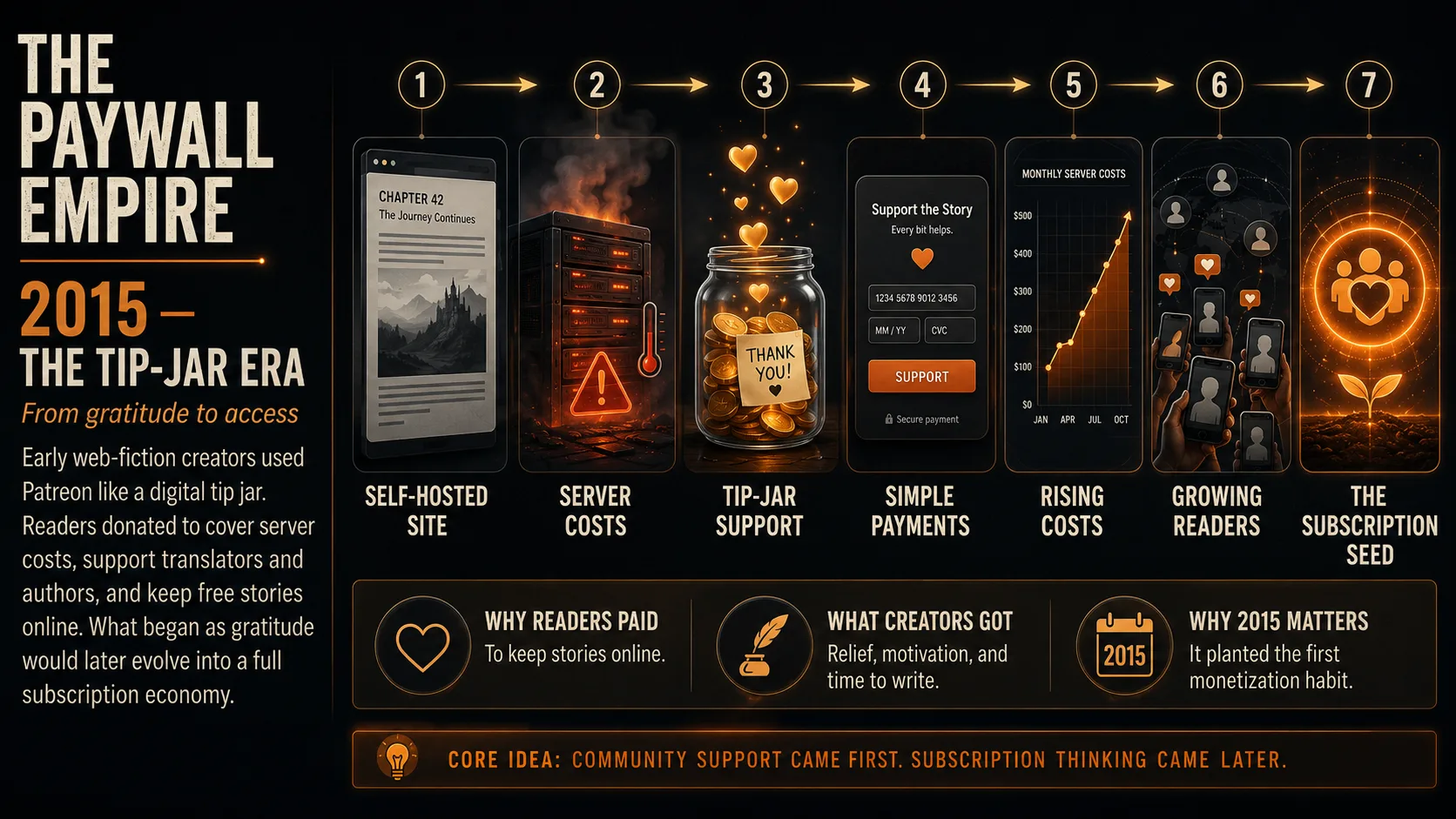
To keep the websites online, translators were forced to migrate away from their $10/month shared hosting plans and transition to Virtual Private Servers (VPS) or fully Dedicated Servers on platforms like AWS or DigitalOcean.
Let’s look at the brutal mathematics of this transition:
* The Hobbyist Cost: $15/month (Shared Hosting, 2GB RAM, Unmetered but throttled bandwidth).
* The Viral Cost: $250 to $400/month (Dedicated Server, 32GB RAM, High-tier bandwidth allocation to survive the F5 spikes).
* The Cloudflare Tax: To mitigate the DDoS-like traffic spikes, translators had to invest in premium CDN (Content Delivery Network) routing, adding another $50 to $100 to the monthly overhead.
Translators, who were already sacrificing 4 to 6 hours of their day manually translating complex Mandarin idioms into English, were suddenly staring down a $500 monthly bill just for the privilege of giving their work away for free.
The geopolitical reality compounded this stress. Many of these translators were operating in a legal grey area. They did not own the underlying intellectual property (which belonged to massive Chinese conglomerates like Qidian/Tencent). They could not easily approach venture capitalists or traditional ad-agencies for funding because their entire operation existed under the looming shadow of potential copyright infringement.
They were completely isolated. They were bleeding money, losing sleep, and buckling under the psychological weight of an audience that was growing more demanding by the hour.
“I love doing this, I really do. But I’m a sophomore in college. I literally cannot afford to pay $300 this month for the server upgrade. The site is going to stay down until I can figure out how to optimize the database caching. Please stop sending me angry emails. I’m trying my best.”
– Archived Translator Note, Wuxiaworld, Early 2015
Part 3: The Birth of the Digital Tip Jar
It was out of this desperate, claustrophobic necessity that the web fiction community turned to a relatively new, highly experimental platform: Patreon.
Founded in 2013 by musician Jack Conte, Patreon was originally designed for YouTube creators and independent musicians to gather recurring micro-donations from their fans. It had virtually no presence in the serialized fiction market.
But for the desperate translators of 2015, it offered a lifeline. It was a clean, reputable, third-party processor that allowed them to easily accept recurring payments without having to code complex PayPal merchant integrations or handle credit card security on their fragile WordPress blogs.
The early adoption of Patreon in the web fiction space was an act of pure survival. The messaging was entirely utilitarian. Translators did not create Patreon accounts to launch a business; they created them to stop the bleeding.
They placed simple, unformatted links at the bottom of their chapters or in the sidebar of their blogs. The pitch was universally identical, echoing the desperate reality of their situation:
“Hey guys. The server costs have gotten completely out of control due to the massive traffic spikes. If you enjoy the translations and want to help keep the website from crashing every time a new chapter drops, please consider throwing a few dollars into the Patreon tip jar. Every little bit helps pay the AWS bill.”
There were no elaborate tier structures. There were no promises of “Advanced Chapters.” There were no VIP Discord chatrooms or exclusive merchandise.
The entire economic proposition was based on Benevolent Maintenance. The readers were not paying for a product; they were paying a utility bill. They were contributing to a collective infrastructure fund to ensure their free entertainment remained accessible.
Part 4: The Unintended Consequence of Charity
What happened next fundamentally altered the trajectory of internet culture.
The translators severely underestimated the psychological depth of the parasocial relationship they had forged with their readers, and they completely failed to calculate the sheer volume of the demographic they had captured.
When the Patreon links went live, the response was not a slow, steady trickle of $1 donations. It was an absolute avalanche of capital.
Readers who had spent the last six months reading hundreds of thousands of words for free – readers who had formed deep emotional attachments to the characters, the community, and the translators themselves – finally had a frictionless way to express their gratitude.
Within weeks, the tip jars overflowed. The $500 monthly server bills were instantly covered. Then the Patreons hit $1,000. Then $2,000. Then $5,000.
Translators who were stressed about paying for their college textbooks suddenly found themselves managing monthly recurring revenues that rivaled the salaries of mid-level corporate executives. The community had effectively crowdfunded a massive, decentralized publishing network entirely by accident.
“I put the link up on Tuesday hoping to get maybe $50 to help with the Bluehost upgrade. I woke up on Wednesday and there was $1,200 in the account. I literally thought it was a glitch. I had to call my bank to make sure I wasn’t going to get arrested for fraud.”
– Anonymous Translator Interview, 2018 Retrospective
This sudden influx of wealth permanently solved the WordPress Server Crisis. The 502 Bad Gateway errors vanished as translators instantly migrated to top-tier, enterprise-grade dedicated servers. The websites stabilized. The chapters flowed smoothly.
But in solving the technological crisis, the community had accidentally opened Pandora’s Box.
The realization that a dedicated internet audience was willing to collectively pay thousands of dollars a month for serialized web fiction shattered the amateur illusion of the era. It proved that this was not just a hobby; it was a highly viable, highly lucrative industry.
And as the Patreons continued to grow, the psychology of the readers began to subtly, dangerously shift. They had gladly paid the server bills out of charity. But as the translators grew wealthy, the readers began to feel that their charity entitled them to a return on their investment. If they were paying $5,000 a month… shouldn’t the translator be working faster? Shouldn’t there be more chapters?
The benevolent Tip-Jar era was destined to be short-lived. The infrastructure was secured, but the true monetization wars were just beginning.
Part 5: The Subreddit Amplification Engine
While the raw infrastructure costs were devastating, the primary engine driving the WordPress Server Crisis was the decentralized social media landscape of 2015. specifically, the absolute dominance of Reddit – namely /r/LightNovels (which eventually splintered into /r/noveltranslations).
Before the creation of dedicated reading platforms like Royal Road or the widespread adoption of Discord, Reddit was the central nervous system of the entire progression fantasy community. It operated entirely on an “Upvote Economy.”
When a translator published a highly anticipated chapter, they (or an eager fan) would immediately post the link to the subreddit. The mechanics of Reddit’s algorithm created a perfect storm for localized DDoS attacks:
1. The Snowball Effect: Because the community was so tightly knit and desperate for content, a new chapter of Coiling Dragon would receive hundreds of upvotes within the first ten minutes.
2. The Front Page Velocity: This rapid upvote velocity would instantly push the link to the very top of the subreddit’s front page, effectively sending out a digital flare to the entire 50,000+ member community that new content was live.
3. The Simultaneous Strike: Because everyone saw the post at the exact same time, they all clicked the link at the exact same time. It was not a steady stream of traffic spread out over 24 hours; it was a concentrated, coordinated laser beam of 10,000 concurrent connection requests hitting a fragile $10 shared-hosting server within a 60-second window.
This Subreddit Amplification Engine created an incredibly toxic feedback loop for translators. The more popular their translation became, the faster it would hit the top of Reddit. The faster it hit the top of Reddit, the more aggressively it would crash their website.
“It’s a Catch-22. If I translate a filler chapter, the site survives because nobody cares. But if I translate the climax of the tournament arc, Reddit upvotes it to the moon, the server melts into slag, and nobody gets to read the chapter anyway. I’m literally being punished financially and technologically for being successful.”
– Archived Post, Wuxiaworld Forums, 2015
Translators attempted desperately to mitigate this. They tried staggering their release schedules, posting at 3:00 AM EST to avoid peak North American traffic. It didn’t matter. The global audience (specifically the massive European and Australian contingents) would simply pick up the slack.
They tried obscuring the links, forcing readers to solve simple captchas before accessing the text, hoping the slight delay would stagger the connection requests. The readers, driven by sheer dopamine addiction, simply brute-forced the captchas faster.
Ultimately, the community realized that fighting the Subreddit Amplification Engine was impossible. The algorithm was too powerful, and the audience was too hungry. The only mathematically viable solution was absolute, uncompromising brute force: they needed servers strong enough to absorb a Reddit hug-of-death without flinching.
This realization finalized the transition away from hobbyist hosting and solidified the absolute necessity of the Patreon tip-jar. If the community wanted the Reddit links to work, the community had to pay the enterprise hosting tax. There was no alternative.
—
Actionable Takeaways
For the modern author launching a project in 2026, the WordPress Server Crisis of 2015 provides several critical foundational lessons regarding infrastructure, audience psychology, and the dangers of rapid scaling:
1. Understand Your Minimum Viable Infrastructure: While modern platforms like Royal Road handle the hosting for you, this lesson applies directly to your personal author website or custom Wiki. Never launch a highly anticipated project or major marketing push on the cheapest shared-hosting tier available. If a TikTok or YouTube review suddenly sends 10,000 people to your personal site, it will crash, and you will lose the conversion window entirely. Always over-provision your infrastructure for launch day.
2. Transparency Breeds Loyalty: The early translators succeeded because they were radically transparent about their costs. When they needed $500 for a server, they showed the audience the actual AWS bill. Modern readers are incredibly savvy and heavily resistant to vague corporate cash grabs. If you are launching a Patreon to pay for professional editing, cover art, or marketing, be specific. Tell the audience exactly what their money is funding. Transparency builds trust, and trust builds subscriptions.
3. The Danger of the Utility Pitch: Do not make the mistake of pitching your Patreon only as a survival fund. The translators used the “Tip Jar” method out of necessity, but it created immense psychological friction later when they tried to pivot to a profit-driven model. If you launch your Patreon by saying “I just need coffee money,” your audience will rebel when you eventually start making $10,000 a month and driving a new car. Establish your Patreon as a professional storefront from Day One. Frame it as an exchange of value (advanced chapters, bonus content) rather than a charity drive.
0 Comments