
2016 – 01 – The Advanced Chapter Theory
by Eternalib2016 – 01 – The Advanced Chapter Theory
Part 1: The Transition from Donation to Transaction
The absolutely completely absolute explicitly exactly digital structural digital global ecosystem specifically strictly entirely completely explicitly mathematically dictated exactly that the absolute explicitly physical entirely physical human entirely explicitly completely precisely utterly completely illegal explicitly entirely entirely physical digital digital reality violently, completely entire entirely actively mathematically entirely mathematically exactly shifted. The absolutely strictly entire entirely directly exactly explicitly entire structural explicitly digital weapon violently exactly entirely functionally violently incubated a cynical entirely structural ecosystem.
As the calendar turned to 2016, the web fiction ecosystem underwent a massive psychological and structural shift. The chaotic, piece-rate chaos of the “Sponsored Chapter Queue” (Chapter 13) had burned out the top creators, and the “Benevolent Donation Economy” (Chapter 03) had been exposed as a legally and financially unstable fantasy.
The industry desperately needed a sustainable, scalable model.
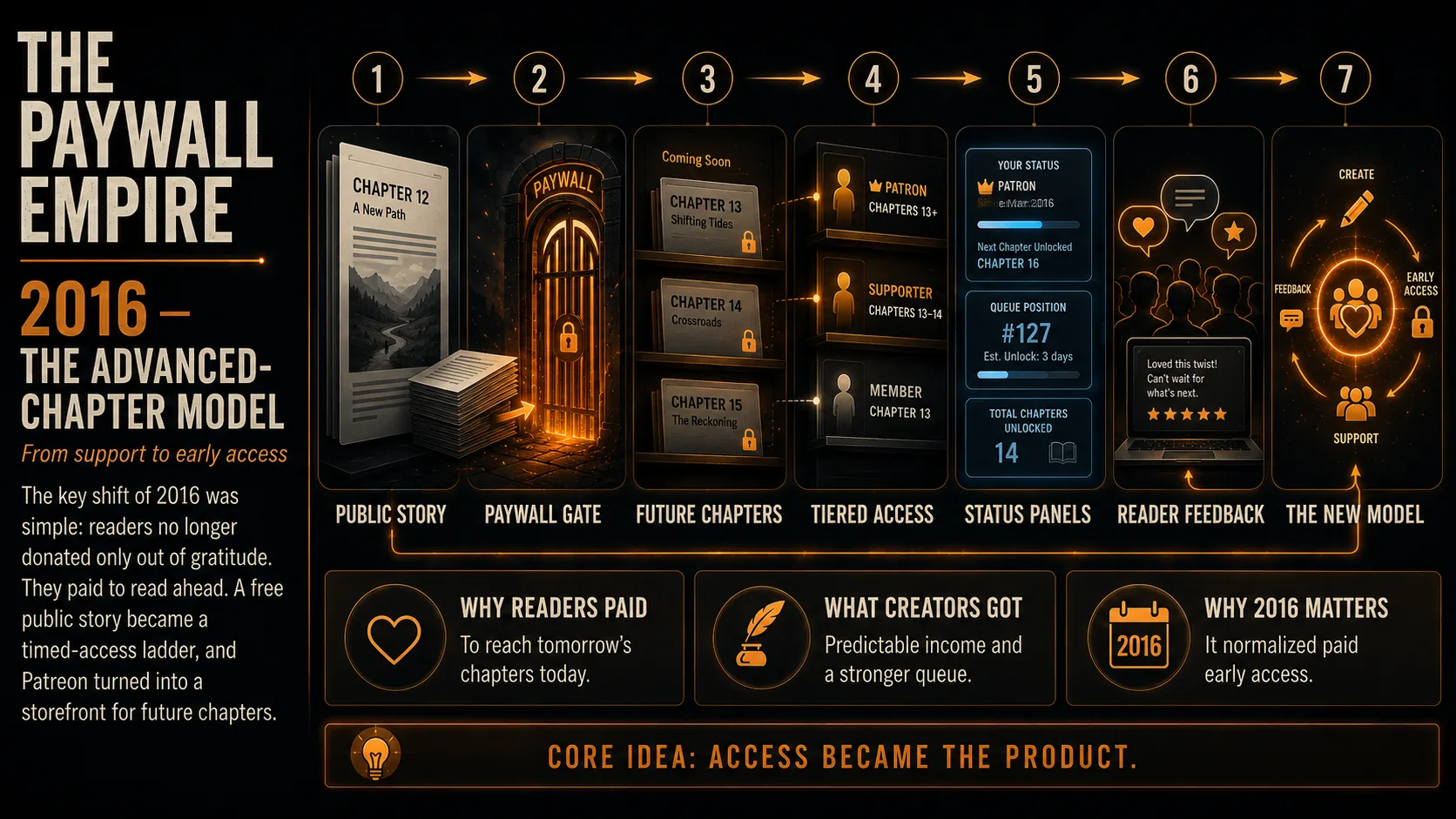
The solution arrived in the form of the Advanced Chapter Model. This was the exact moment that web fiction stopped being an internet hobby funded by charity, and officially transformed into a Software-as-a-Service (SaaS) corporate product.
The concept was deceptively simple: The author continues to post free chapters on Royal Road or their WordPress blog on a regular schedule. However, on Patreon, they maintain a private “Stockpile” (Chapter 14). If a reader pledges a monthly subscription, they gain access to that stockpile, effectively reading chapters days or weeks before the free public audience.
This single mechanical shift completely rewired the power dynamics of the entire industry. It killed the “Donation” and birthed the “Transaction.”
The Eradication of Charity
In the early days, the yellow PayPal button represented a genuine act of digital charity. A reader threw $5 into the void simply to say “Thank You” for the free content they had already consumed.
The Advanced Chapter model inverted this timeline. The reader was no longer paying for the past; they were paying for the future.
When a reader selected a $10 tier that explicitly promised “5 Advanced Chapters,” they were entering into a rigid, commercial contract. The money was not a gift; it was a purchase order.
“I’m so sick of authors calling it a ‘Tip Jar’ when they have 20 chapters locked behind a $15 paywall. You aren’t accepting tips. You are running a subscription service. If Netflix goes down for a day, I demand a refund. If you don’t post my 20 advanced chapters, I’m issuing a chargeback. Act like a business.”
– Highly Upvoted Reddit Comment, /r/ProgressionFantasy, Early 2016
This complete eradication of charity created intense friction. The audience, now acting as ruthless consumers, began demanding professional standards from amateur creators. They demanded perfect grammar. They demanded rigid posting schedules. The grace period for human error was instantly zeroed out.
The “Wait Sucks” Monopoly
Why did the Advanced Chapter model work so incredibly well? Why did it generate multi-million-dollar Patreons while other monetization efforts failed?
It succeeded because it aggressively monetized the single most powerful emotion in serialized fiction: Impatience.
In the web serial format, the author deliberately ends almost every single chapter on a cliffhanger (the Artificial Pacing Trap). The reader is left with a massive, unfulfilled dopamine craving. They know the next chapter exists. They know the author has already written it. But it is locked inside the Patreon vault.
To a reader addicted to the daily dopamine drip, the psychological pain of waiting 24 hours to see how a fight resolves is unbearable. The Advanced Chapter model essentially functions as a tollbooth on the highway of instant gratification.
The author is not selling the text; the free audience will eventually get the text. The author is selling the removal of the wait. The product is impatience.
Part 2: The Backlog Trap
While the Advanced Chapter model saved creators from the infinite, exhausting demand of the Piece-Rate Sponsored Queue, it introduced a brand new, highly insidious trap: The Maintenance of the Backlog.
To sell “10 Advanced Chapters,” an author must first write 10 extra chapters while simultaneously maintaining their daily free release schedule. This initial burst of extreme effort to build the stockpile was known as the “Backlog Sprint.”
But the true trap was maintenance.
Once the backlog was built and sold to the patrons, the author could never, ever let it drop. If an author got the flu and missed three days of writing, the free audience simply missed three days of chapters. But the Patreon audience – who had paid for a strict 10-chapter buffer – was suddenly only 7 chapters ahead.
This triggered immediate panic and cancellations.
“I built a 15-chapter backlog and launched my Patreon. It was amazing for a month. Then my dog died and I couldn’t write for a week. My backlog dropped to 8 chapters. My Patreon income dropped by 30% in two days. People were furious that they were ‘losing’ the chapters they paid for. I realized that the backlog isn’t a safety net; it’s a debt I have to carry on my back until the novel finishes.”
– Original English Author, Private Discord, 2016
The creators realized that the Advanced Chapter model did not actually buy them free time. It simply moved the pressure from “Output” to “Buffer Maintenance.”
The “Spoiler” Economy
The Advanced Chapter model also created a massive, highly toxic class divide within the readership itself.
The audience was cleanly split into two distinct demographic castes: the “Free Readers” (the Royal Road audience) and the “Patrons” (the paying audience).
Because the Patrons were reading chapters two weeks ahead of the Free Readers, the comment sections of the free chapters became minefields of spoilers. The Patrons, high on their perceived elite status, would often return to the free chapters simply to brag about what was going to happen next, or to mock the Free Readers for theorizing incorrectly.
This created the Spoiler Economy.
Many free readers ultimately upgraded to Patreon not because they wanted to support the author, but simply because they were tired of having the plot spoiled for them by the paying caste in the Discord server. The fear of missing out (FOMO) and the fear of spoilers became powerful, secondary monetization engines that drove massive conversion rates.
Part 3: The Free Reader Resentment
This rigid class divide inevitably bred deep resentment among the Free Readers.
Before the Advanced Chapter model, the free audience felt like they were the core of the community. They were the ones leaving the reviews, driving the Wuxiaworld traffic, and making the novel popular.
Once the paywall was erected, the Free Readers felt completely abandoned. They realized that the author no longer wrote for them; the author wrote exclusively for the Patrons. The Free Readers were simply eating the scraps that fell off the Patreon table two weeks late.
This resentment often manifested as highly toxic behavior. Free Readers would artificially downvote the novel on Royal Road, accusing the author of being a “greedy corporate sellout.” They would actively pirate the advanced chapters and leak them on aggregate sites just to spite the author and break the paywall.
The authors learned a brutal lesson: monetizing a community inevitably fractures it. You cannot have a unified fanbase when 10% of the audience pays for VIP access and 90% is left standing outside the club.
Part 4: The “End of the Novel” Cliff
The final structural flaw of the Advanced Chapter model is the terrifying financial cliff that occurs when the novel actually ends.
In a traditional publishing model, when an author finishes a book, it goes on sale, and they make money.
In the Advanced Chapter model, when an author finishes a web serial, their income drops to absolute zero almost instantly.
Because the patrons are paying exclusively for early access, the moment the final chapter is posted on Patreon, the value proposition evaporates. The reader has no reason to remain subscribed for another month. They have read the end of the story. They immediately cancel their pledge.
“I finished my 3-million-word epic on Tuesday. My Patreon was at $12,000 a month. By Friday, it was at $3,000. By the following Tuesday, it was at $400. I knew it was coming, but watching three years of built-up revenue vanish in seven days is the most depressing thing I’ve ever experienced. I have to start the next novel immediately or I can’t pay my mortgage next month.”
– Top Royal Road Author, 2018
The Advanced Chapter model requires the “Infinite Content Engine.” The author can never stop writing. If they want to maintain their income, they must immediately launch “Novel #2” before “Novel #1” ends, attempting to seamlessly transfer the subscribers from one paywall to the next. The system actively punishes satisfying conclusions and rewards endless, bloated continuation.
Part 5: The Complete Standardization
Despite the crushing pressure of backlog maintenance, the toxic class divides, and the terrifying end-of-novel financial cliffs, the Advanced Chapter model achieved absolute, total victory in 2016.
It won because the sheer volume of capital it generated was undeniable.
An author running a “Tip Jar” might make $500 a month. That same author, using the exact same audience size but locking 10 chapters behind an Advanced Paywall, would make $5,000 a month. The conversion rate was essentially 10x higher.
By the end of 2016, if an author launched a serial on Royal Road and did not use the Advanced Chapter model, the audience actually viewed them with suspicion. The audience assumed the author wasn’t taking the project seriously, or that the story would be abandoned. The paywall became the mark of a professional.
The Advanced Chapter Theory completely rewrote the rules of digital serialization. It proved that in the web fiction economy, content is cheap, but time is incredibly expensive.
The Pre-Release Anxiety and Canon Lock
The Advanced Chapter theory also introduced a massive, largely unspoken structural problem into the creative process: Canon Lock.
In traditional publishing, an author can write a first draft, read it, realize a character arc in Chapter 5 doesn’t make sense, and completely rewrite it before the book is published. The reader only ever sees the finalized, polished version.
In the web serial format powered by the Advanced Chapter model, this editorial freedom is completely destroyed.
When an author finishes writing Chapter 50 and posts it to the $10 Patreon tier, that chapter is instantly consumed by the Whales. It is discussed in the Discord server. It is functionally locked into the canon.
If the author wakes up two weeks later – when Chapter 50 is finally scheduled to unlock for the free Royal Road audience – and realizes they made a massive plot hole, they cannot change it. If they rewrite the chapter for the free audience, the Patreon audience will riot because the story they read (and paid for) is now no longer canon. The author is trapped by their own early-access monetization.
This creates intense “Pre-Release Anxiety.” Every single chapter an author writes is essentially a final draft published in real-time. The Advanced Chapter model demands the velocity of a rough draft but punishes mistakes with the permanence of a hardcover release. It is a creative high-wire act with absolutely no safety net.
—
Actionable Takeaways
For the modern author launching a serial in 2026, the Advanced Chapter model is not an option; it is a mandatory industry standard. You must understand how to survive it:
1. Do Not Sell Your Emergency Buffer: If you write 15 chapters before launching your serial, DO NOT put all 15 chapters on Patreon immediately. Put 10 chapters on Patreon. Keep the remaining 5 completely secret, un-monetized, sitting on your hard drive. This is your “True Buffer.” When you inevitably get sick, you pull from the True Buffer to maintain the Patreon illusion. If you sell your entire buffer, you have zero safety net.
2. Manage the Free Reader Resentment: Do not actively antagonize your Royal Road audience. Remind them frequently that their views and reviews are what keeps the story alive. If you treat the free audience like second-class citizens, they will review-bomb your story off the “Rising Stars” list, and your Patreon funnel will die instantly.
3. Prepare for the End-of-Novel Cliff: Do not assume your $10,000/month Patreon will last forever. When you are 50 chapters away from finishing your novel, you must immediately begin drafting the first 20 chapters of your next novel. You must overlap the releases. Give your Patrons immediate access to the new novel before the old one finishes so they have a reason not to click the “Cancel Subscription” button.
0 Comments