

2016 – 17 – The Qidian Cease & Desist Warning
by EternalibChapter 37: The Qidian Cease & Desist Warning—The End of the Hobby
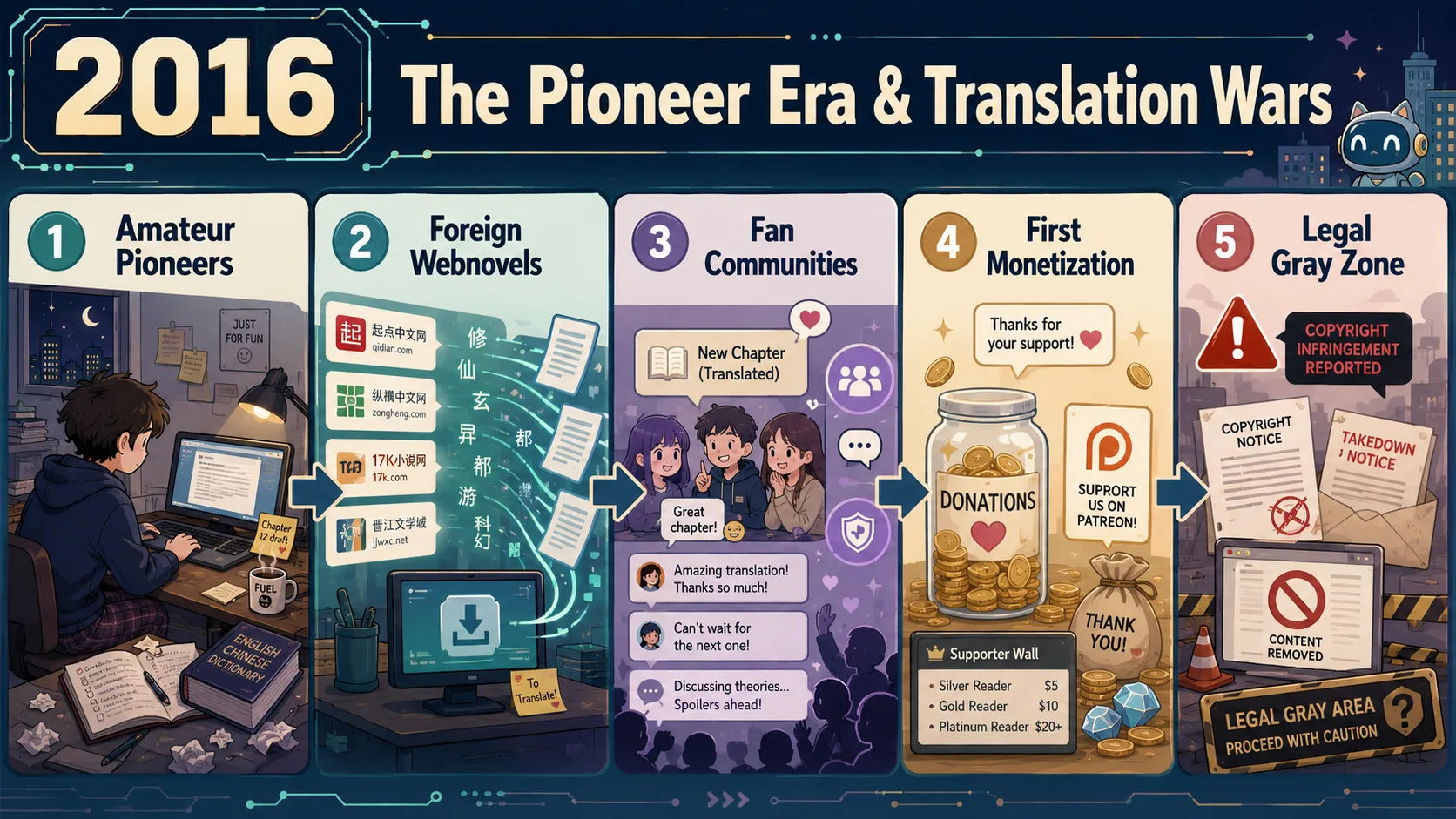
For two years, the Western web fiction scene had operated in a state of blissful, lawless anarchy. Translators and authors viewed their work as a community service—a “fan labor” that existed in the benevolent shadows of the internet.
But in late 2016, the shadows vanished.
This was the era of the Qidian Cease & Desist Warning, the moment the corporate legal machinery of Tencent finally turned its gaze toward the English-speaking world. It was a cold, clinical “Shot Heard ‘Round the Web” that signaled the official end of the hobbyist era and the beginning of a multi-year legal war for the rights to the Western imagination.
—
Part 1: The First Letters—The Death of “Fair Use”
The first C&D (Cease and Desist) letters did not arrive with a fanfare. They arrived as quiet, terrifying emails in the inboxes of individual translators on WordPress and Blogspot.
They weren’t from “Fans” or “Original Authors.” They were from law firms representing China Literature Limited. The language was sterile, precise, and absolute:
- “You are in violation of international copyright law.”
- “You are profiting from intellectual property owned by China Literature.”
- “You must immediately cease all publication and delete all archives.”
For a 20-year-old college student who had spent eighteen months translating a novel for “fun” and $2,000 a month in Patreon tips, these letters were an existential nightmare. The illusion of “Fair Use” or “Fan Translation” evaporated instantly. They realized that they weren’t “Missionaries” anymore; they were “Pirates” with a target on their backs.
—
Part 2: The NovelUpdates Panic—The Great Purge
The reaction on the NovelUpdates Forums was a mix of absolute panic and defiant rage.
Within 48 hours of the first letters going public, hundreds of projects were “Nuked.” Translators, fearing lawsuits they couldn’t possibly afford, deleted their entire sites. Years of work, millions of words, and thousands of community comments vanished from the internet overnight.
This is known in the history of the scene as The Great Purge.
The community realized that the “Grey Market” had a fatal flaw: Centralization. Because everyone was listing their chapters on NovelUpdates, Qidian had a perfect map of exactly who to sue. The very tool that had built the community (Chapter 27) was now being used as a corporate hit-list.
—
Part 3: The “Corporate Operative” Paranoia
As the legal threats intensified, the community descended into a state of Hyper-Paranoia.
Every new user on the forums, every “curious” question about a translator’s income, and every “official” sounding DM was viewed as a Qidian Operative scoping out targets. Translators began moving their Discord servers to “Private” status. They started using VPNs. They scrubbed their real names from their Patreon accounts.
The “Community Spirit” of 2015—the open sharing of techniques and scrapers—was replaced by a “Bunker Mentality.” If you weren’t part of the “Inner Circle,” you were a potential spy. This insularity protected some, but it also made the scene incredibly hostile to newcomers, further accelerating the “Genre Hardening” (Chapter 31) as the barriers to entry became legal as well as literary.
—
Part 4: The Wuxiaworld Shield—The Fight for Legitimacy
At the center of this storm stood Wuxiaworld.
As the largest hub in the world, Wuxiaworld was the primary target. But unlike the individual bloggers, Wuxiaworld’s founder, RWX, had been preparing for this war for months. Instead of deleting the site, he attempted to negotiate a “Peace Treaty.”
He argued that the independent translators were not “Stealing” value; they were “Creating” it. He claimed that without the independent scene, Qidian would have no audience in the West. He attempted to turn the “Pirates” into “Partners.”
This negotiation was the first time that “Fan Logic” was forced to reconcile with “Corporate Logic.” RWX was trying to save the community, but to do so, he had to admit that the community didn’t own the stories. This “Admission of Guilt” was a bitter pill for the fans, but it was the only way to avoid a total legal annihilation.
The “Wuxiaworld Shield” was also a Financial Shield. Because Wuxiaworld had incorporated in the United States, they had a legal personhood that could negotiate with Tencent. The independent bloggers, operating as individuals, had no such shield. This forced the “Great Realignment” (Chapter 32), as dozens of independent translators abandoned their personal blogs and fled to Wuxiaworld, seeking the protection of the “Official” negotiations. It was the end of the “Solo Dev” era and the birth of the “Translation conglomerate.”
—
Part 5: The Birth of “Stealth Hosting”
For those who refused to negotiate or join the corporate app, the C&D warnings birthed a new era of Stealth Hosting.
Translators began moving their content to servers in countries with weak copyright enforcement (like Russia or Vietnam). They started using “Password-Protected” chapters where the password was hidden in an image or a riddle to prevent corporate scrapers from finding the text.
This was the birth of the Shadow Scene—a parallel world of translation that operated entirely outside the law. This shadow scene is where the “Aggregator Virus” (Chapter 28) thrived, as the pirates didn’t care about legal threats. The corporate C&Ds successfully killed the “Honest Hobbyist,” but they inadvertently created a vacuum that was filled by the “Hardened Criminal.”
—
Part 6: The Moral Realignment—”Who Do I Support?”
The final result of the C&D era was a profound Moral Realignment of the reader.
The audience was forced to choose:
1. Support the “Official” app (Webnovel.com) and the original authors, but deal with predatory microtransactions.
2. Support the “Pirate” translators who were being sued, but deal with potential site-deletions and unstable releases.
3. Support the “Independent” Western authors (OEL) who owned their own rights.
This was the moment the “Translation Era” began to die. The legal friction was too high. The readers, tired of the drama and the disappearing sites, began to move toward the “Safe Harbor” of Original English Literature on Royal Road. The lawyers didn’t just win the legal battle; they won the cultural battle by making the translation scene too exhausting to follow.
—
Part 7: The “DMCA Trolling” Era—The Fake Lawyer Meta
In the chaos of late 2016, a new and darker phenomenon emerged: DMCA Trolling.
Aggregator site owners and rival translation groups realized that they could destroy their competition simply by sending a fake C&D letter. Because the community was so terrified of Qidian, a translator who received a realistic-looking (but entirely fake) legal threat would often nuke their own site before even checking the credentials of the lawyer.
This was Psychological Warfare disguised as law. It turned the community against itself. Translators began accusing each other of sending “Fake DMCAs” to clear the market for their own projects. The trust that had built the “Passion Economy” was replaced by a “State of Nature” where everyone was a potential predator. The corporate giant didn’t even have to send the letters themselves; the fear they had planted was doing the work for them.
—
Part 8: The Ghost of the Fan-Sub—History Repeating
The 2016 C&D crisis was a perfect echo of the Anime Fan-Sub Crisis of the early 2000s.
Just as the early anime fansubbers believed they were “promoting” Japanese culture to a western audience that would otherwise never see it, the web novel translators believed they were the “pioneers” of a new medium. And just as the Japanese production committees eventually arrived to claim their profits, the Chinese conglomerates arrived to do the same.
The difference was the Speed of Professionalization. In the anime world, the transition from fansubs to Crunchyroll took a decade. In the web novel world, the transition from WordPress blogs to the Qidian App took less than two years. The industry was moving too fast for its own ethics to catch up, leading to the massive “Burnout Generation” (Chapter 14) of creators who were crushed between their fan-roots and their corporate future.
—
Part 9: The “Nuclear Option”—The Dark Web and Private Archives
For the most radical members of the community, the C&D warnings triggered the Nuclear Option.
They realized that if the “Public Web” was no longer safe, they had to go underground. This was the birth of the Private Archive Meta. Readers began using “Scraper Tools” (Chapter 34) to download entire websites before they could be deleted. These archives were then shared in private Discord servers, encrypted MEGA folders, and even on the Tor network.
This created a Shadow Library that exists to this day. While the corporate platforms claim to own the “Official” version of the history, the true, unedited, fan-translated history of the 2015-2016 era lives on in these private bunkers. It was the ultimate act of defiance—the refusal to let the corporate legal team delete the community’s memory. It ensured that no matter how many Spirit Stones Qidian charged, the “Original Vision” would always be one click away for those who knew where to look.
—
Part 10: The Legal Geopolitics—Tencent’s Long Game
To truly understand why the C&Ds were sent in 2016, we must look at the Long Game of Tencent.
Tencent wasn’t just interested in stopping piracy; they were interested in Market Consolidation. They knew that if they allowed the independent translation hubs to continue growing, those hubs would eventually become too powerful to control. By issuing the C&Ds, Tencent was effectively “De-valuing” the hubs. They were making the independent scene a high-risk environment, which lowered the buyout price of sites like GravityTales.
It was a brilliant, cold-blooded application of Enclosure Logic. Just as common land was once enclosed by the state to create private property, the common “Fan Space” of 2015 was being enclosed by Tencent to create “Intellectual Property.” The C&Ds were the fences. By the end of 2016, the fans realized that the internet was no longer a “Global Village”; it was a series of corporate estates, and if you wanted to walk on them, you had to pay the toll.
—
Part 7: The “Spirit Stone” Retaliation—The Cost of Legalization
When Qidian finally launched their “Official” monetization in the wake of the C&Ds, they justified the high prices of Spirit Stones as the “Cost of Legalization.”
They claimed that the money was going to pay the lawyers, the authors, and the “Legitimate” staff. But the fans didn’t buy it. They saw the Spirit Stones as a “Fine” they were being forced to pay for having enjoyed the fan-translations for free for two years.
This “Retaliatory Pricing” created a permanent resentment between the corporate giant and the western fan-base. Even a decade later, in 2026, the scars of the “C&D Winter of 2016” remain visible in every forum thread that discusses “Official vs. Unofficial” platforms. It was the moment the “Family” became a “Market,” and for many, the magic was gone.
—
Part 4.1: The Legal Chilling Effect
When the first official Cease & Desist (C&D) letters arrived from Qidian’s legal department in late 2016, they did not just target the individual translators; they targeted the psychological foundation of the entire independent ecosystem.
For years, the fan-translators had operated under a massive delusion of invincibility. They genuinely believed that because they were “just fans” operating offshore servers, the massive Chinese corporations either didn’t know about them or didn’t care enough to navigate the complexities of international copyright law.
The C&D letters shattered this delusion.
The letters were not standard, automated DMCA templates. They were highly specific, meticulously documented legal threats delivered by top-tier international law firms. The letters precisely detailed the estimated ad-revenue the translator was generating, their Patreon income, and the exact financial damages Qidian intended to seek in a US Federal Court if the translator did not immediately cease operations and hand over the domain names.
The Discord Panic
The arrival of these letters triggered absolute panic within the private Discord Cartels (Chapter 29). The “Sect Leaders,” who had spent the last two years cultivating aggressive, untouchable internet personas, suddenly realized they were facing genuine personal bankruptcy.
The immediate result was the “Great Purge.” Translators frantically began deleting years of financial transparency posts, trying to hide evidence of their massive Patreon incomes. They scrubbed their “About Me” pages to remove any identifiable personal information. Several highly lucrative translation projects were abruptly abandoned mid-sentence, with the translator simply deleting their WordPress blog and disappearing from the internet entirely, terrified of a looming lawsuit.
Part 4.2: The Wuxiaworld Licensing Gamble
While the smaller independent blogs folded immediately, the massive hubs—specifically Wuxiaworld—chose a different, highly dangerous strategy. They attempted to negotiate with the Leviathan.
RWX, the founder of Wuxiaworld, recognized that fighting Qidian in court was financial suicide. Qidian (backed by Tencent) had infinite capital; Wuxiaworld was funded by Patreon.
Instead of fighting, Wuxiaworld leveraged its one remaining asset: Its massive, hyper-loyal Western audience.
Wuxiaworld approached Qidian with a proposal. They argued that Qidian’s upcoming “Webnovel.com” platform would fail in the West because it lacked the cultural understanding and the parasocial community trust that Wuxiaworld had built. Wuxiaworld offered to become an official, licensed distributor for Qidian’s intellectual property in the West, paying Qidian a substantial licensing fee and a cut of the revenue in exchange for legal immunity.
The Illusion of Partnership
In late 2016, this gamble appeared to work. Wuxiaworld announced that they had secured an unprecedented, official licensing agreement with Qidian. The independent community rejoiced, believing that the “Wild West” era had successfully transitioned into a legitimate, sustainable, legally protected industry.
However, this “partnership” was fundamentally an illusion.
Qidian did not view Wuxiaworld as a partner; they viewed Wuxiaworld as a temporary incubator. Qidian used the licensing agreement to temporarily pacify the Western audience while they furiously built and perfected their own native Webnovel application.
Qidian allowed Wuxiaworld to continue translating the novels, fully intending to eventually revoke the licenses, copy the translated text (which Qidian technically owned), and migrate the entire audience to their own proprietary platform. Wuxiaworld had essentially paid a massive licensing fee just to dig their own grave.
Part 4.3: The Balkanization of the Market
The Qidian C&D wave caused the permanent Balkanization of the independent translation market.
Prior to late 2016, a reader could go to NovelUpdates and find a centralized index of every translated Chinese novel on the internet. But after the C&D wave, the market fractured.
Translators who refused to sign with Qidian (and who were terrified of being sued) pivoted violently away from Chinese novels entirely. They began translating obscure Japanese Light Novels or completely unlicensed Korean web novels, praying they could fly under the radar of a different set of corporate lawyers.
Meanwhile, Original English (OEL) authors on Royal Road saw the chaos and realized they possessed the ultimate strategic advantage: 100% undisputed copyright ownership of their own work. The Qidian C&D wave was the final catalyst that drove the massive migration of Whale readers away from the unstable, legally dubious translation scene and directly into the waiting arms of the Western LitRPG authors.
The era of the Fan-Translator was effectively dead. The era of the Corporate Platform and the Original Independent Author had begun.
Part 8: Actionable Takeaways for the Modern Author
The 2016 C&D era is a masterclass in Legal Risk Management.
1. Own Your IP or Lose Your Income
If you are writing in someone else’s playground (Fan-Fiction, Translations, Game-Mods), you are a tenant, not an owner. Never allow your primary income to depend on a property you don’t own. Always have an “Original IP” project in development as your escape pod.
2. Diversify Your Hosting
Don’t put all your content on a single platform (like Amazon or Webnovel). Maintain a “Sovereign Site” (your own domain) where you can interact with your audience directly. If a platform decides to “Nuke” your account for a Terms of Service violation, your sovereign site is the only thing that keeps you from vanishing.
3. Professionalize Your Legal Understanding
In 2026, you cannot afford to be “Legal-Illiterate.” Understand what “Fair Use” actually means (and its limits). Understand the “Terms of Service” of every platform you use. A single hour of legal research can save you 1,000 hours of wasted labor.
4. Build a Community, Not Just a Traffic Stream
A loyal community will follow you to a new domain if your old one gets shut down. “Traffic” from Google or NovelUpdates is fickle and easily blocked. Build an email list, a Discord, or a newsletter. Your “Direct Connection” is the only thing a lawyer cannot take away from you.
*(The lawyers were clearing the field, but the real war was being fought by bots. While the humans argued over copyright, a different kind of predator was silently devouring the entire industry. In Chapter 38: The Rise of the Scrubbers, we explore the technical apocalypse of the scraper-bot epidemic).*
0 Comments