

2015 – 03 – The Passion Economy
by EternalibChapter 03: The Passion Economy—Beta Testing an Empire for Free
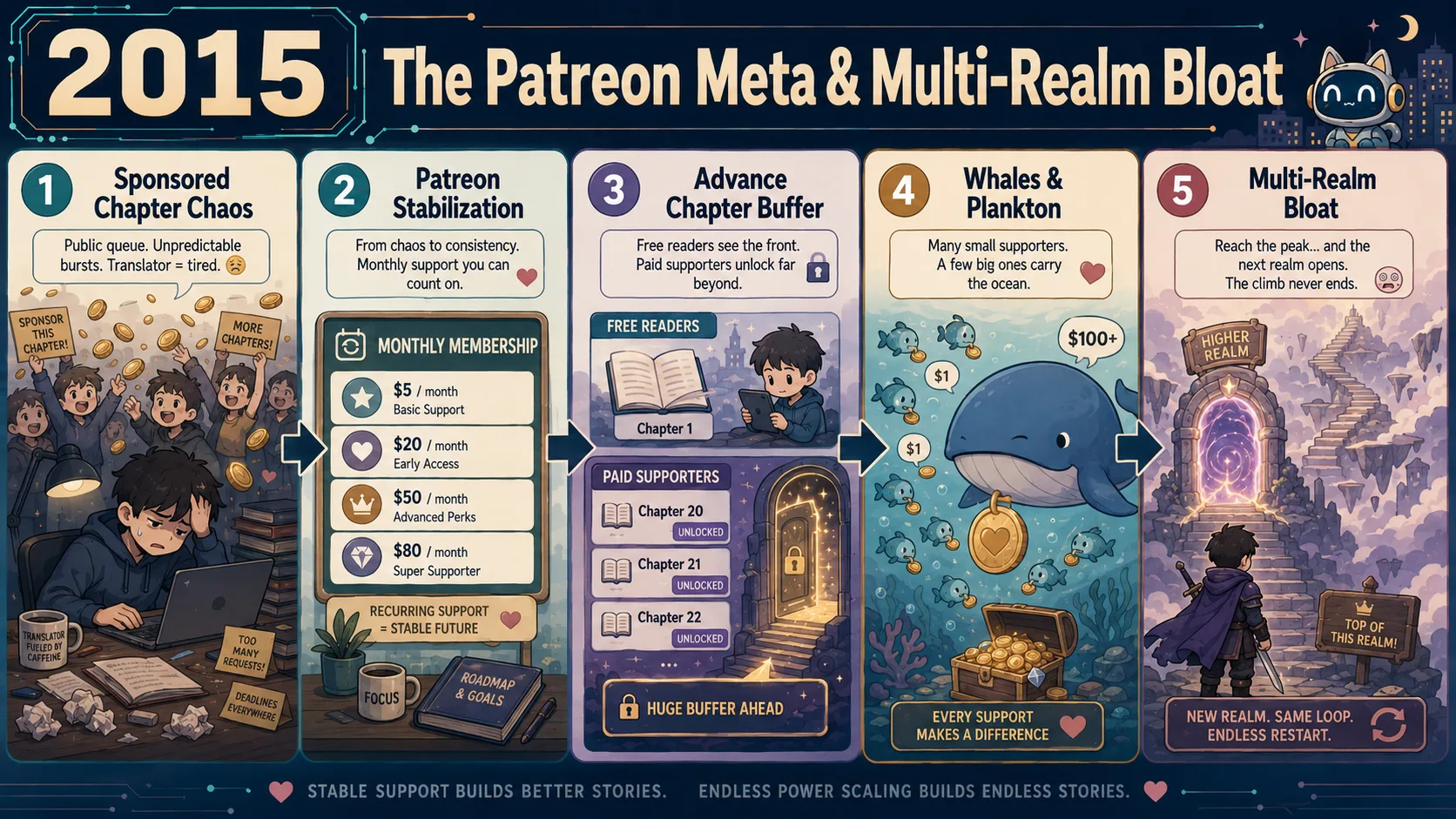
If you examine the financial mechanisms of the early English web fiction movement, the most staggering realization is that the translators were completely unaware of their own economic significance. They genuinely believed they were passing around a collective tip jar simply to keep their passion projects alive.
In reality, they were executing the most expensive, successful, and completely unauthorized market research study in the history of Tencent.
The Passion Economy wasn’t a business plan designed in a boardroom. It was born purely out of architectural desperation. It was a chaotic amalgamation of PayPal donations, panic-inducing server bills, and the sheer financial willpower of a highly addicted audience. And it accidentally proved to the sleeping giants of Chinese literature that the West was functionally a goldmine waiting to be tapped.
—
Part 1: The Raw Mathematics of Bandwidth
As translators fled the crumbling infrastructure of Spcnet to host their projects on independent WordPress blogs (most notably the early iteration of Wuxiaworld), they encountered a terrifying reality. Surviving virality is incredibly expensive.
Building a website to host localized translations of Against the Gods or Martial God Asura was easy. But surviving the daily tsunami of readers mashing the refresh key to read a new chapter required enterprise-tier cloud hosting. The translators suddenly found themselves financing massive digital infrastructure:
- AWS Database Scaling: To prevent the site from crashing under the weight of 200,000 daily page views.
- Cloudflare DDoS Mitigation: Crucial infrastructure needed to survive frequent, malicious server attacks from internet trolls or rival translation groups.
- Global Content Delivery Networks (CDN): Required to physically route the digital text to the massive readership concentrated in Southeast Asia, South America, and Europe without experiencing agonizing lag.
At its peak in 2015, the monthly burn rate for a dominant site like Wuxiaworld hovered anywhere between $2,500 to $5,300.
A single college student obviously could not subsidize that level of extreme financial bleed. They had to ask the readership for money. But asking a community for money to support content that you do not legally own is an argument that becomes exceptionally difficult to defend in a courtroom. The translation hubs needed a careful framing that maintained their status as innocent, passionate fans while generating enough cash to keep the lights on.
They found that framing in the polite, unassuming PayPal donation link.
—
Part 2: The Invention of the Micro-Transaction Whale
Initially, the tip jar was exactly what it sounded like: a simple link at the bottom of the page suggesting readers buy the translator a cup of coffee if they enjoyed the chapter. It was a quiet economy based entirely on gratitude.
Then the translators realized that their audience wasn’t just feeling gratitude. The readers were deeply, physiologically impatient. And in the digital space, impatience is exponentially more valuable than gratitude.
This realization was weaponized through the Sponsored Chapter Queue (the mechanics and psychological horror of which we analyzed heavily in Chapter 02). But focusing purely on the author’s burnout ignores the incredible, terrifying consumer psychology that the Queue revealed about the western reader.
The Queue proved, mathematically, that the western audience contained Whales.
In mobile gaming terminology, a Whale is a high-net-worth individual with massive disposable income and very low impulse control. The translation queue wasn’t filled by thousands of readers politely donating one dollar. It was filled by a tiny fraction of individuals casually dropping hundreds of dollars just to see how a tournament arc ended.
“I spent about $600 on ‘Against the Gods’ queue donations back in 2015. I have absolutely no regrets. The alternative was waiting until the next day to find out if Yun Che survived the arena fight, and I was not willing to entertain that option. Was it financially irresponsible? Obviously. Did I do it eleven more times the following month? Yes.”
— Archivedr/WuxiaWorldConfession Thread, 2016
The financial returns were staggering. Top-tier translators were clearing $10,000 to $15,000 a month purely through the queue, entirely detached from the site’s massive ad-sense revenue.
But this massive financial success birthed an unintended, catastrophic consequence.
—
Part 3: The Unintentional Market Validation
The primary danger of succeeding loudly on the internet is that you cannot hide your success from the people who actually own the physical product.
Qidian, the massive Chinese publishing arm of Tencent, didn’t need to deploy an elite team of corporate spies to figure out what was happening in the West. Wuxiaworld’s Alexa ranking was public data. Its traffic patterns were entirely visible through standard web analytics tools. The sheer volume of PayPal transactions flowing through the site could be easily triangulated because the translators themselves constantly boasted about their queue earnings in public forum posts to encourage more donations.
The translators were unintentionally generating massive, enthusiastic, publicly searchable documentation of exactly how much money was moving through an ecosystem built entirely on stolen IP.
When Qidian looked across the Pacific, they didn’t see a charming, passionate fan-project. They ran a straightforward cost-benefit analysis and saw an astonishing reality.
1. Demand: Independent American college students were generating highly engaged, daily recurring traffic that eclipsed mid-tier media networks.
2. Monetization: Western users were utilizing PayPal to demonstrate a completely astronomical willingness to pay for Eastern progression fantasy.
3. The Meta: The absolute optimal financial structure for the genre was extreme, serialized cliffhangers locking away immediate plot resolutions.
China Literature understood that they could launch an official, licensed Western platform, absorb the existing translator community through legally binding commercial contracts, construct a heavy micro-transaction paywall, and cleanly capture one hundred percent of the English market internally.
The only potential risk of launching a multinational corporate platform was the time and massive capital usually required to test if the foreign market actually wanted the product. But the independent translators had already eliminated that risk. The amateurs had spent two entire years conducting the market validation completely for free.
The Passion Economy essentially drafted the precise business plan for its own corporate replacement. The translators had shown the sleeping dragon precisely where the western gold was buried, and the only remaining question was exactly when Qidian would arrive to dig it up.
—
Part 4: The AWS Invoice Shock — The Day the Bill Arrived
There is a specific, deeply human moment in the story of the Passion Economy that is almost never discussed, because it is not glamorous. It is not a dramatic courtroom confrontation or a triumphant viral moment. It is a college student opening an email from Amazon Web Services and going completely silent.
The number in the invoice was wrong. It had to be wrong. He had budgeted for his server costs when he registered the domain. He had done the math. He had a student budget and a carefully allocated Amazon plan, and the number he was looking at was approximately eight times larger than any number he had prepared for.
This wasn’t a theoretical crisis. This was a real invoice, attached to a real credit card, belonging to a real twenty-two year old who had signed a real terms-of-service contract with Amazon. The bill was due.
This scenario — or some close variation of it — played out repeatedly across every major translation hub in 2014 and 2015. The speed of organic viral growth on the internet almost always outpaces the creator’s financial preparation. A blog that expects five thousand readers and receives fifty thousand does not simply receive ten times more love. It receives ten times more server load, ten times more bandwidth consumption, and ten times more Amazon charges.
The specific financial breakdown that repeatedly detonated across translator budgets looked roughly like this:
- Expected monthly server cost: $30–70 (standard shared hosting or small VPS)
- Actual bandwidth usage from 50,000+ daily page views: 2–5 TB of data transfer per month
- AWS cost for 5 TB data transfer at 2015 pricing: $450–$600, plus storage and compute
- Total monthly invoice: $800–$1,500 before any optimization or scaling
- The translator’s student bank account: Usually well below this threshold
The translators responded with the only tool they had: extreme, vulnerable transparency. They posted the actual screenshots of their AWS and Cloudflare invoices in the comment sections of their novels. They didn’t frame it as a slick corporate fundraising campaign. They framed it exactly as what it was — a panicking college student showing their readers an expense they genuinely could not afford, begging for help so the website wouldn’t be permanently deleted by Amazon.
The geopolitical irony was staggering: American college students were paying Jeff Bezos thousands of dollars a month to host pirated Chinese text, and they were relying on the sheer goodwill of international nerds to bail them out.
“I just posted the AWS bill screenshot in the comments. I wasn’t asking for money, I was just being honest. Within 45 minutes, the PayPal account had over $2,000 in it. I was shaking. I had never seen that much money in my life. The readers just… fixed it. I didn’t know how to feel. I still don’t know how to feel.”
— Archived Translator Forum Post, Early 2015
This raw, panicked transparency created something that no corporate marketing team could ever engineer: genuine parasocial investment. The readers didn’t feel like they were paying a subscription fee to a faceless media company. They felt like they were rescuing a friend. That distinction — that deeply emotional sense of personal stakes — is the psychological engine that turned the Passion Economy into a multi-million-dollar gray market.
The readers weren’t just buying chapters. They were buying the right to keep the thing they loved alive.
—
Part 5: Actionable Takeaways for the Modern Author
The Passion Economy is a stark lesson in digital infrastructure, audience psychology, and intellectual property. It proved that audiences will happily fund infrastructure if they feel a sense of ownership over the project. For the modern author attempting to build a brand in 2026, the 2015 financial model provides terrifying, immutable laws of publishing.
1. Identify Your ‘Whale’ Trap
The vast majority of your revenue will not come from your casual silent readers; it will come from the top 1% of your audience who possess zero impulse control. In 2015, this was the Sponsored Queue. In 2026, this is your $50 Patreon Tier offering 30 advanced chapters, or your highest-priced Kindle Vella bundle. You must actively engineer your monetization structure to accommodate the reader who wants to throw a hundred dollars at your novel in a single afternoon. If your highest Patreon tier is only $10, you are mathematically leaving the Whale money on the table.
2. Impatience is the Ultimate Currency
Nobody donates to a serial out of pure, sustained gratitude. They pay for relief. The genius of the early translators was realizing that the tension of a serialized cliffhanger is practically a biological weapon. If you want to convert free readers into paying patrons, you must structure your free chapters so that they end on an excruciating, unresolved spike of tension. The friction of the paywall must feel less painful than the friction of waiting until tomorrow for the resolution.
3. You Cannot Hide Success
If you are engaging in gray-market tactics—such as writing fan-fiction on Patreon using explicitly copyrighted Disney or Marvel IP, or utilizing “Systems” that closely mirror established games—understand that virality is a death sentence. The moment you cross the threshold from “obscure hobbyist” to “generating five-figure incomes,” the IP holders will find you. The Qidian acquisition proved that corporate entities will let you build the audience for free, but they will never let you keep the money permanently.
*(With the economics established, we must pivot to the actual literature that made this addiction possible. In Chapter 04: The Pure Xianxia Meta, we explore the brutal, highly calculated mathematics of Cultivation that fundamentally broke Western fantasy readers).*
0 Comments