2016 – 05 – The Chinese Author Rebellion
by EternalibChapter 25: The Chinese Author Rebellion—The End of the Gray Market
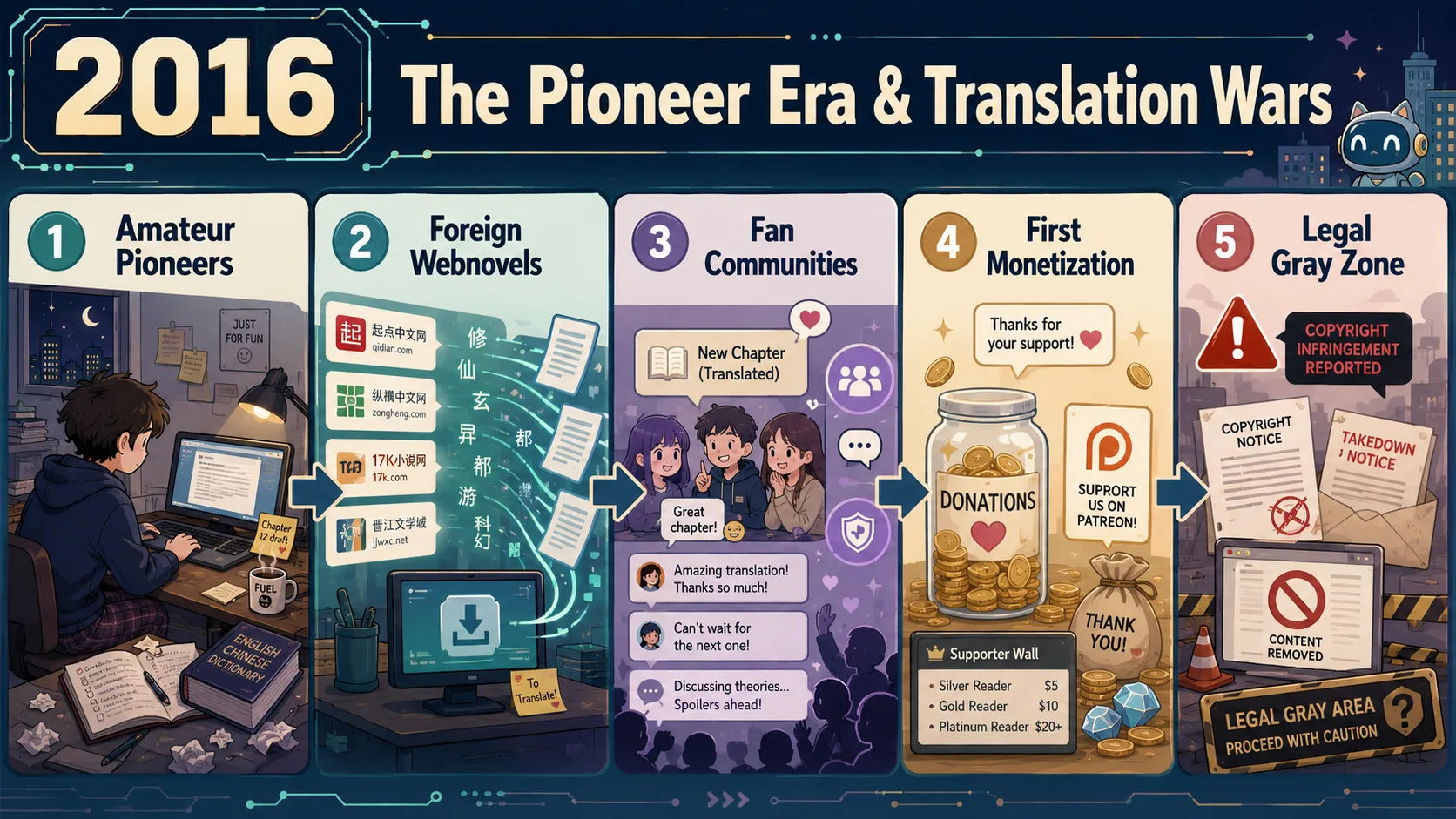
As the year 2016 drew to a close, the Western web fiction ecosystem was operating at a terrifying, hyper-optimized velocity. The independent hubs like Wuxiaworld and the massive translation Cartels were generating millions of dollars in untaxed, unregulated revenue. Webnovel.com was solidifying its corporate infrastructure. The readers were voraciously consuming tens of millions of translated words every single week.
But this entire multi-million dollar economy was built on a massive, glaring geopolitical blind spot.
For two years, the western audience and the western translators had operated under the psychological illusion that they were participating in a “fan community.” They viewed themselves as digital missionaries, bringing obscure Chinese literature to the English-speaking world.
They conveniently ignored the fundamental, inescapable reality of their business model: They were making a staggering amount of money selling intellectual property that did not belong to them.
The final chapter of the 2016 narrative arc does not focus on the translators, the readers, or the corporate executives at Tencent. It focuses on the people who actually wrote the words. This is the era of the Chinese Author Rebellion, the moral crisis that finally destroyed the “Wild West” of web fiction, and the catalyst that permanently shifted the western audience toward Original English Literature.
—
Part 1: The Firewall Disconnect
To understand how the gray market survived for as long as it did, one must understand the absolute informational isolation created by the Great Firewall of China.
In 2015 and early 2016, the original creators of these massive Xianxia and Wuxia epics—authors writing under pen names like I Eat Tomatoes, Er Gen, or Tang Jia San Shao—had absolutely no idea that their novels were being translated into English.
They lived in a completely separate internet ecosystem. They did not use Google; they used Baidu. They did not use Twitter; they used Weibo. They did not use Reddit; they used Tieba.
Furthermore, the concept of their novels achieving international success was simply inconceivable. Cultivation novels were deeply entrenched in Chinese mythology, Taoist philosophy, and hyper-specific cultural idioms. The authors assumed that a Western audience wouldn’t be able to comprehend the magic system, let alone become financially addicted to it.
Therefore, while a Western translator sitting in a college dorm in California was clearing $15,000 a month on Patreon by translating Coiling Dragon, the actual author of Coiling Dragon was completely oblivious, continuing to grind out their daily word count on the Chinese Qidian platform for a fraction of that western income.
—
Part 2: The Translation Guilt and the Failed Revenue Share
The illusion could not last forever. As the independent translation hubs grew massively in 2016, the top-tier translators began to experience a profound, creeping moral crisis: The Translation Guilt.
Translators who had originally started their projects for free out of sheer passion were suddenly looking at their bank accounts and realizing they were making six-figure annual incomes off someone else’s creativity. They were getting rich while the original creators—many of whom were overworked and underpaid—saw absolutely nothing.
The community attempted to rectify this. The most prominent translators, led by figures like RWX at Wuxiaworld, attempted to establish direct contact with the original Chinese authors. They bypassed the corporate Qidian infrastructure and reached out directly via Weibo and WeChat.
The goal was noble: The western translators wanted to set up a direct revenue-sharing model. They wanted to take 30% of their Patreon earnings and wire it directly into the bank accounts of the original Chinese authors as a “thank you” for creating the worlds they were profiting from.
“I felt sick to my stomach. I was making more money in a month translating this novel than I made in a year at my old retail job. And I knew for a fact the actual guy writing the story in China was probably making minimum wage. I tried to contact him on Weibo to send him a $2,000 PayPal transfer. He didn’t even know what PayPal was. When I explained that 10,000 Americans were reading his book every day, he thought I was running a scam.”
— Archived Confession from a Top 10 NovelUpdates Translator, 2016
These attempts at direct revenue sharing almost entirely failed, primarily due to structural blockades. Transferring massive amounts of USD into Chinese bank accounts independently was a logistical nightmare due to international financial regulations. Even when translators attempted to use Chinese domestic payment apps like WeChat Pay or Alipay via proxies, the sheer volume of the cross-border transfers frequently triggered anti-money laundering algorithms. This resulted in frozen accounts on both sides of the Pacific, creating a maddening scenario where western translators physically could not pay the original authors, even when they desperately wanted to. But more importantly, the moment the corporate giants caught wind of what was happening, they slammed the door shut entirely.
—
Part 3: The Corporate Weaponization of the Creator
When the original Chinese authors finally realized the sheer scale of the western gray market, they were furious. Their intellectual property was being wholesale stripped from the Chinese internet, translated without their permission, and monetized by anonymous westerners.
The authors began posting angry manifestos on Chinese social media, demanding that the western translators immediately cease and desist.
Tencent and China Literature (the owners of Webnovel.com and the Chinese Qidian platform) watched this outrage unfold and realized they had been handed the ultimate public relations weapon.
During the Wuxiaworld War (detailed in Chapter 23), the western audience had vehemently defended the independent translators, viewing the corporations as greedy villains. But now, Tencent inverted the narrative.
They announced that they were launching the official Webnovel.com platform specifically to protect the rights of their exploited Chinese authors. They claimed that every DMCA takedown they issued against a western translator, and every pirate site they sued, was an act of justice for the original creators who had been robbed of their royalties.
Qidian explicitly forbade their Chinese authors from accepting any independent “donations” or revenue-share deals from the western translators. If an author wanted to see international royalties, they had to allow Qidian to handle the official, corporate translation through the newly launched Webnovel app.
The independent translators were trapped. They could no longer claim the moral high ground. The “Fan Community” excuse evaporated the second the original authors explicitly asked them to stop stealing their work. The translation scene was forced to accept that they were, structurally and legally, operating a highly lucrative piracy ring.
—
Part 4: The Ideological Fracture
The revelation of the Chinese Author Rebellion fractured the western readership.
When a reader discovered that the $20 they were spending on Patreon was not supporting the creator of the story, but merely the person running the text through an MTL program and a spellchecker, a deep sense of betrayal set in.
A significant portion of the audience refused to continue supporting the gray market. But they also violently refused to transition to the official Webnovel.com app, because they despised the predatory Spirit Stone micro-transactions and the gamified user interface.
They wanted to support independent creators directly on Patreon, but they wanted to do it legally and ethically.
This ideological fracture created a massive, highly lucrative vacuum in the market. The audience had money, they had a desperate addiction to serialized LitRPG and progression fantasy, and they had nowhere to ethically spend their capital.
—
Part 5: The Birth of the “Original English” (OEL) Era
Nature abhors a vacuum, and capitalism fills it instantly.
The moral collapse of the translation market in late 2016 acted as the direct catalyst for the explosion of Original English Literature (OEL).
Western authors, who had spent the last two years quietly reading translated Chinese Cultivation novels and Korean LitRPGs, realized they didn’t need to translate stolen content. They could simply write their own Cultivation novels, set in westernized fantasy worlds, utilizing the exact same addictive narrative tropes (Face-slapping, System pop-ups, Arrogant Young Masters) that the audience craved.
They began publishing these original serials on platforms like Royal Road and Scribble Hub.
The audience reaction was explosive. Readers flocked to these Original English authors in droves.
* There was no guilt, because the author on Patreon was the actual creator of the world.
* There was no risk of a sudden corporate DMCA takedown deleting the novel from the internet.
* There were no awkward, stilted Machine Translation errors, because the prose was written natively in English.
* And most importantly, the author was deeply ingrained in the western community. They understood western pop culture, they interacted in the Discord servers, and they actively tailored the narrative to Western sensibilities.
Authors like TurtleMe (who created The Beginning After The End in 2017) and Zogarth (who created The Primal Hunter) recognized the massive unfulfilled demand left by the translation wars and stepped in to build absolute empires.
By the end of 2016, the golden age of the Fan-Translator was permanently over. The corporate platforms had reclaimed their intellectual property, the pirate aggregators had established their shadow economy, and the independent Whales had successfully pivoted to funding a brand new generation of native Western web serial authors. The board was set for the modern era.
—
Part 7: The Unpaid Originator Guilt—The Shadow of the Starving Artist
While the “Author Rebellion” was a corporate-led PR strategy, there was a deeply personal layer to the 2016 moral crisis: The Unpaid Originator Guilt.
In late 2015, translating was a hobby. By mid-2016, it was a business. Translators who were previously living with roommates were suddenly buying houses and high-end PCs. They were, by every metric, “Internet Famous.” But every time they logged into their PayPal dashboards, they saw the shadow of the original Chinese creator.
They knew that while they were making $10,000 a month for localization, the original authors were often tied to “Slave Contracts” in China (Chapter 24) that paid them less than $500 a month for 10,000 words of daily output. The western success was built on a foundation of extreme labor exploitation that the western community was technically benefiting from.
This guilt led to the first wave of Philanthropic Diversion. Translators began spending massive portions of their Patreon revenue on unrelated charity work—donating to hospitals, planting trees, or funding scholarships—as a way to “balance the scales” of their uncompensated IP usage. It was a desperate attempt to maintain the “Fan” identity in the face of a predatory business reality. The “Wild West” was fun when everyone was poor, but the moment the money arrived, the moral weight of the stolen supply chain became unbearable.
—
Part 4.1: The Asymmetry of Wealth and The Great Awakening
The true catalyst for the “Chinese Author Rebellion” was not an abstract legal dispute over copyright; it was a profound, deeply emotional reaction to the sudden, staggering asymmetry of wealth generated by the Patreon Hybrid Model.
To understand this, we must examine the reality of a mid-tier author on Qidian in 2016. In the Chinese market, web fiction was a volume game. An author was contractually obligated to write 4,000 to 6,000 words a day. The competition was incredibly fierce, and the revenue per chapter (derived from fractional micro-transactions on the Qidian app) was tiny. A mid-tier author might work grueling, 80-hour weeks just to earn the equivalent of $1,500 to $2,500 USD a month.
They were industrial workers operating on a digital assembly line.
Then, word began filtering back across the Pacific. Screenshots of western Patreon pages were translated and posted on Chinese author forums (like Lkong). The Chinese authors looked at the numbers and suffered a collective, psychological shock.
A western fan-translator—a college student in California or Europe who did not invent the world, did not create the characters, and did not write the original prose—was making $40,000 a month simply by translating the text into English.
The translator was making twenty times the income of the original creator.
The Cultural Translation of “Fair Use”
The Western translators, operating under the deeply naive “Fan-Fiction Exemption” mindset, genuinely believed they were doing the Chinese authors a favor. They argued they were providing free marketing and building a global audience.
From the perspective of the Chinese authors, this was not marketing; it was digital colonialism. The Westerners were extracting the raw material (the story) from the Chinese laborers, processing it (translating it), and reaping 100% of the massive financial rewards in the much wealthier Western economic market, without sending a single dollar back to the creators.
The original authors began actively protesting on their Weibo accounts and within their chapter author notes. They demanded that their readers petition Qidian to intervene. They demanded that the Western translators immediately cease and desist, or at the very least, implement a 50/50 revenue split on the Patreon income.
Part 4.2: Qidian’s Iron-Clad Contracts and the Illusion of Ownership
When the Western translators attempted to negotiate in good faith with the protesting Chinese authors, they collided with a terrifying legal reality: The authors did not own their own stories.
In the West, authors generally retain the copyright to their Intellectual Property (IP), merely licensing specific publishing rights to a publisher. The Chinese Webnovel ecosystem operated under a vastly more draconian corporate structure.
When an author signed a contract with Qidian (backed by Tencent), they essentially signed over the total, permanent, and exclusive copyright of the entire universe they had created. Qidian owned the text, the characters, the merchandising rights, the video game adaptation rights, and crucially, the global translation rights.
If a Western translator offered to send $10,000 a month directly to a Chinese author to officially “license” the translation, the Chinese author legally could not accept it. The author had no legal right to authorize a translation. Only Qidian’s corporate executives could authorize a translation.
This structural reality completely derailed the independent ecosystem. The Western translators could not ethically compensate the original creators even if they wanted to. The money had to flow through the Tencent corporate structure. And Tencent had absolutely no interest in sharing their multi-billion-dollar IP with amateur translators on Patreon.
Part 4.3: The “DMCA Nuke” and the Scorched Earth Policy
In late 2016, armed with the outrage of their contracted authors and the absolute legal ownership of the IP, China Literature (Qidian) launched the first wave of their corporate offensive against the Western independents.
They did not negotiate. They deployed the DMCA Nuke.
Instead of targeting the translator’s personal websites (which could be moved to offshore servers outside of US jurisdiction), Qidian’s legal teams targeted the financial and structural bottlenecks of the ecosystem.
1. They sent DMCA notices to Patreon, instantly freezing the accounts of translators generating tens of thousands of dollars a month.
2. They sent DMCA notices to Google AdSense, threatening to blacklist entire domains like Wuxiaworld.
3. They sent DMCA notices to Cloudflare and the server hosting providers.
The independent translation scene, which had grown accustomed to operating with total impunity, was plunged into absolute chaos. Translators woke up to find their entire livelihood eradicated overnight.
The Community Schism
This corporate offensive fractured the Western audience.
One faction, deeply loyal to the fan-translators, argued that Qidian was an evil, greedy corporation that had ignored the West for years, only stepping in to steal the market after the fans had done the hard work of building it. They launched massive boycotts against any official Qidian English releases.
The other faction, taking a more pragmatic and ethically rigid stance, pointed out that the translators had been operating a highly illegal, multi-million-dollar piracy ring for years. They argued that the original authors deserved to be compensated, and that the “Wild West” era of fan-translation had to end.
This schism destroyed the previously unified, communal feeling of the web fiction ecosystem. It transformed the community from a group of passionate hobbyists into deeply entrenched political camps, fighting a proxy war on behalf of massive Chinese corporations and millionaire Western translators. The innocence of the Spcnet era was officially, permanently dead.
Part 6: Actionable Takeaways for the Modern Author
The moral and legal crisis that ended the 2016 translation era provides the absolute foundational rule for surviving as a modern author in 2026.
1. You Cannot Build an Empire on Rented Land
The translators of 2016 built massive, six-figure incomes, but they owned absolutely none of the underlying intellectual property. The moment the true owners (Qidian) arrived, the translators were wiped out.
If you are an author currently writing Fan-Fiction for a massive Patreon income, you are walking the exact same tightrope. You do not own the IP. You are building an empire on rented land, and Nintendo, Disney, or Games Workshop can issue a DMCA strike and delete your entire livelihood overnight. You must use the audience you build through Fan-Fiction to immediately pivot into Original Fiction where you hold 100% of the copyright.
2. The Audience Wants to Fund the Creator
The rapid migration of the Whale readers from translated novels to Original English novels proved a vital psychological truth: The audience fundamentally wants to support the creator of the world. They want the parasocial connection. They want to know that their $20 Patreon pledge is directly feeding the imagination that birthed the characters they love. As an author, you must lean heavily into this connection. Do not hide behind a corporate facade. Be human, be accessible in your Discord, and remind the audience that they are directly funding art.
3. Tropes are Universal; Execution is Local
The success of Western LitRPG proved that you do not need to be Chinese to write a Cultivation novel, and you do not need to be Korean to write a System Apocalypse. The tropes are universally addictive psychological mechanics. The key to massive success is taking those proven, addictive tropes and executing them with a localized, native cultural understanding.
4. Understand Your Supply Chain
The translation market collapsed because the supply chain (the original authors) was cut off. As a modern author, your supply chain is your own creative stamina and your structural infrastructure. If you rely on a single artist for all your webcomic adaptations, or a single editor for all your chapters, you have a single point of failure. Diversify your workflow, own your copyrights, and never put yourself in a position where a third party can legally or physically stop you from publishing.
5. The “Guilt-Free” Revenue Strategy
The moral crisis of 2016 proves that transparency is your best defense. If you are using any external tools, collaborators, or inspirations, be upfront with your audience about how they are being compensated. In 2026, where AI and human labor are increasingly blurred, the audience will pay a premium for “Ethical Content.” Make sure your revenue stream is one you can defend in a public audit.
*(The authors were reclaiming their power, but the platforms were also changing. While the legal war raged, the hubs realized they needed better technology to survive. In Chapter 26: The Custom Engine Pivot, we look at the move away from WordPress and toward professional web apps).*
0 Comments