

2016 – 01 – The Patreon Hybrid Model
by EternalibChapter 21: The NovelUpdates Directory Launch & The Patreon Hybrid Model
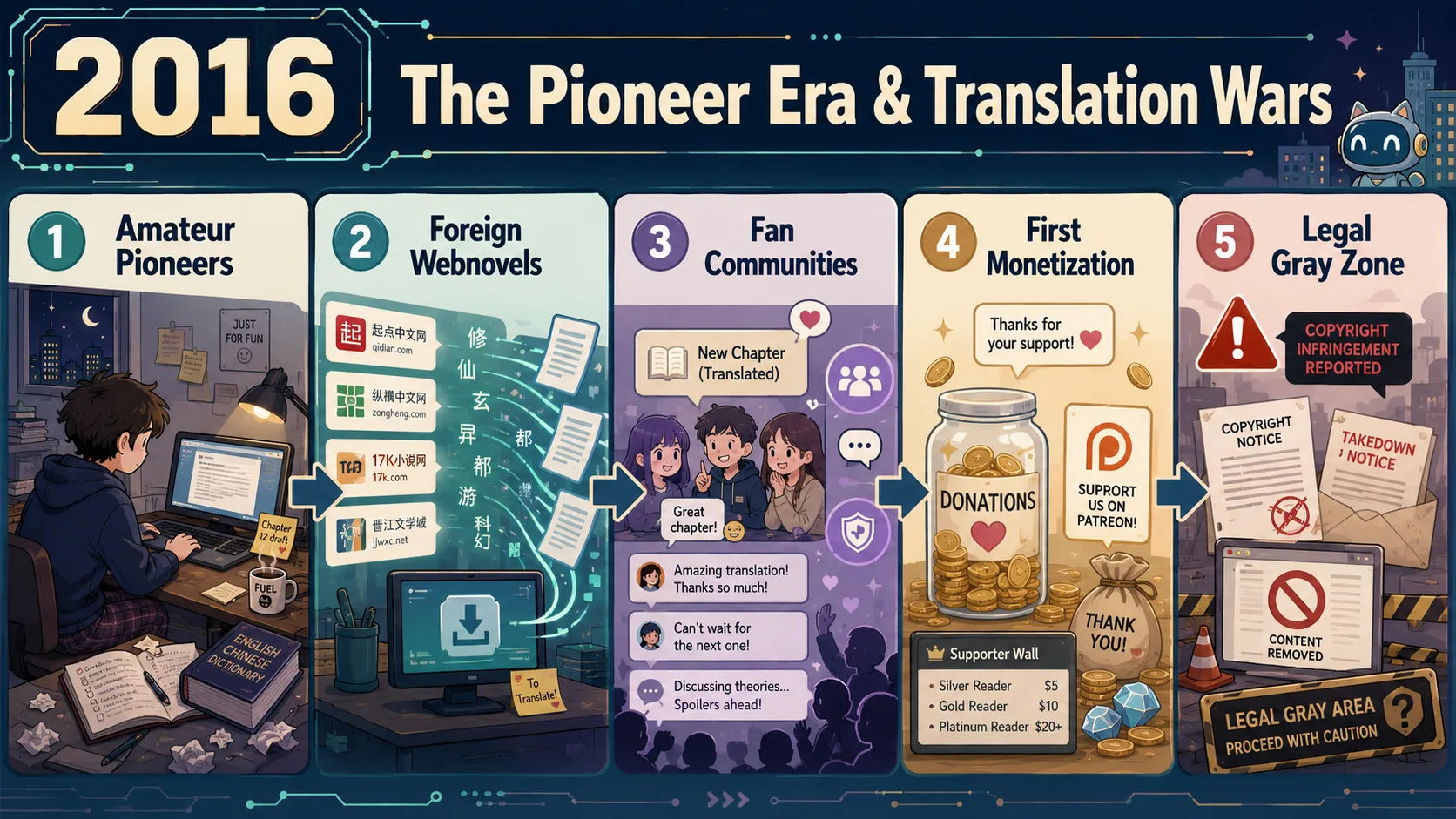
As the year 2016 burned through the digital landscape, the web fiction ecosystem found itself trapped between two terrifying monoliths. On one side stood the corporate leviathan of China Literature and Webnovel.com, rapidly deploying venture-backed infrastructure and legally assimilating the translation market. On the other side swarmed the Aggregator Epidemic, a parasitic plague of automated scraper bots that stole content the absolute millisecond it touched the internet, completely obliterating traditional ad-revenue models.
For an independent creator—whether a fan-translator refusing to sign a corporate contract, or a pioneer Western author writing an Original English LitRPG—the traditional avenues of survival were completely blocked.
They could no longer rely on ad-sense banners on a personal WordPress blog; the Aggregators stole the traffic. They could no longer rely on sporadic PayPal donations; the corporate ecosystem had fundamentally shifted reader psychology toward expected, guaranteed daily content.
The independents needed a lifeline. They needed a monetization architecture that could simultaneously survive the absolute theft of the Aggregators while matching the raw financial output of the corporate Webnovel platform.
The solution they engineered was a masterpiece of psychological leverage and structural exclusivity. It was the birth of the Patreon Hybrid Model. This single structural pivot saved the independent writing community from total extinction in 2016, and it remains the undisputed financial backbone of the web serial industry a full decade later.
—
Part 1: The Death of the Sponsored Queue
To understand the genius of the Patreon Hybrid Model, one must first autopsy the corpse of the system it replaced: The Sponsored Queue.
During the 2015 Genesis Era, translators utilized a chaotic, hyper-capitalist structure. A translator would guarantee a baseline of, say, three free chapters a week. If the community wanted more, they had to “sponsor” a chapter by donating to a public PayPal pool. The going rate for a sponsored chapter was typically $60 to $80. Once the donation bar filled up, the translator was contractually obligated by the community to drop an extra chapter that week.
Initially, this was highly lucrative. But by late 2016, the Sponsored Queue collapsed under the weight of its own psychological flaws.
First, it created an exhausting, unpredictable financial environment for the creator. A translator might make $3,000 one month during a highly anticipated tournament arc, and then plummet to $400 the next month during a slower exposition arc because readers simply stopped hitting the donate button. You cannot pay a mortgage on a “maybe.”
Second, the Sponsored Queue relied heavily on the “Whales”—the elite 1% of readers with massive disposable incomes who would casually drop $300 to fund four chapters on a Saturday night. The “Plebs”—the 99% of readers who couldn’t afford a $60 chapter—simply sat back and waited for the Whales to fund the release. This created extreme resentment. The Whales realized they were subsidizing the entertainment for 50,000 strangers who contributed absolutely nothing. Eventually, the Whales got tired of carrying the financial burden and stopped donating.
Third, and most devastatingly, the Sponsored Queue actively encouraged extreme burnout. If a novel went viral, the donation bar would fill up fifty times in a single weekend. The translator would suddenly owe the community fifty chapters. They were trapped in a horrific debt cycle, translating for twenty hours a day, fueled by energy drinks and sheer panic, desperately trying to clear the queue before the community turned toxic.
“I woke up on a Tuesday and saw my PayPal had $4,500 in it. I should have been thrilled, right? Instead, I literally threw up in my wastebasket. That money meant I owed the queue 60 chapters. If I didn’t translate three chapters a day for the next month, the readers would accuse me of stealing their money. I didn’t sleep for three weeks. The money wasn’t a reward anymore. It was a ransom.”
— Archived Translator Post, r/NovelTranslations, October 2016
The independents realized that selling raw velocity was a fatal trap. They needed to stop selling the speed of their labor, and start selling exclusivity.
—
Part 2: The Invention of the “Advanced Chapter”
Patreon was not originally designed for serialized web fiction. It was designed as a digital tip-jar for YouTubers and podcasters—a place where fans could donate $5 a month to support a creator they liked.
But in 2016, the web fiction community violently forcibly repurposed Patreon’s tier system into a highly rigid, transactional storefront. They invented the concept of the Advanced Chapter.
The mechanic was brilliantly simple. The author or translator would maintain a “Public Release Schedule” on Royal Road or their WordPress blog—say, one free chapter a day. But behind the scenes, they would write a massive backlog of chapters that no one had seen.
They would then create Patreon tiers that offered the reader the ability to read ahead of the public release schedule.
* The $1 Tier: Read 1 chapter ahead of the public.
* The $5 Tier: Read 5 chapters ahead of the public.
* The $10 Tier: Read 10 chapters ahead of the public.
* The $25 “Sect Elder” Tier: Read 20 chapters ahead of the public.
This was the ultimate paradigm shift. The author was no longer begging the community to fund an extra chapter for everyone. The author was selling a VIP fast-pass to the individual reader.
If a reader hit a massive, agonizing cliffhanger on the free site—the protagonist is bleeding out, the villain is raising their sword, the chapter ends—the reader did not have to wait until tomorrow. They didn’t have to organize a $60 PayPal pool. They just had to click the Patreon link in the author’s note, pay $10, and they could instantly read the next ten chapters.
It was the most brutally effective monetization funnel ever designed for serialized fiction.
—
Part 3: The Economic Mathematics of the Hybrid Model
The financial superiority of the Patreon Hybrid Model was absolute. It solved every single problem the independent ecosystem was currently facing.
1. Defeating the Aggregator Epidemic
As detailed in the previous chapter, the pirate scraper bots were stealing the free traffic, destroying ad-revenue. The Hybrid Model completely neutralized this threat by shifting the financial burden away from the masses and onto the highly dedicated superfans.
An author no longer needed 50,000 daily readers to click on an AdSense banner to make $2,000 a month. Look at the hard math of the Patreon funnel:
* Total Free Readership: 10,000 readers.
* Conversion Rate: 3% of readers hate cliffhangers enough to pay.
* Total Patrons: 300 paying subscribers.
* Average Tier Spend: $10 a month.
* Monthly Income: $3,000 a month.
Even if a pirate aggregator stole 90% of the author’s public traffic, the author was still clearing $3,000 a month in recurring, highly stable subscription revenue from that dedicated 3% core audience. The pirates could steal the text, but they couldn’t steal the VIP access.
2. The Illusion of Infinite Value
The brilliance of the Advanced Chapter system is that it sells the exact same product, infinitely, without requiring extra labor.
If an author writes Chapter 50 and places it behind the $10 tier, three hundred different readers can pay $10 to read that specific chapter. The author wrote 2,000 words, but generated $3,000 of value from it.
Furthermore, when Chapter 50 eventually rotates out from behind the paywall and becomes free to the public a week later, the author simply puts Chapter 60 behind the paywall. The Patreon subscriber feels like they are constantly getting “new” chapters every single month, but the author is actually just maintaining a static buffer of ten chapters. The reader is fundamentally paying a $10 monthly subscription fee simply to stay ahead of the free readers.
3. Financial Predictability
Unlike the terrifying feast-or-famine cycle of the Sponsored Queue, Patreon provided stable, recurring monthly revenue. An author could look at their dashboard on the 15th of the month and know exactly how much rent money they would receive on the 1st of the next month. This financial security allowed amateur writers to safely quit their day jobs, permanently professionalizing the Western web novel ecosystem.
—
Part 4: The Golden Handcuffs and The Backlog Trap
While the economic math of the Hybrid Model was flawless, the psychological reality was terrifying. The Advanced Chapter system did not eliminate burnout; it simply weaponized it in a completely different direction.
By creating a system where readers were paying $25 a month to remain “20 chapters ahead,” the author fundamentally locked themselves in a state of perpetual debt. This is known in the industry as The Backlog Trap.
Before an author could even launch their Patreon, they had to sit in total isolation and write twenty complete chapters (roughly 40,000 to 50,000 words) that no one was allowed to see. This was the “Buffer.”
Once the Patreon launched and readers paid for the 20-chapter tier, the author was locked in. They were forced to maintain that 20-chapter gap forever. If the author got sick, or took a vacation, or simply suffered from a week of writer’s block, they could not stop publishing the public chapters, because that would anger the free readers and stall their organic growth on platforms like Royal Road.
So, if the author missed a week of writing, their 20-chapter buffer shrank to a 15-chapter buffer.
Suddenly, the $25 tier subscribers, who were promised they would always be 20 chapters ahead, realized they were only 15 chapters ahead. The audience felt cheated. The author had broken the transactional promise.
“I haven’t taken a real vacation in three years. If I take a week off, the gap shrinks. If the gap shrinks, the tier 4 patrons start canceling their subscriptions and demanding refunds because they aren’t getting the 30 advanced chapters they paid for. The only way I can take a break is if I write 35 chapters ahead of time, take my week off, and let the buffer drain down to 30. I am literally working overtime just to buy myself the right to sleep.”
— Discord Log from a Top 50 Royal Road Author, 2018
The Patreon Hybrid Model effectively placed a set of Golden Handcuffs on the independent creators. They were making six-figure incomes, but they were tethered to a relentless, unyielding daily publishing schedule. If they stopped running on the treadmill for even a second, the entire multi-tiered financial structure collapsed.
—
Part 5: The Geopolitical Leveling of the Playing Field
Despite the psychological horrors of the Backlog Trap, the widespread adoption of the Patreon Hybrid Model in late 2016 triggered a massive geopolitical shift in the web fiction ecosystem.
For the first time in the history of the medium, independent Western authors writing Original English Fiction (OEL) had access to the exact same financial velocity as the corporate translation farms at China Literature.
Prior to 2016, if a college student in Ohio wanted to write a LitRPG, they posted it on a forum for free and maybe made $50 in PayPal tips. But with the Advanced Chapter model, that same college student could write a highly addictive LitRPG on Royal Road, end every chapter on a massive cliffhanger, and successfully convert 5% of their audience to a $10 Patreon tier.
Western authors were suddenly making $10,000, $20,000, and even $50,000 a month entirely on their own, completely bypassing traditional publishing gatekeepers and corporate megastructures like Webnovel.com.
The corporate monopoly that Tencent thought they had cemented in early 2016 was suddenly facing a massive, decentralized, incredibly well-funded rebellion of independent creators. The war for the Western audience was no longer a legal battle between corporations; it was a brutal, algorithmic dogfight between thousands of hyper-capitalist independent authors fighting for the top spot on the trending lists.
—
Part 24: The Ad-Sense Monopoly—The Invisible Landlord
While Patreon provided the “exclusivity” revenue, the vast majority of translation hubs in 2016 were still structurally dependent on Google Ad-Sense.
By 2016, Google had achieved a virtual monopoly over the digital advertising space for independent blogs. For a site like Wuxiaworld or Gravity Tales, which were generating upwards of 20 million to 50 million page views a month, Ad-Sense was a multi-thousand-dollar-a-month engine.
But this engine was built on a knife’s edge. Because web novels operated in a legal “Grey Market” (Chapter 11), they were constantly at risk of being flagged for “Copyright Infringement” by Google’s automated bots. If a single novel on your site was hit with a DMCA, Google could “Blacklist” your entire domain.
This created the Ad-Sense Anxiety. Hub owners spent more time policing their comment sections and removing “offensive” or “copyright-triggering” keywords than they did managing their translators. They were living in a house owned by a landlord who could evict them at any second without warning. This vulnerability was the primary driver for the “Custom Engine Pivot” (Chapter 31)—the move away from WordPress to bespoke platforms that could better hide from or negotiate with ad-providers.
—
Part 25: The Bitcoin Donations Drop—The Failed Alternative
In late 2015 and early 2016, there was a brief, feverish attempt to bypass both PayPal and Ad-Sense using Bitcoin.
Translators, fearing the “PayPal Freeze” (where PayPal would lock a translator’s account for 180 days due to “suspicious” donation volume), began putting Bitcoin wallet addresses in their footers. For a few months, it looked like the ultimate solution for the grey-market economy. It was anonymous, global, and immune to corporate censorship.
But by late 2016, the “Bitcoin Experiment” had largely failed for two reasons:
1. Friction: The average web novel reader in 2016 had no idea how to buy or send Bitcoin. The “Conversion Friction” was so high that for every $1,000 received via PayPal, a translator might receive $2 in Bitcoin.
2. Volatility: A translator who received 1 BTC in early 2016 (worth roughly $400) saw it as a nice bonus. But as the price began to fluctuate wildly, the “Stable Income” requirement of the professionalized era (Chapter 26) made Bitcoin a terrifying gamble.
The failure of Bitcoin as a primary donation tool in 2016 cemented the dominance of centralized processors like Stripe and Patreon. The community chose Convenience over Sovereignty, a choice that would have massive repercussions when the “Corporate Takeover” of 2017 arrived.
—
Part 6: Actionable Takeaways for the Modern Author
The Patreon Hybrid Model engineered in 2016 remains the absolute gold standard for independent serialization in 2026. However, the system is fundamentally dangerous if managed incorrectly. Modern authors must deeply understand the mechanics of the paywall to avoid the psychological traps that destroyed the pioneers.
1. Sell Access, Not Chapters
You must train your audience to understand what they are purchasing. They are not buying specific chapters; they are buying a distance. If your $10 tier promises “10 Advanced Chapters,” you are promising that the reader will always be 10 chapters ahead of whatever is currently public on Royal Road. If you try to sell Patreon as a “tip jar” for your hard work, you will fail. The audience is transactional. They want the fast-pass.
2. Protect the Buffer at All Costs
Your backlog buffer is your absolute lifeline. Do not launch a Patreon until you have successfully written your entire Advanced Chapter gap. If your highest tier is 20 chapters, you must have 20 chapters completely written, edited, and scheduled before you ever accept a single dollar. If you attempt to write “by the seat of your pants” while managing a 20-chapter gap, a single bout of the flu will permanently break your paywall and destroy your audience’s trust.
3. The Mathematics of the Cliffhanger
The Advanced Chapter model mathematically relies on unresolved tension. If you write a chapter that ends peacefully, with all conflicts resolved, the free reader will happily close the tab and wait until tomorrow. You must strategically place your most agonizing, high-stakes cliffhangers at the exact point where the free chapters end and the paywall begins. You are not tricking the reader; you are leveraging the core biological mechanic of serial fiction to drive your conversion funnel.
4. Cap Your Tiers to Protect Your Sanity
The greatest mistake early pioneers made was offering a 50-chapter Advanced Tier simply because Whales were willing to pay $100 for it. Maintaining a 50-chapter gap requires holding back roughly an entire book’s worth of content from your free audience. This destroys your organic growth and locks you into a terrifying production cycle. In 2026, the optimal maximum gap is 15 to 20 chapters. Do not let greed dictate your production schedule; protect your mental health by capping the gap.
5. Diversify Your “Monetization Stack”
The Ad-Sense Monopoly of 2016 taught us that relying on a single ad-provider is suicide. In 2026, ensure your revenue is split between direct subscriptions (Patreon/Ko-fi), platform royalties (Amazon/Royal Road), and direct sales (Epubs/Merch). If one pillar is “Blacklisted,” the others must be able to support you.
6. The Crypto-Stability Paradox
If you accept crypto-donations, treat them as “Venture Capital,” not “Rent Money.” Never let your daily operations depend on a volatile asset. Use crypto to build a long-term “War Chest” for legal fees or infrastructure, but keep your lights on with fiat currency.
*(With the monetization problem solved, the independent creators faced a new existential crisis: Discoverability. With Wuxiaworld neutered and WN.com dominating the SEO, the independents needed a centralized map. In Chapter 22: The NovelUpdates Discovery Engine—The Traffic Hub, we explore how one developer built the algorithm that would rule the industry).*
—
Part 7: The Data Architecture of Exclusivity
To fully grasp why the Patreon Hybrid Model saved the industry in 2016, we must dive beneath the surface-level economics and examine the raw data architecture of exclusivity. In the modern web fiction space, content is fundamentally worthless unless it is artificially restricted.
The internet naturally trends toward infinite, free distribution. When an author writes a chapter, the marginal cost of distributing that chapter to a million readers is exactly zero. Because the supply of text is infinite, basic economics dictates that its price should be zero. And indeed, for the Plankton audience, it is.
But Patreon introduced Artificial Scarcity into an infinite digital medium.
By utilizing time-locked release schedules, authors were not selling the words; they were selling the time. In a hyper-connected, hyper-anxious digital culture, waiting 24 hours for a resolution to a cliffhanger is perceived as a form of psychological torture by highly engaged superfans. The $10 Patreon tier is effectively a ransom payment to bypass that specific psychological distress.
This created a totally new data paradigm: The Anxiety Conversion Metric (ACM).
Authors began tracking exactly which types of narrative anxiety generated the highest immediate Patreon conversions. They discovered that killing a character did not drive conversions; it drove drop-offs. But putting a character in immediate, unavoidable danger, ending the chapter right as the sword swings, and leaving the outcome unresolved? That drove massive, immediate upgrades to the $25 tiers.
The Conversion Engine
Let us break down a hypothetical, highly optimized release week for a top 50 Royal Road author in late 2016:
* Monday to Wednesday: The author releases chapters focusing on world-building, exposition, and character dialogue. These chapters are designed to build attachment. Patreon conversions during these days hover at a baseline of 0.5%.
* Thursday: The narrative shifts. An unexpected threat is introduced. The protagonist is cornered. The tension spikes. Conversions rise to 1.2%.
* Friday: The author releases the “Trigger Chapter.” The protagonist is severely wounded. An ally betrays them. The chapter ends abruptly mid-combat.
* The Weekend: The author intentionally does not release any public chapters on Saturday or Sunday. They let the anxiety ferment in the free audience.
During that 48-hour weekend blackout, Patreon conversions would routinely spike to 5% or even 8% of the total active readership. The readers simply could not handle the unresolved tension over the weekend. They paid the $10 to instantly access the backlog, resolving their anxiety.
This cycle was repeated endlessly. Build attachment, introduce immediate threat, cut the feed, harvest the conversions. It was a mathematically perfected engine of psychological exploitation, entirely dependent on the structural architecture of Patreon.
—
Part 8: The Systemic Vulnerability of Centralization
However, the complete reliance on the Patreon Hybrid Model introduced a terrifying, systemic vulnerability into the independent ecosystem.
In 2016, Patreon was effectively a monopoly in the creator-subscription space. Subscribestar was barely a fringe alternative, and Ko-fi was exclusively used for one-off tips. This meant that the entire multi-million-dollar independent web novel economy was entirely reliant on the policy decisions of a single Silicon Valley startup.
This vulnerability manifested in three distinct threat vectors:
Threat Vector 1: The Content Policy Purge
Web fiction, particularly in the LitRPG and Progression Fantasy spaces, frequently traffics in extreme violence, grimdark themes, and occasionally, explicit adult content. Patreon, desperate to appease major credit card processors (Visa and Mastercard), maintained notoriously vague and arbitrarily enforced “Community Guidelines.”
An author generating $15,000 a month could wake up on a Tuesday to find their Patreon account completely suspended because an automated bot flagged a chapter for “violent or graphic content.” There was no appeal process. There was no human representative to call. The author’s entire livelihood was instantly vaporized by an algorithm in San Francisco. This led to extreme self-censorship among top authors, who began heavily sanitizing their narratives to protect their revenue streams.
Threat Vector 2: The Platform Tax Creep
When Patreon launched, they charged a flat 5% fee on transactions. This was universally hailed as a massive improvement over traditional publishing royalties. However, as Patreon sought profitability, they began aggressively restructuring their fee system. They introduced “Founder’s Status,” forcing newer creators onto plans that took 8% or even 12% of their revenue, while additionally passing payment processing fees directly to the patrons.
For an author grossing $50,000 a month, a 3% increase in platform fees meant an instant loss of $1,500 every thirty days. The independent creators realized they were simply trading one corporate landlord (Amazon/Webnovel) for another (Patreon).
Threat Vector 3: The De-Platforming Weaponization
As the corporate rivalry between China Literature (Webnovel) and the Western independents heated up, the corporate entities realized they could weaponize Patreon against their competitors.
If a fan-translator was generating $20,000 a month translating a Chinese novel on Patreon, the IP holder did not need to sue them in court. They simply filed a barrage of DMCA takedown notices directly to Patreon’s legal department. Patreon, legally obligated to comply to maintain their Safe Harbor status, would instantly freeze the translator’s account.
This became the absolute most effective weapon in the corporate arsenal. By striking the financial engine directly, they bypassed the slow, expensive legal system entirely. The independents were completely defenseless.
—
Part 9: The Birth of the “Direct Sales Fortress” Concept
The realization of these vulnerabilities in late 2016 planted the seeds for what would eventually become the “Sovereign Data Vaults” of 2026.
Top-tier authors realized that renting their audience from Royal Road and renting their monetization infrastructure from Patreon was a recipe for eventual disaster. They began exploring the concept of the Direct Sales Fortress.
Instead of relying solely on Patreon, authors began heavily incentivizing their fans to join private Discord servers and subscribe to personal email newsletters. This was the critical realization: If you do not own the email address of your reader, you do not own your audience.
By capturing email addresses and migrating their most dedicated fans into private Discord communities, the authors began building an infrastructure that could survive a Patreon ban or a Royal Road algorithm change.
If Patreon suspended their account, the author could instantly email their 5,000 superfans with a link to a new Stripe-integrated portal on their own private website. This early concept of community ownership was the primitive ancestor of the massive, zero-commission mobile applications that dominate the industry today.
—
Part 10: The Ultimate Legacy of the 2016 Hybrid Model
Looking back from the vantage point of 2026, the 2016 Patreon Hybrid Model must be recognized as the single most important structural innovation in the history of serialized fiction.
It proved, definitively, that a single author, working from their bedroom, could out-earn traditional New York Times bestselling authors by cutting out the publishing middlemen and leveraging the psychological mechanics of artificial scarcity.
It transformed web fiction from a chaotic, legally ambiguous hobby into a highly professionalized, ruthlessly optimized digital industry. It built the financial foundation that allowed thousands of authors to quit their day jobs and dedicate their lives to writing.
But it also introduced the toxic production culture of the “Golden Handcuffs,” the endless, grueling treadmill of the Advanced Chapter Buffer, and the eventual realization that the independent creators had merely traded the tyranny of traditional publishing for the algorithmic tyranny of Silicon Valley platforms.
The Patreon Hybrid Model was the ultimate Faustian bargain. It gave the creators financial independence, but it demanded their sanity, their free time, and their total submission to the release schedule in return.
*(With the monetization problem solved, the independent creators faced a new existential crisis: Discoverability. With Wuxiaworld neutered and WN.com dominating the SEO, the independents needed a centralized map. In Chapter 22: The NovelUpdates Discovery Engine—The Traffic Hub, we explore how one developer built the algorithm that would rule the industry).*
0 Comments