

2016 – 14 – The Patreon Saturation Point
by EternalibChapter 34: The Patreon Saturation Point—The Wallet Fatigue
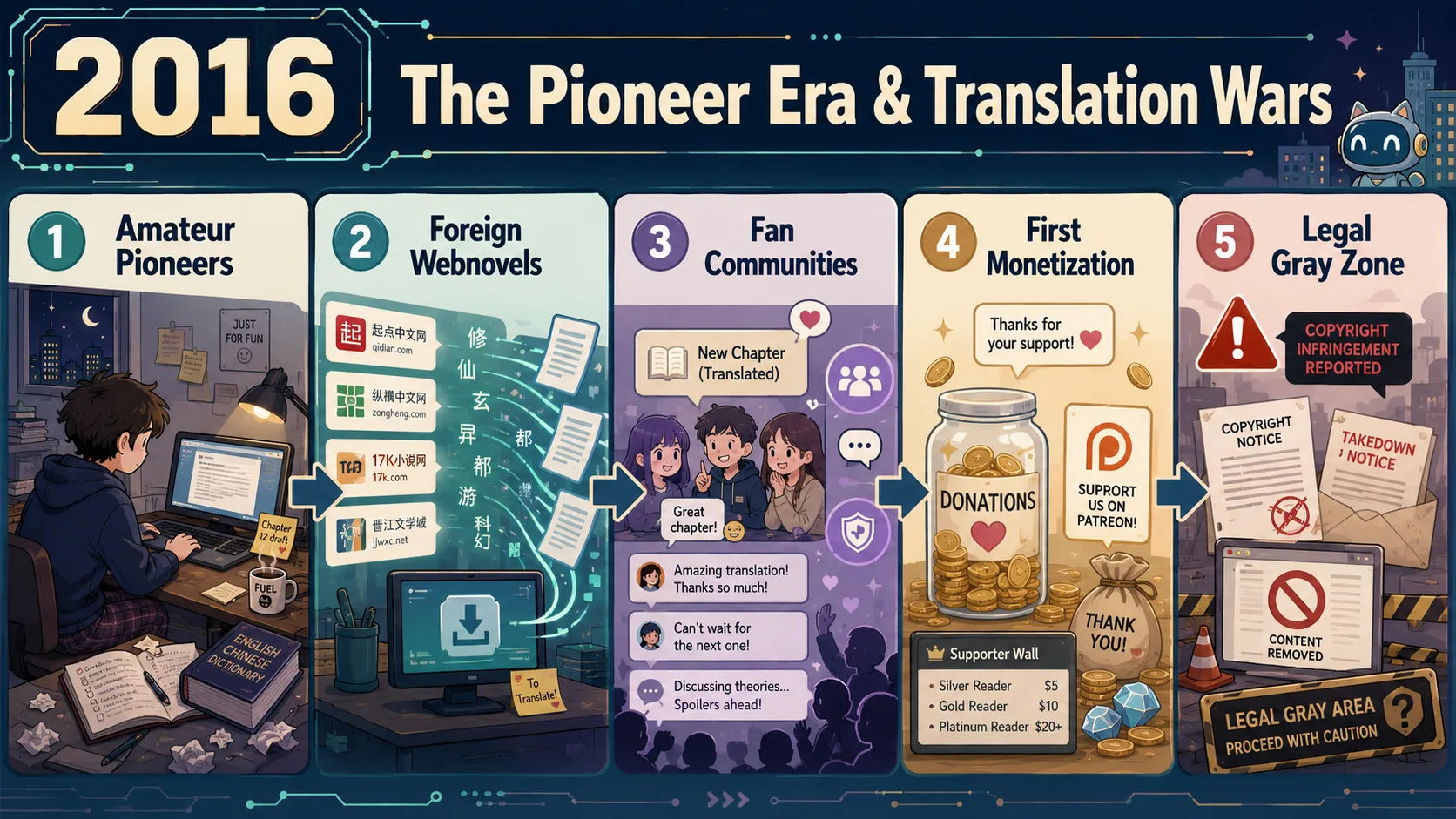
In 2016, Patreon was the “Golden Goose” of the web novel world. As we saw in Chapter 25, the “Sponsored Chapter” model had been replaced by a recurring subscription model that provided translators with a stable, predictable income. For a few months, it felt like a utopia. Every translator was launching a Patreon, and every reader was signing up for $5 or $10 a month.
But by late 2016, the goose was starting to look exhausted.
This was the era of the Patreon Saturation Point. The audience for web novels, while massive, was not infinite. More importantly, the audience’s Disposable Income was not infinite. As hundreds of translators launched hundreds of different Patreons, the market reached a breaking point where “Subscription Fatigue” set in, and the growth of the independent “Tip-Jar” economy began to stall.
—
Part 1: The “Netflix” Comparison
The first sign of the saturation point was the Wallet Limit.
By late 2016, a hardcore web novel fan wasn’t just following one story; they were following twenty. If they wanted “Advanced Chapters” for all twenty stories, and each translator was charging $5 a month, the reader was looking at a bill of $100 a month.
In a world where Netflix cost $9.99 and provided thousands of high-budget shows, the “Value Proposition” of a single web novel Patreon began to feel skewed. Readers were forced to make difficult choices. They could no longer support every translator they liked; they had to pick their “Top Three” and let the rest survive on ad-revenue alone.
This created a “Winner-Take-All” hierarchy. The “Star Translators” at the top (Chapter 09) continued to grow their Patreons, but the mid-list and new translators found it increasingly difficult to get even a single subscriber. The “Middle Class” of the web novel economy was being hollowed out. You were either a “Patreon Giant” making $10,000 a month, or you were a “Struggling Independent” making $50. There was very little in between.
—
Part 2: The “Whale” Ceiling
The second wall was the Whale Ceiling.
The web novel economy had always been driven by “Whales”—the top 1% of readers who were willing to pay $50, $100, or even $500 a month to support their favorite stories. In 2015, these whales were spread out across the community. By late 2016, the whales had been “Tapped Out.”
A whale only has so much money. If they were already giving $200 a month to Wuxiaworld translators, they didn’t have another $200 for the new Gravity Tales novel. The “Pool of Whales” had reached its maximum capacity. This led to a “Stagnation” in the top-tier revenue. Translators realized that they were no longer “Finding New Whales”; they were just “Stealing Whales” from each other.
This triggered a defensive shift in the Patreon tiers. Translators began adding more and more “Advanced Chapters” to justify their prices. What started as 5 chapters for $5 became 10 chapters, then 20, then 50. The “Content Requirement” to keep a whale was skyrocketing, but the revenue was staying the same. The translators were working harder just to stay in the same place.
—
Part 3: The Demand for “Bundling”
As “Subscription Fatigue” set in, a new demand began to emerge from the community: The Bundle.
Readers were tired of managing twenty different Patreon accounts. They wanted a single payment—a “Netflix for Web Novels”—that gave them access to everything on a platform. They wanted to pay $15 a month to a hub and get “Advanced Chapters” for every novel on that site.
This demand was the final nail in the coffin for the “Independent Blog” (Chapter 33). A solo translator couldn’t offer a bundle. Only a major hub with fifty different novels could provide the “Variety” and “Value” that the readers were now demanding.
The hubs realized that “Bundling” was the only way to break the Patreon saturation point. By offering a “Site-Wide Subscription,” they could capture the $15 a month from the “Average Reader” who couldn’t afford $100 for twenty Patreons. This shift marked the transition from the Donation Economy (supporting an individual) to the Subscription Economy (paying for a service).
—
Part 4: The “Advanced Chapter” Arms Race
The saturation point triggered an Advanced Chapter Arms Race.
To stand out in a crowded market, translators began competing on Quantity rather than Quality. If your rival was offering 10 advanced chapters, you had to offer 15. If they offered 15, you offered 20.
This race was a disaster for the “Health” of the translators. It required them to maintain a massive “Buffer” of unreleased chapters. To build this buffer, they had to work double-time for months without any additional pay. If they ever fell behind—due to illness, burnout, or life events—they would lose their Patreon subscribers instantly.
This created the “Quality-Velocity Paradox.” As the pace increased, the quality of the prose inevitably dropped. Translators stopped editing their work, and authors stopped refining their plots. The audience noticed the drop in quality, which led to further “Subscription Fatigue,” which then forced the creators to increase the quantity even more to compensate. It was a downward spiral that would only be broken by the corporate “Salaries” of 2017.
The Patreon model had become a “Golden Handcuff.” It provided a high income, but it required a level of mechanical consistency that was physically impossible to maintain forever. The industry was “Burning Through” its best talent to satisfy the demands of a saturated market. The “Passion” was being replaced by “Pressure.”
This led to the rise of The Burnout Generation. In the final months of 2016, we saw a massive wave of “Hiatus” announcements. Translators who had been the backbone of the community for two years suddenly disappeared. They weren’t leaving because they weren’t making money; they were leaving because the “Debt of Chapters” they owed their Patreon supporters had become a psychological weight they couldn’t carry. The “Saturation Point” wasn’t just a financial limit; it was a human one. The industry had optimized for “Release Speed” at the cost of “Translator Longevity.”
—
Part 6: The Patreon-Aggregator Cold War—The Watermark Wars
The final symptom of the saturation point was the Escalation of Piracy.
In early 2016, aggregators mostly stole the “Free” chapters. By late 2016, they began targeting the Patreon-Exclusive advanced chapters. This was a direct attack on the translators’ livelihood. If a reader could get the “Advanced Chapters” for free on a pirate site, they had no reason to pay for the Patreon.
This triggered the Watermark Wars. Translators began “Poisoning” their Patreon texts with invisible characters, fake sentences, or mid-paragraph “Shout-outs” to their supporters to identify which subscriber was leaking the content. The aggregators responded by building bots that could “Clean” the text of these watermarks.
The relationship between the creator and the audience began to turn Toxic. Translators started viewing their own supporters as potential “Spies.” They implemented strict “Background Checks” for high-tier Patreons and used software to track IP addresses. The “Community” feel of 2015 was being replaced by a state of “Constant Surveillance.” The saturation of the market had made every single subscriber a precious resource, and the fear of losing that resource to a pirate was driving the creators to the brink of paranoia.
—
Part 5: The Corporate “Paywall” Inevitability
The Patreon saturation point was the ultimate justification for the Corporate Paywall.
When Qidian International launched its “Spirit Stone” model (Chapter 30), they were essentially answering the demand for bundling and professionalized pricing. They realized that the “Tip-Jar” model was too unstable for a multi-billion-dollar business. They needed a system where they controlled the pricing, the bundling, and the “Currency.”
By the end of 2016, the “Independents” were trapped. They couldn’t raise their prices because of saturation, and they couldn’t lower their workload because of the arms race. The corporate giants stepped in with a “Solution”: Centralization. They offered to take over the billing, the platform, and the marketing, in exchange for total control. The “Patreon Era” was the peak of independent wealth, but it was also the catalyst for corporate dominance.
This corporate shift was the only way to break the “Human Ceiling” of the Patreon model. A corporation could hire a rotating team of translators to ensure the treadmill never stopped, and they could bundle hundreds of novels together to make the $15 monthly cost feel like a bargain. The saturation point didn’t destroy the web novel economy; it just paved the way for the “Walmart-ization” of the industry. The 2016 Era ended with the realization that “Community” was a luxury that the market could no longer afford.
—
Part 4.1: The Subscription Fatigue Epidemic
By late 2016, the mathematical reality of the “Advanced Chapter” model hit a brutal, unavoidable wall: The Patreon Saturation Point.
The early adopters of the Patreon model (in late 2015 and early 2016) experienced explosive, unprecedented growth. Because they were the only ones offering the service, a Whale reader with $100 of disposable income a month could easily support the top four or five translators.
But as the success of the model became obvious, every single translator in the ecosystem launched a Patreon. The market flooded. A reader who followed twenty different serialized novels was suddenly asked to pay $10 a month for twenty different Patreons just to stay current on the cliffhangers.
The math no longer worked. The audience’s disposable income was finite, but the supply of serialized fiction was infinite.
The Cannibalization of the Whales
This led to the hyper-competitive cannibalization of the Whale demographic.
Translators realized that they could not attract “new” money into the ecosystem; they had to steal existing money from rival translators. If a reader only had $50 a month to spend, they had to ruthlessly prioritize which five novels were worth the $10 tier.
This triggered the most extreme escalation of the “Anxiety Conversion Metric” (Chapter 21). Authors were forced to end every single chapter on a mind-bending, life-or-death cliffhanger, not for artistic reasons, but simply to prevent the reader from canceling their subscription at the end of the month.
If an author wrote a “cooldown” chapter where the protagonist rested in an inn, the reader would immediately cancel their $10 pledge and move that $10 to a different novel that was currently in the middle of a high-stakes tournament arc. The audience’s loyalty was purely transactional, dictating an exhausting, permanently elevated state of narrative tension that burned out both the creators and the readers.
Part 4.2: The “Whale Tier” Escalation
To combat the stagnation of the $5 and $10 tiers, translators began aggressively targeting the absolute top 1% of their audience—the ultra-wealthy superfans.
This resulted in the terrifying escalation of the “Whale Tiers.”
Initially, a $50 tier was considered exorbitant. But as translators desperately tried to increase their Monthly Recurring Revenue (MRR) without having to attract new readers, they introduced $100, $200, and even $500 monthly tiers.
What could a translator possibly offer to justify a $500 monthly subscription?
1. Massive Buffers: Offering the reader 50 or even 100 chapters ahead of the public release.
2. Naming Rights: Allowing the Whale to name a major character, a city, or a divine artifact in the translation (often leading to bizarre, immersion-breaking names).
3. Direct Editorial Control: Allowing the Whale to directly communicate with the translator on Discord and suggest minor changes to the localization.
This created a horrifying power dynamic. A translator making $10,000 a month might rely on just ten individuals for $5,000 of that revenue. The translator became a digital hostage to the whims of these ten Whales. If a Whale didn’t like the pacing of a particular arc, they could threaten to pull their $500 pledge, forcing the translator to alter the translation or rush the pacing just to appease a single mega-donor.
Part 4.3: The Patreon Algorithm and the “First of the Month” Purge
The stress of the Saturation Point was exponentially worsened by Patreon’s deeply flawed billing architecture in 2016.
Patreon utilized a “Charge Upfront” model on the 1st of every month. This meant that a massive percentage of a creator’s audience would routinely decline on the 1st of the month due to expired credit cards, insufficient funds, or readers intentionally canceling at the last minute to avoid the charge.
Translators referred to this as the “First of the Month Purge.” A translator could go to sleep on October 31st with $15,000 in pledged revenue, and wake up on November 1st with $11,000.
Because the audience was saturated and suffering from subscription fatigue, regaining those lost subscribers became nearly impossible. A reader who’s card declined for a specific novel often just accepted the loss and didn’t bother to update their payment information, deciding they were following too many novels anyway.
The Desperation Tactics
To fight the Purge, translators resorted to desperate retention tactics.
They would intentionally schedule massive, multi-chapter “Mass Releases” for the 2nd or 3rd of the month, explicitly stating that these chapters would only be available to active Patreon subscribers. They were actively blackmailing their own audience into updating their credit card information.
The Patreon Saturation Point proved that the independent economic model was fundamentally a bubble. It relied on a small pool of high-spending Whales who were eventually bled dry by an endlessly expanding roster of creators. The model required infinite growth in a finite ecosystem, a contradiction that would eventually force the industry toward the micro-transaction “Coin” model pioneered by Qidian.
Actionable Takeaways for the Modern Author
The Patreon Saturation Point proved that there is a hard limit to “Fan Generosity.” To survive as a modern author, you must transition from a “Donation” mindset to a “Product” mindset.
1. Avoid the “Volume Trap”
Don’t compete solely on the number of “Advanced Chapters.” If you enter a “Volume Race,” you will eventually burn out or be beaten by a “Content Farm” or AI. Instead, focus on Unique Value. Give your subscribers things that can’t be mass-produced: behind-the-scenes lore, direct interaction, community voting on plot points, or exclusive high-quality art. Make them support You, not just your “Buffer.”
2. Tier-Stacking Strategy
Don’t just have a $5 tier. Have a “Path to Growth.” Create a $1 “Entry Tier” for the average fan, a $5 “Standard Tier” for the dedicated, and a $25+ “Patron Tier” for the whales. By spreading your “Value” across different price points, you can capture the maximum amount of “Disposable Income” without triggering “Subscription Fatigue.”
3. The “Netflix” Test
Periodically ask yourself: “Is my content worth more than a Netflix subscription?” If the answer is no, you need to either lower your price or increase your “Perceived Value.” In 2026, you are not just competing with other authors; you are competing with every other form of digital entertainment. You must justify your spot in the reader’s monthly budget.
4. Build a “Back-Catalog” Asset
Your Patreon revenue is “Active Income”—it stops the moment you stop writing. To survive the “Saturation Point,” you must build “Passive Income” assets. Publish your completed volumes on Kindle, build a direct-sales store on your website, or license your work for audio. Use the “Patreon Peak” to fund the creation of a “Back-Catalog” that will support you when the next saturation point hits.
5. Community over Commodity
The only thing that is “Saturation-Proof” is Community. If your readers feel like they are “Part of something” when they support you, they are much less likely to cancel their subscription when they need to save money. Treat your Patreons like “Members of a Club,” not “Customers of a Store.” The “Human Bond” is the ultimate defense against corporate centralization.
*(The 2016 Era was drawing to a close. The hubs had merged, the blogs had died, and the wallet had reached its limit. But as the subscription model stabilized, a more fundamental part of the economy was dying—the direct gift. In Chapter 35: The Death of the Sponsored Chapter, we explore why the ‘Donation’ model hit a wall and how the tip-jar was replaced by the recurring bill).*
—
Part 7: The “Tier 0” Experiment—The Illusion of Choice
As saturation hit, some groups tried a new tactic: The Tier 0 Subscription.
This was a $1 tier that offered no “Advanced Chapters” but gave the reader access to a private Discord or “Early Access” to a chapter by just 2 hours. It was a psychological trick designed to lower the barrier to entry. If you could get a reader to pay $1, they were 70% more likely to eventually pay $5.
The UI was being used to “Warm Up” the reader’s wallet. It was a precursor to the “Freemium” models of the modern era, where the goal isn’t just to make money, but to establish a “Payment Connection” that can be exploited later. It turned “Free Readers” into “Active Customers,” even if they weren’t spending much yet.
—
Part 8: The “Patreon Exclusive” Novels—The Birth of the Walled Garden
2016 saw the birth of the Patreon-First Novel.
Instead of posting on a hub and using Patreon for “Advanced Chapters,” some authors (specifically in the western LitRPG scene) began posting the entirety of their work behind a Patreon paywall, leaving only the first few chapters free on public sites.
This was a radical shift toward Isolationism. It proved that if an author’s brand was strong enough, they didn’t need a platform; they could build their own “Walled Garden.” However, it also signaled the end of the “Public Commons” of web fiction. The industry was fragmenting into a thousand tiny, private clubs, making it harder for new readers to discover stories without having their credit card ready.
—
Part 9: The Psychological “Lock-in”—The Friendship Tax
Finally, the most effective defense against saturation was the Friendship Tax.
Translators and authors began spending hours a day chatting with their patrons on Discord, sharing personal stories, and making them feel like “Insiders.” This created a powerful Psychological Lock-in. When a reader hit their budget limit, they would cancel their Netflix or their gym membership before they canceled their $5 Patreon, because canceling the Patreon felt like “Betraying a Friend.”
This was the “Secret Sauce” of the 2016 survivors. They didn’t just sell chapters; they sold Affiliation. They turned a transaction into a relationship, ensuring that even in a saturated market, their “Core Fans” would never leave. This taught the corporate giants a valuable lesson: you can buy the content, but you have to engineer the community.
—
0 Comments