2016 – 13 – The Death of the Independent Blog
by EternalibChapter 33: The Death of the Independent Blog—The Infrastructure Ceiling
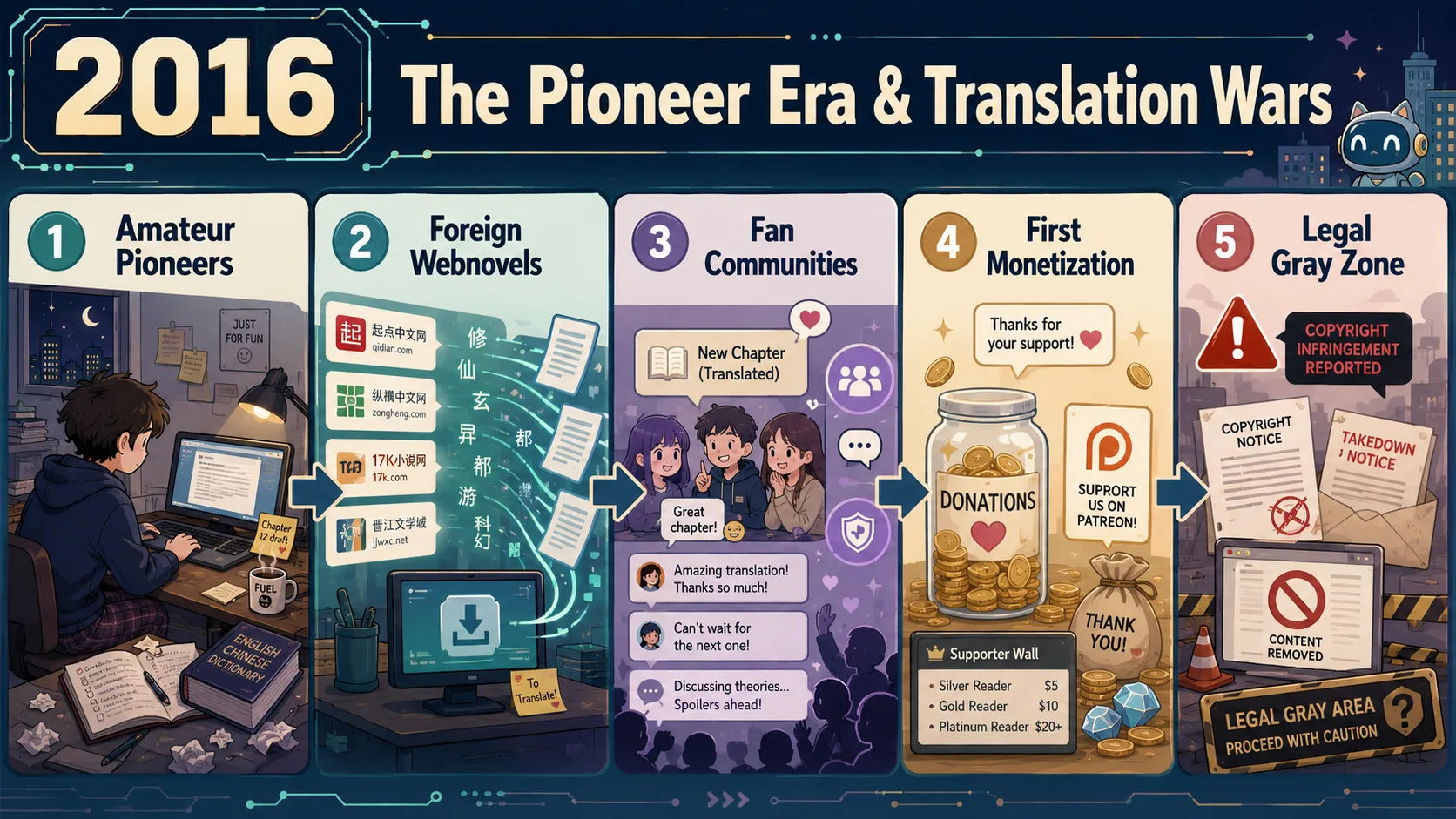
In the early days of the “Genesis Era” (2015), the barrier to entry for a web fiction translator was essentially zero. If you had a basic grasp of Mandarin or Korean and a free WordPress.com account, you could build a multi-thousand-dollar-a-month business from your bedroom. It was the ultimate democratization of the publishing industry.
But by late 2016, that door was being slammed shut—not by the corporate giants, but by the physical reality of the internet.
This was the era of the Infrastructure Ceiling. As the audience for web novels exploded into the millions, the technical requirements for hosting a popular series became so astronomical that a solo translator on a free blog could no longer survive. The “Small Town” of web fiction was being cleared away to make room for a digital metropolis, and if you couldn’t afford the rent on a high-end server, you were evicted.
—
Part 1: The “Cloudflare” Requirement
The first sign of the infrastructure ceiling was the total failure of basic hosting.
In 2015, a WordPress.com blog could handle a few hundred readers a day without a hitch. By 2016, a popular chapter release would attract 50,000 readers simultaneously. The resulting traffic spike was indistinguishable from a DDoS Attack (Distributed Denial of Service).
Implementing Cloudflare required a level of technical expertise that many fan-translators simply didn’t have. They were linguists, not sysadmins. The frustration of constant site-crashes and “Error 522” screens began to sap the passion out of the hobby. A translator who spent four hours a day translating and four hours a day fixing their server was a translator who was rapidly approaching burnout.
But the crashes weren’t always accidental. In 2016, we saw the rise of DDoS for Hire services—low-cost “Booter” sites that allowed anyone with $10 to knock a website offline. These services were frequently weaponized by rival pirate sites to take down the “Official” source. If a solo blog was offline, the readers would be forced to go to the pirate aggregator. It was a digital “Protection Racket.” The independent blogger was being hit by a tech-war they didn’t even know existed. They were being targeted by professionals who specialized in “Network Stressing,” and they had no way to fight back.
“I got an email from a random address saying they would keep my site offline for 48 hours unless I sent $50 in Bitcoin. I thought it was a joke. Ten minutes later, my site was dead. I contacted my host, and they told me I was being hit by 10 million requests a second. They didn’t even try to help; they just terminated my account to protect their other customers. I wasn’t just losing my readers; I was losing my digital home. That was the day I realized that being an ‘Independent’ was just another word for being ‘Unprotected’.”
— Archived Forum Post from a 2016 WordPress Translator
—
Part 2: The Scraper Death-Spiral
The second technical wall was the Aggregator Scraper (Chapter 28).
By late 2016, the pirate aggregator sites had developed such sophisticated scraping bots that a solo blog was essentially a “Victim-in-Waiting.” These bots didn’t just crawl the site; they hammered it. Every time a new chapter was posted, hundreds of bots would descend on the solo blog to steal the text. For the solo translator, this was a “Death-Spiral.” The bots would eat all the server’s bandwidth, causing the site to crash for the legitimate readers. To fight the bots, the translator had to implement expensive “Anti-Bot” software or complex JavaScript obfuscation.
—
Part 3: The SEO Ghetto
Even if a solo translator managed to keep their site online and defend it from scrapers, they faced the final, most insurmountable wall: The SEO Ghetto.
By late 2016, the major hubs (Chapter 32) had become such “Authority Giants” in Google’s eyes that a solo blog had zero chance of ranking for its own keywords. If you started a new blog to translate a new novel, Google would bury you on page 10, while a pirate aggregator or a major hub would rank on page 1. The “Discovery Engine” was broken for the independent. To get readers, you had to be on a platform that already had millions of users. The “Organic Growth” that had defined the early 2015 era was dead.
—
Part 4: The Birth of the “Platform Tax”
This technical shift gave birth to the Platform Tax.
The major hubs realized that they held all the technical and marketing power. They began charging translators a significant percentage of their revenue (often 30% to 50%) in exchange for “Hosting, Security, and SEO.” To the solo translator, this felt like “Protection Money.” But in reality, it was the “Cost of Doing Business” in a professionalized market. The hubs were no longer just fan-sites; they were Infrastructure Providers. They were selling a “Safe Haven” where a translator could focus on the text without worrying about Cloudflare configurations or DDoS attacks.
—
Part 5: The “App” Barrier
The final blow to the solo blog was the Mobile Transition.
By late 2016, over 70% of web novel readers were consuming content on their phones. A mobile-responsive website was no longer enough; the audience wanted a Dedicated App. They wanted “Offline Reading,” “Push Notifications,” and a “Library” that synced across devices. Building and maintaining a mobile app is an order of magnitude more expensive and complex than running a website. It requires a dedicated team of iOS and Android developers, constant updates for new OS versions, and the ability to navigate the complex “App Store” regulations.
—
Part 6: The “Walled Garden” of the Hub—The End of the Open Web
The final consequence of the infrastructure ceiling was the creation of the Walled Garden.
To protect their content from scrapers and to monetize their traffic more efficiently, the major hubs began implementing Mandatory Account Creation. You could no longer just “visit” a site and read a chapter. You had to have an account. You had to log in. You had to be “part of the system.”
This was the end of the Open Web for web fiction. The “Blog-roll” era of 2015, where you could jump from one site to another without friction, was replaced by a series of isolated, corporate silos. Each hub was a “Walled Garden” that tried to keep the reader inside its own ecosystem.
This shift was a technical necessity for anti-scraping, but it was a cultural disaster for the community. The “Global” web novel fan-base was being split into “Wuxiaworld Readers,” “Gravity Tales Readers,” and “Qidian Readers.” The hubs were no longer part of a larger internet; they were trying to be the internet. This insularity was the price of security. The “Independent” blog couldn’t build a wall, so it was eventually swallowed by the ones who could.
The death of the independent blog was the death of the “Frictionless Web.” It was the moment that the internet stopped being a series of open pathways and started being a collection of guarded gates. For the individual translator, the price of entry into the professional market was their autonomy. They had to trade their personal flag for a corporate banner, and their personal site for a “User Profile.” The era of the “Hobbyist Pioneer” was over; the era of the “Platform Professional” had begun.
“I remember when I could just bookmark twenty different WordPress sites and read them all in my browser. Now, I have to have five different apps on my phone, three different passwords, and I have to ‘check-in’ to earn points. It feels less like a library and more like a high-security prison for books. I understand why they did it, but I miss the days when the web felt… open. Now, everything is just a gated community.”
— Archived Post from r/novelupdates, January 2017
—
Part 4.1: The SEO Consolidation and The Walled Gardens
The death of the independent blog was fundamentally an algorithmic execution. In the early days of 2015, if a translator launched a new WordPress blog to host their translations, they could rely on NovelUpdates to drive initial traffic, and Google to handle the rest.
But by late 2016, the major translation hubs (Wuxiaworld, Gravity Tales, Volare Novels) had grown so massive that their domains carried overwhelming SEO authority. Google’s algorithm inherently favored massive domains with millions of inbound links and incredibly high daily user retention.
If an independent translator hosted Chapter 1 of a new novel on MikesTranslations.wordpress.com, and an aggregator bot scraped it and posted it on a pirate site, the pirate site would rank higher on Google than Mike.
But if Mike joined Wuxiaworld and hosted his novel there, Wuxiaworld’s massive domain authority would instantly crush the aggregator site in the search rankings.
This created an unavoidable gravity well. Independent translators were forced to abandon their personal blogs and submit to the corporate structures of the massive hubs simply to protect their SEO visibility. The era of the decentralized, highly fragmented blogosphere died, replaced by three or four massive “Walled Gardens” that controlled 90% of the Western market.
The Hub Taxation System
When an independent translator joined a massive hub like Wuxiaworld, they did not join as an equal partner; they joined as a sharecropper.
The hubs provided the infrastructure: the custom engine, the anti-DDoS protection, the massive SEO authority, and the pre-existing audience. In exchange, the hub took a significant percentage of the Ad-Sense revenue generated by the translator’s specific novel.
For many translators, this was a perfectly acceptable trade-off. They no longer had to worry about server maintenance or fighting off aggregator bots. They could simply translate and collect their Patreon revenue (which the hubs usually allowed them to keep 100% of).
But this consolidation concentrated immense, unchecked power into the hands of the Hub Owners (the “Kings” of the Cartels mentioned in Chapter 29). They dictated the terms, they controlled the layout, and they had the ultimate authority to banish a translator back into algorithmic obscurity if they stepped out of line.
Part 4.2: The Infrastructure Escalation
The independent blogs simply could not afford to keep the lights on.
As the readership grew from a few thousand dedicated fans to millions of daily readers, the infrastructure costs skyrocketed. A standard $15/month shared hosting plan on HostGator would instantly melt down the moment a translator posted a link on NovelUpdates, generating 5,000 concurrent connections in ten seconds.
Translators were forced to migrate to expensive Virtual Private Servers (VPS) or Dedicated Servers, costing hundreds of dollars a month. They had to implement costly Cloudflare Enterprise plans to mitigate the relentless Distributed Denial of Service (DDoS) attacks launched by rival translation groups and aggregator sites.
A translator running a solo blog might make $1,000 a month on Patreon, but spend $600 a month on server costs and DDoS protection, while spending twenty hours a week trying to optimize their MySQL database.
The massive hubs solved this through economies of scale. Wuxiaworld could afford a $5,000-a-month dedicated server cluster because they were amortizing that cost across forty different highly lucrative novels. The solo blogger simply could not compete with that math.
Part 4.3: The Homogenization of the Reading Experience
The death of the independent blog also meant the death of the unique, highly personalized aesthetic of the early translation scene.
In 2015, every translator’s WordPress blog looked different. Some were heavily customized with anime themes, custom cursors, and elaborate lore compendiums in the sidebars. It felt like exploring a decentralized, chaotic internet.
When the massive hubs absorbed these translators, the UX was completely homogenized. Every novel was forced into the exact same standardized template. The font, the background color, the comment section layout—everything was identical.
This homogenization was highly efficient for the reader (they didn’t have to navigate a new, confusing website for every novel), but it fundamentally altered the relationship between the reader and the text. The reader was no longer visiting “Mike’s Translation Blog”; they were visiting “Wuxiaworld.”
The brand loyalty shifted from the individual translator to the massive platform.
Part 4.4: The Perfect Setup for Corporate Assimilation
This massive consolidation was the final, fatal mistake of the independent era.
By grouping 90% of the market share into three massive, highly centralized hubs, the independent translators made it incredibly easy for the corporate giants (China Literature / Qidian) to execute their takeover in 2017.
Instead of having to hunt down and sue two hundred individual WordPress bloggers scattered across different offshore hosting providers, Qidian’s legal department only had to send three Cease and Desist letters.
The Walled Gardens that the independents built to protect themselves from aggregators and SEO obscurity became the exact cages that Qidian would use to trap them. The independent era had centralized itself right into a corporate buyout.
Actionable Takeaways for the Modern Author
The Death of the Independent Blog proved that talent is useless without infrastructure. In a professionalized market, your “Stack” is as important as your “Story.”
1. Know Your Technical Limits—Don’t be a DIY Sysadmin
If you are an independent author in 2026, don’t try to be your own IT department. Use established platforms (Royal Road, Patreon, Kindle, etc.) that handle the “Infrastructure” for you. Your time is best spent on your prose, not on fixing “502 Bad Gateway” errors. The “Platform Tax” is often cheaper than the “Burnout Cost” of doing everything yourself. Your core competency is storytelling; don’t let technical debt kill your creative momentum. By outsourcing the headaches of server uptime, security patches, and database optimization, you reclaim the mental bandwidth required to maintain a consistent release schedule, which remains the single most important factor in long-term audience retention.
2. The SEO “Power Law”—Leverage Authority
Understand that in the modern internet, “The Big Get Bigger.” If you want to grow an audience from scratch, you must leverage existing platforms with high Domain Authority. Don’t launch a solo site until you have a large enough “Mailing List” to bypass Google entirely. Your mailing list is the only infrastructure that you truly own and that no algorithm can take away. While major platforms will do the heavy lifting of initial discovery, your personal newsletter is the insurance policy that protects you against platform volatility. When the search engines shift their favor or the platform changes its payout structure, your direct line to your readers will keep your career stable regardless of the digital winds.
3. Mobile-First is a Requirement—Optimize for the Thumb
If your story is not easy to read on a phone, it doesn’t exist for 70% of your audience. Ensure your website or platform of choice is hyper-optimized for mobile. If you are serious about your career, look for platforms that offer a dedicated mobile app. In 2026, the “Reader Experience” is a competitive advantage. If a reader has to pinch-to-zoom to read your dialogue, you have already lost them. Modern readers equate quality of content with quality of interface; if your layout is clunky or your navigation is non-intuitive, they will perceive your writing as amateurish, regardless of the quality of the prose itself.
4. Build for “Resilience”—The Cloudflare Mindset
Don’t just plan for your site to handle 100 readers; plan for it to handle 10,000. Use tools like Cloudflare from Day 1. It is significantly easier and cheaper to build a “Resilient” stack early than it is to try and migrate a crashing site in the middle of a viral success. Resilience is not an “Add-on”; it is a foundational requirement for any serialized business. Treat every piece of your digital stack as a potential point of failure. If you are hosting your own assets, use a CDN (Content Delivery Network). If you are using a CMS, keep your plugins minimal. Success is a stress test, and if your infrastructure isn’t ready for a sudden influx of thousands of readers, your greatest moment of growth will become your most damaging moment of technical failure.
5. Own Your Reader Relationship
While you should use platforms for their infrastructure, you must never let the platform become the only way readers can find you. Always have a “Backdoor”—a newsletter, a Discord, or a personal site that serves as your permanent home. If a platform raises its tax or shuts down your “Walled Garden,” you need to be able to move your “Guests” to a new home without losing them. Building a decentralized audience is the ultimate hedge against platform consolidation. Treat the platform as a place to acquire new readers, but treat your mailing list as the place to retain them. This distinction is the difference between a writer who is a hostage to a platform’s policy changes and one who can thrive regardless of the changing digital landscape.
*(The solo blog was a ghost of the past, and the major hubs were the new masters of infrastructure. But as they stabilized their platforms, they ran into a different kind of ceiling: the limit of the human wallet. In Chapter 34: The Patreon Saturation Point, we explore why the ‘Donation’ model hit a wall and why the ‘Subscription Bundle’ became the next inevitable evolution).*
0 Comments