
2015 – 12 – The Wuxia Shift
by EternalibChapter 12: The Wuxia Shift—The Addiction to Infinite Escalation
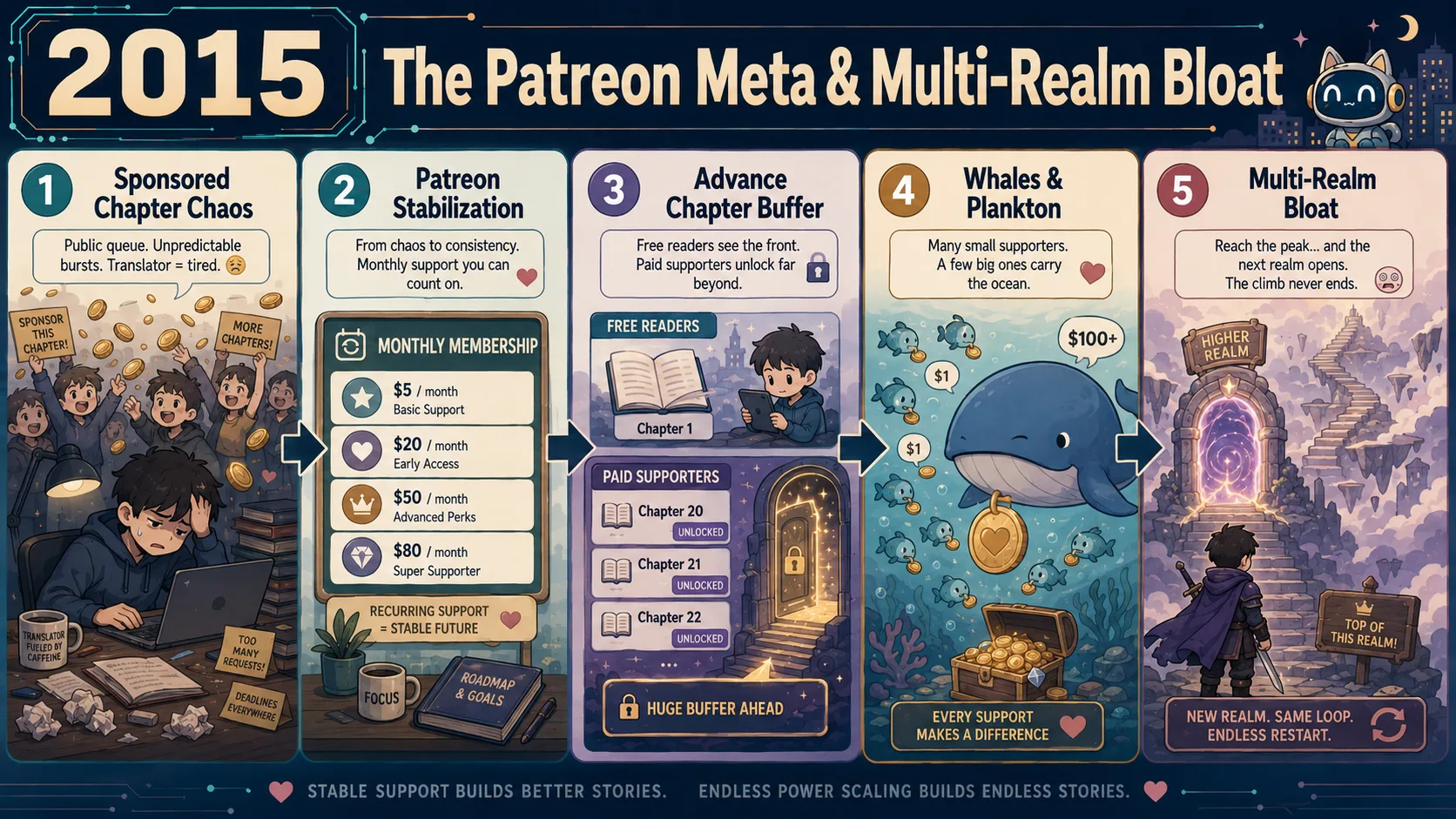
If you analyze the name of the most dominant translation platform of the Genesis Era—Wuxiaworld—you will find a deeply ironic historical artifact. By the end of 2015, the platform was hosting almost entirely Xianxia and Xuanhuan novels. The actual genre of Wuxia had been practically eradicated from the Western reading diet.
To understand why the Western audience violently rejected grounded martial arts in favor of reality-breaking, planet-destroying Cultivation fantasy, you have to understand the specific psychological threshold of the dopamine addict. You cannot give an addict a smaller dose of the drug and expect them to remain engaged.
The Wuxia Shift was the moment the community explicitly demanded infinite escalation, permanently altering the DNA of internet progression fantasy.
—
Part 1: The Grounded Reality of Wuxia
To the uninitiated Western reader in early 2015, all Chinese fantasy novels were generally lumped into a single, highly confusing bucket. But structurally, there is a massive distinction between the sub-genres.
Wuxia (translating literally to “Martial Heroes”) is grounded, historical low-fantasy. It is the literary equivalent of the film Crouching Tiger, Hidden Dragon.
- The protagonists are exceptional martial artists, but they are fundamentally human.
- They can leap across rooftops, shatter boulders with their fists, and utilize inner ‘Qi’ to heal wounds.
- However, they cannot fly into outer space. They cannot live for ten thousand years. If a Wuxia protagonist is stabbed through the heart with a normal steel sword, they will die.
In the very early days of the Spcnet forums, Wuxia novels like the classic works of Jin Yong were the primary focus of translation. They were deeply political, highly dramatic, and heavily focused on martial arts tournaments and factional warfare within a grounded Chinese historical setting.
But as the daily serialization format began to mathematically addict the Western readership, a severe structural flaw within the Wuxia genre became agonizingly apparent.
—
Part 2: The Power-Scaling Ceiling
In a serialized format, an author must constantly escalate the tension to keep the reader logging in every single day for thousands of chapters. The easiest, most universally effective way to escalate tension is to increase the scale of the violence.
Wuxia has a definitive physical power ceiling. A human martial artist can only get so strong before the author runs out of physical ways to demonstrate their strength. Once the protagonist can successfully defeat fifty men with his bare hands, how does the author mathematically raise the stakes for the next five hundred chapters? The author is forced to rely on complex political intrigue, emotional drama, or deep philosophical themes to carry the narrative.
This structural limitation directly impacted the monetization model of the translators. If a Wuxia novel naturally concludes its narrative arc at Chapter 300 because the protagonist has avenged his master and retired to a quiet village, the translator’s AdSense and Patreon revenue stream immediately dies. The translators needed novels that could run for 3,000 chapters to ensure financial stability.
The hyper-addicted Western audience, reading on mobile phones at three in the morning, did not want political intrigue or peaceful retirements. They wanted raw, undeniable, visually spectacular power progression. They wanted the numbers to go up forever.
This demand perfectly catalyzed the rise of Xianxia (Immortal Heroes) and Xuanhuan (Mysterious Fantasy).
“I tried reading a classic Wuxia novel because everyone said the prose was beautiful. I lasted thirty chapters. The main character spent ten chapters learning a sword technique that just let him cut a tree in half. Meanwhile, in Coiling Dragon, Linley is literally transforming into a half-dragon and fighting demigods in a pocket dimension. I just can’t go back to normal guys fighting with normal swords.”
— Archived Reddit Comment,r/noveltranslations, Mid-2015
—
Part 3: The Xianxia Escalation
Xianxia completely shattered the physical power ceiling. It abandoned humanity entirely in pursuit of Godhood.
In a Xianxia novel, the progression is infinite. A protagonist might begin as a weak mortal who can barely punch a tree, but through the rigid, mathematical tiers of Cultivation (as detailed in Chapter 04), they eventually achieve the ability to fly. Then they achieve the ability to live for five hundred years. By chapter 800, they are casually destroying entire mountain ranges with a single flick of their finger. By chapter 1,500, they are physically shattering the dimensional boundaries of their universe to ascend to a higher plane of existence, where they are once again at the bottom of the food chain, allowing the violent escalation to begin anew.
This infinite escalation perfectly accommodated the brutal economics of Chinese word-count manufacturing. Because a Xianxia author can simply invent a “Higher Realm” whenever the protagonist gets too powerful, the novel never structurally has to end. The author can comfortably serialize the story for five years, generating daily micro-transaction revenue, without ever worrying about hitting a physical power ceiling.
—
Part 4: The Death of the Mortal Hero
By late 2015, the Wuxia Shift was absolute. Novels featuring grounded, mortal martial artists plummeted in popularity. Translators actively stopped picking up Wuxia projects because the Patreon donations and AdSense revenue were mathematically concentrated exclusively in the high-fantasy Xianxia hubs.
The Western readership had essentially developed a profound tolerance to low-level violence. If a protagonist wasn’t fighting a thousand-year-old demon patriarch or suppressing an entire city with their spiritual pressure, the readers perceived the chapter as “boring.”
But the shift wasn’t merely about the scale of the magic; it fundamentally altered the morality of the protagonist. Because Xianxia required infinite escalation and constant conflict to generate daily chapters, the authors had to constantly introduce new enemies. The easiest way to generate a new enemy every week was to make the protagonist incredibly easy to offend.
This birthed the era of the Cultivation Murder-Hobo. A traditional Wuxia hero might forgive a slight or spare a defeated enemy to demonstrate moral superiority. A Xianxia protagonist would slaughter the enemy, slaughter the enemy’s entire extended family, and burn down their sect simply because the enemy looked at them with “disrespect.”
The audience did not reject this psychopathic behavior; they enthusiastically demanded it. They wanted a power fantasy entirely stripped of moral friction. They coined phrases like “cutting weeds by the roots” to justify the protagonist’s absolute, genocidal ruthlessness. If a protagonist showed mercy, the comment section would revolt, accusing the author of writing a “weak” character. The audience had decided that true power meant absolute impunity from consequence.
This transition fundamentally rewired the expectations of the progression fantasy audience. It trained them to evaluate a protagonist’s worth entirely by their capacity for apocalyptic destruction. The emotional nuance of a character’s journey was entirely subjugated to the mechanical progression of their power level.
When you look at the modern landscape of LitRPG and System novels dominating platforms like Royal Road today, you are looking at the direct descendants of the Wuxia Shift. The modern audience still inherently rejects stories where the protagonist remains a normal, grounded human restricted by standard human morality. The demand for infinite, God-tier escalation and absolute ruthlessness is the single most defining psychological trait of the web fiction consumer.
—
Part 5: The Death of Martial Strategy
There is a specific, irreplaceable quality to classical Wuxia combat that the western audience fundamentally killed when they demanded the shift to Xianxia. It is a quality that, once lost, has proven almost impossible to recover in the modern platform ecosystem.
In a traditional Wuxia novel, a fight scene was a chess match. The protagonist did not simply accumulate more raw power than the opponent and hit them harder. The protagonist had to think. They had to read the opponent’s stance, identify a gap in their footwork, bait them into overextending on the third exchange, and exploit that overextension with a precisely timed counter from a non-dominant angle. Victory was earned through intelligence, creativity, and the application of specifically learned technique.
The greatest Wuxia narratives — Jin Yong’s The Legend of the Condor Heroes, Louis Cha’s The Smiling Proud Wanderer — are celebrated specifically because the combat functions as an extension of the character’s psychology. How a character fights reveals who they are.
Xianxia abandoned this entirely.
In a Xianxia battle, the outcome is determined before the first exchange. The character with the higher Cultivation Realm wins. Strategy is largely decorative. A late-stage Core Formation cultivator cannot defeat a Nascent Soul practitioner through clever footwork, because the Nascent Soul’s spiritual pressure passively crushes the bones of anyone in their Aura radius before the fight even begins. The numbers simply overrule the chess match.
The western audience chose this outcome explicitly.
“God, I’m so tired of reading 30-page fights where the author has to explain exactly which meridian got struck and which acupoint got blocked. Just tell me who won. Linley doesn’t need a 10,000-word dissertation on his sword technique. Just have him destroy the guy. Save the philosophy for the meditation caves.”
— Archived NovelUpdates Comment Thread, Mid-2015
The western reader, conditioned by anime combat, video game power levels, and the rapid-fire pace of the daily cliffhanger chapter, simply did not have the patience for the tactical depth of Wuxia. They consumed fiction at an industrial pace — multiple chapters a day, thousands of words per session — and the slow, intricate martial chess matches felt like friction rather than depth.
What the audience gained was spectacular, explosive, visually imaginative power fantasy. What they lost was the tradition of the fight scene as a lens into the human soul. The modern LitRPG genre, filled with System windows and numeric damage outputs, is the direct heir of this bargain. And it is a bargain the industry is still living with.
—
Part 6: Actionable Takeaways for the Modern Author
The Wuxia Shift proves that in web serialization, scaling power is scaling revenue. For an author attempting to build a massive, long-running serial today, you must architect your magic system for infinite growth.
1. The Danger of Early Peaking
If your protagonist defeats the absolute strongest villain in your universe in Chapter 50, your serial is structurally dead. You cannot de-escalate power in web fiction. If the audience has tasted a battle that destroys a city, they will immediately drop the novel if the next arc focuses on a fistfight in a tavern. You must strictly gatekeep the upper echelons of your power system. Ensure that for every tier of power the protagonist achieves, there are explicitly three higher tiers of power looming in the distance.
2. Meaningful Numbers (The LitRPG Engine)
The modern LitRPG genre (combining literary progression with RPG stat screens) was heavily influenced by the rigidity of Cultivation. If you are using a System in your novel, the numbers must have actual, tangible weight in the narrative. If the protagonist’s “Strength” stat increases from 10 to 100, the reader must see the physical difference in the prose. The environment must react differently. The enemies must die faster. If the numbers increase but the combat feels exactly the same, the audience will immediately recognize the illusion and abandon the story.
3. The Power Reset (Ascending Realms)
To prevent power-creep from destroying your narrative stakes, you must utilize the “Realm Ascension” mechanic. When a protagonist becomes too powerful for their local environment, you must physically remove them from that environment. Transport them to a higher dimension, a new continent, or a higher-tier dungeon where their previously god-like power is suddenly considered average. This allows you to reset the tension and begin the underdog Face-Slapping loop all over again without actually nerfing the protagonist’s hard-earned abilities.
*(While the tropes escalated into the heavens, the real-world translators were descending into fierce factional warfare. In Chapter 13: The GravityTales Rivalry, we dissect the dramatic power struggle between the two largest translation hubs, and how their competition actively accelerated the corporate apocalypse).*
0 Comments