

2015 – 06 – The Sponsored Chapter Exhaustion
by EternalibChapter 06: The Sponsored Chapter Exhaustion—When Money Becomes a Weapon
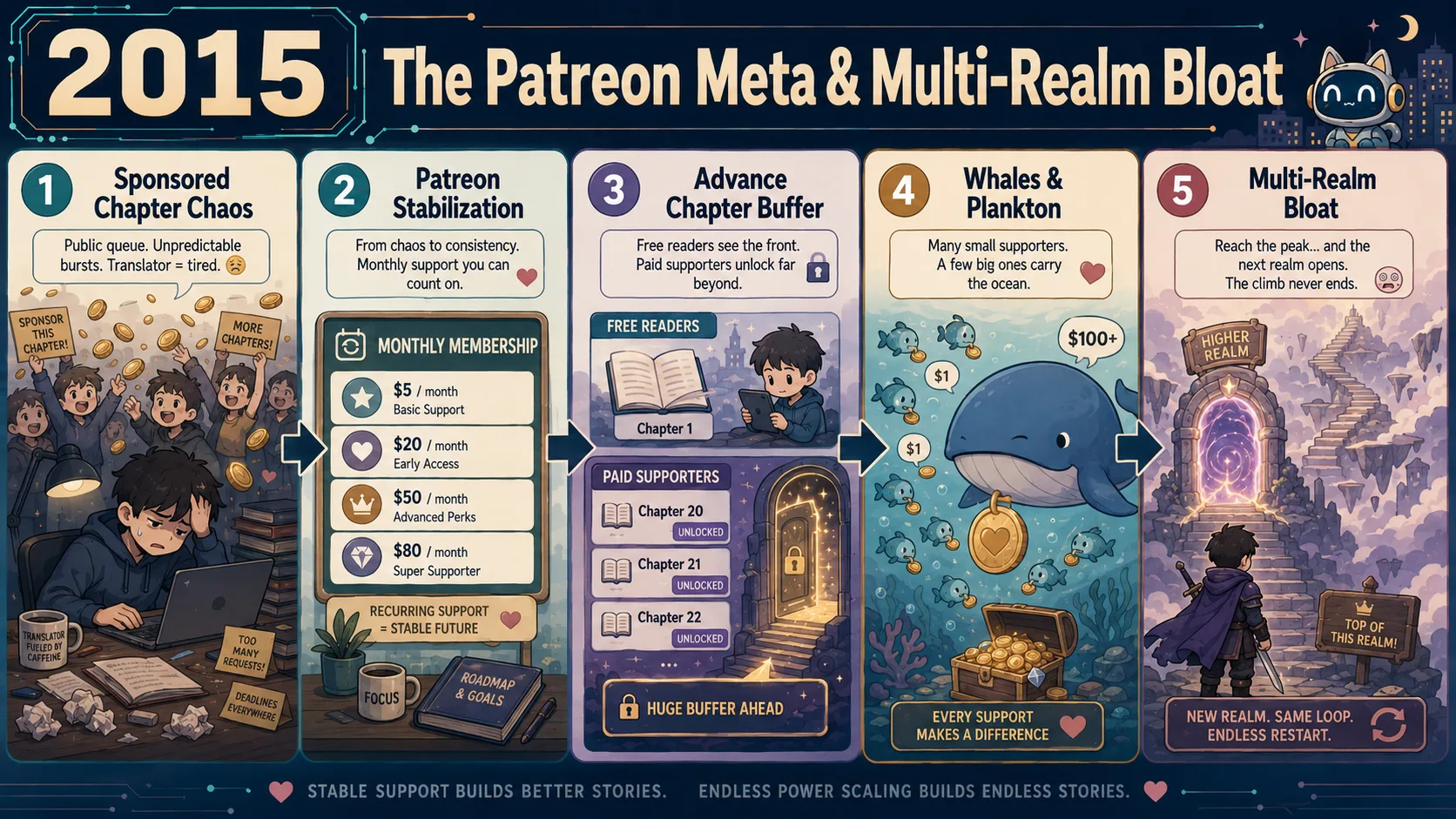
If you examine the financial mechanisms of the 2015 translation era solely through a spreadsheet, the Sponsored Chapter Queue appears to be a flawless economic engine. For the first time in internet history, independent writers and amateur translators were generating massive, direct-to-consumer revenue without a publisher acting as a middleman. Earning five to ten thousand dollars a month via PayPal donations simply by translating Chinese fantasy novels was, on paper, the ultimate millennial gig-economy dream.
However, examining the Sponsored Queue purely through its financial output completely ignores the devastating psychological reality of the individuals operating the machinery.
The Queue was not a passive income stream. It was a digital treadmill wired directly to a college student’s nervous system, operating at a speed controlled entirely by an anonymous mob of highly addicted teenagers with disposable income. For the translators trapped inside it, the system rapidly mutated from a lucrative bonus into a weapon of psychological torture.
—
Part 1: The ‘Stockpile’ Illusion
To understand the specific pathology of this burnout, you have to understand how translators attempted to survive the daily grind.
Because the baseline expectation of the western audience was one free chapter every single day, translators attempted to build a “Stockpile.” If a translator had a free weekend, they might aggressively translate five extra chapters and save them in a digital vault. This stockpile was a psychological safety net. If they got sick, or had a university midterm, they could simply publish a chapter from the stockpile and maintain the illusion of daily output without actually working that day.
The Sponsored Queue completely obliterated the concept of the stockpile.
The mechanical rules of the Queue dictated that every time the community donated a cumulative chunk of money (usually fifty dollars), the translator owed them an immediate bonus chapter. This effectively transformed the audience into unpredictable slave-drivers.
A translator could confidently log off for the night, possessing a healthy stockpile of four chapters to cover their upcoming exam week. But overnight, the novel might hit a massive story climax. Two wealthy readers, absolutely desperate to see how the tournament arc resolved, might drop two hundred dollars entirely unprompted.
When the translator woke up, their entire four-chapter safety net was gone, immediately owed to the queue to satisfy the financial contract. They were back to absolute zero, facing another grueling daily publish, with a looming university exam and completely exhausted mental reserves.
—
Part 2: Toxic Philanthropy
This brutal rhythm birthed a deeply perverse dynamic: Toxic Philanthropy.
Traditionally, giving a creator money signifies support and appreciation. But in the context of the Queue, the money was weaponized. Some readers actively found it amusing to dump hundreds of dollars onto a clearly exhausted translator specifically to watch them struggle to meet the quota. It was a dark, parasocial power dynamic where the audience wielded financial generosity as a blunt instrument of control.
“It legitimately felt like being held hostage. The more tired I told the Discord I was, the more money they threw at the PayPal link. They thought it was a joke. They thought they were being supportive by ‘forcing’ me to succeed. I eventually had to pull the PayPal link off the site completely just so I could sleep on a Sunday.”
— Archived Wuxiaworld VIP Discord Confession, 2016
The physical and psychological toll was catastrophic. College students who had launched translation projects to practice their Mandarin actively began failing their actual university coursework because they were spending forty hours a week managing the Queue. The most tragic paradox of the era was that the more popular a translation project became, the faster the translator’s real life fell apart. Success directly correlated with an unsustainable acceleration of labor.
Because the translators were earning substantial incomes, they felt trapped in a psychological prison entirely of their own making. Quitting didn’t simply mean abandoning a fun hobby; it meant walking away from an eighty-thousand-dollar annualized salary while still sleeping in a college dorm room.
They suffered from profound Golden Handcuff Guilt. When a translator complained about their wrists hurting or their eyes failing from staring at raw Mandarin text for fourteen hours a day, the broader internet ecosystem showed absolute zero sympathy. “You make $10,000 a month playing on the internet,” the commenters would reply. “Stop whining and translate the chapter.”
This lack of external validation isolated the translators completely. They could not complain to their real-life friends, because their friends were broke college students eating instant ramen who could not comprehend the concept of ‘too much internet money.’ They could not complain to their audience, because the audience was the entity holding the whip. They simply suffered in silence, churning out chapter after chapter until their bodies physically gave out.
—
Part 3: The Patreon Stabilization and the Discord Buffer
The toxicity of the Queue eventually forced a profound structural pivot across the entire Wuxiaworld network. To escape the brutal, unpredictable volatility of raw queue donations, translators began heavily promoting an alternative monetization method: Patreon.
Patreon offered the translators a psychological lifeline. Instead of relying on random, spontaneous PayPal donations triggered by cliffhangers, Patreon allowed readers to subscribe for a predictable monthly fee. The most critical innovation was the “Advance Chapter” tier.
For ten dollars a month, a reader could read five chapters ahead of the free daily release schedule. For twenty dollars, they could read ten chapters ahead.
The Patreon model completely neutralized the horror of the Sponsored Queue. If a translator fell sick, the Advance Chapter readers didn’t violently revolt; they simply maintained their relative distance ahead of the free readers, while the translator slowed the free release schedule to rebuild their buffer. The financial income became stabilized, predictable, and completely decoupled from the exhausting requirement to produce spontaneous bonus chapters at three in the morning.
Crucially, Patreon allowed translators to build Discord Buffers. By funneling their highest-paying, most dedicated readers into private, locked Discord servers, translators created insulated communities. In these private servers, the readers were generally much more empathetic and understanding than the anonymous mob of the public comment sections. If a translator needed a weekend off, they could explain it directly to their VIP Discord, securing the blessing of their highest-paying customers before facing the public.
By the end of 2015, the massive, chaotic PayPal donations that had built the Wuxiaworld empire began shifting entirely into heavily structured Patreon subscriptions. The era of the wild, unmitigated gig economy was ending. The translators had successfully unionized their own labor output, setting reasonable boundaries while locking their readership into recurring financial contracts.
However, by transitioning the deeply unpredictable Passion Economy into a highly stable, predictable subscription model, the independent translators sealed their ultimate fate.
Qidian’s corporate administration had previously viewed the PayPal tip jars as a chaotic, unscalable anomaly. But when they looked at the Patreon data, they didn’t see an anomaly. They saw a perfectly polished, highly scalable recurring revenue model based entirely on copyright-infringing content. They saw a business plan that was entirely ready for corporate extraction.
—
Part 4: The First Rage Quits — When the Machine Broke a Person
In late 2015, a specific and devastating pattern began appearing across the major translation hubs with increasing frequency. A translator who had been faithfully publishing for six to eighteen months would simply… stop.
Not slow down. Not post an apology note about needing a brief hiatus. Stop. The website would go silent. The Patreon would go dark. And then, typically days later, a massive, raw, emotionally unfiltered post would appear on the site’s front page or the translator’s personal Tumblr, explaining in exhaustive detail that they were done.
These were the Rage Quits — and they became a specific, recurring cultural event within the translation community.
The anatomy of a Rage Quit was almost identical every time:
1. The Breaking Point Event: Usually a small, specific humiliation. A reader complaining that the chapter released at 5:02 PM instead of 5:00 PM. A sarcastic comment on an emotional Author’s Note. An anonymous message demanding to know why there was no chapter “today” when the translator had posted one three hours earlier.
2. The Public Disclosure: An extraordinarily candid, often heartbreaking post documenting the translator’s deteriorating mental health, their failed university semester, their collapsed relationships, and the exact moment they realized the community had stopped seeing them as a human being.
3. The Community Reaction: A catastrophic split. A vocal minority of readers would express genuine remorse and gratitude. The majority would pivot immediately to asking who was “taking over” the translation.
“I just read the translator’s goodbye post for Against the Gods. Three years of their life, thousands of hours of work. And the top comment, with 847 upvotes, is: ‘Anyone know if another translator is picking this up? Please link in replies.’ I am going to be sick.”
— Archived Wuxiaworld Forum, 2016
The Rage Quit posts served an important, if painful, function. They were the first raw, public documentation of the true human cost of the Passion Economy. They broke the idealistic narrative that the translation community was a utopian ecosystem of mutual passion.
They also accelerated an important systemic change. When multiple high-profile translators rage quit within a short period in late 2015, the administrators at Wuxiaworld recognized that the platform’s entire content library was dangerously dependent on the continued mental health of a small, overworked group of individuals. This realization directly contributed to the formalization of the Patreon advance-chapter model as a platform-wide standard — not just to stabilize the income, but to stabilize the humans producing the income.
The Rage Quit was, in a perverse way, the catalyst for the first real labor reforms in the history of internet fiction.
—
Part 5: Actionable Takeaways for the Modern Author
The transition from the Sponsored Queue to Patreon established the definitive rules for monetizing web fiction. Surviving as a web serial author in 2026 relies absolutely on understanding predictable labor.
1. Sell ‘Access’, Never Sell ‘Speed’
The fatal flaw of the Sponsored Queue was that the translators were selling reactivity. They were selling their immediate physical ability to type faster. The human body always fails this metric. On modern Patreon tiers, you must sell access. The “Advance Chapter” model is brilliant because you are not promising to write more words; you are simply allowing a reader to look past the paywall. It costs you mathematically zero extra labor to allow a patron to read chapter 40 while the free readers are on chapter 30.
2. Predictability is Leverage
A massive web serial cannot operate on chaotic surges of income. If you do not know if you are making $500 or $5,000 next month, you cannot make strategic decisions regarding editors, cover art, or advertising. Patreon transitions the highly chaotic “tip jar” economy into stable monthly recurring revenue (MRR). You must funnel your casual readers away from one-off Ko-fi donations and aggressively incentivize them into low-tier ($3 or $5) monthly subscriptions to stabilize your floor.
3. The Toxicity of ‘Obligation’
Never let the audience dictate your output schedule via financial pressure. If you state you are taking a week off for mental health, and a reader offers to pay you $200 right now to skip the break, you must refuse the money. The moment you accept that transaction, you teach the entire audience that your boundaries are purely financial, and they will mercilessly test those boundaries for the rest of your career.
*(While the translators battled their own psychological limits, an entirely different war was brewing behind the scenes. In Chapter 07: The Server Cost Reality, we dissect the hidden war between web fiction platforms and ad-blocking software that nearly bankrupted the industry).*
0 Comments