

2016 – 15 – The Death of the Sponsored Chapter
by EternalibChapter 35: The Death of the Sponsored Chapter—The End of the Tip-Jar
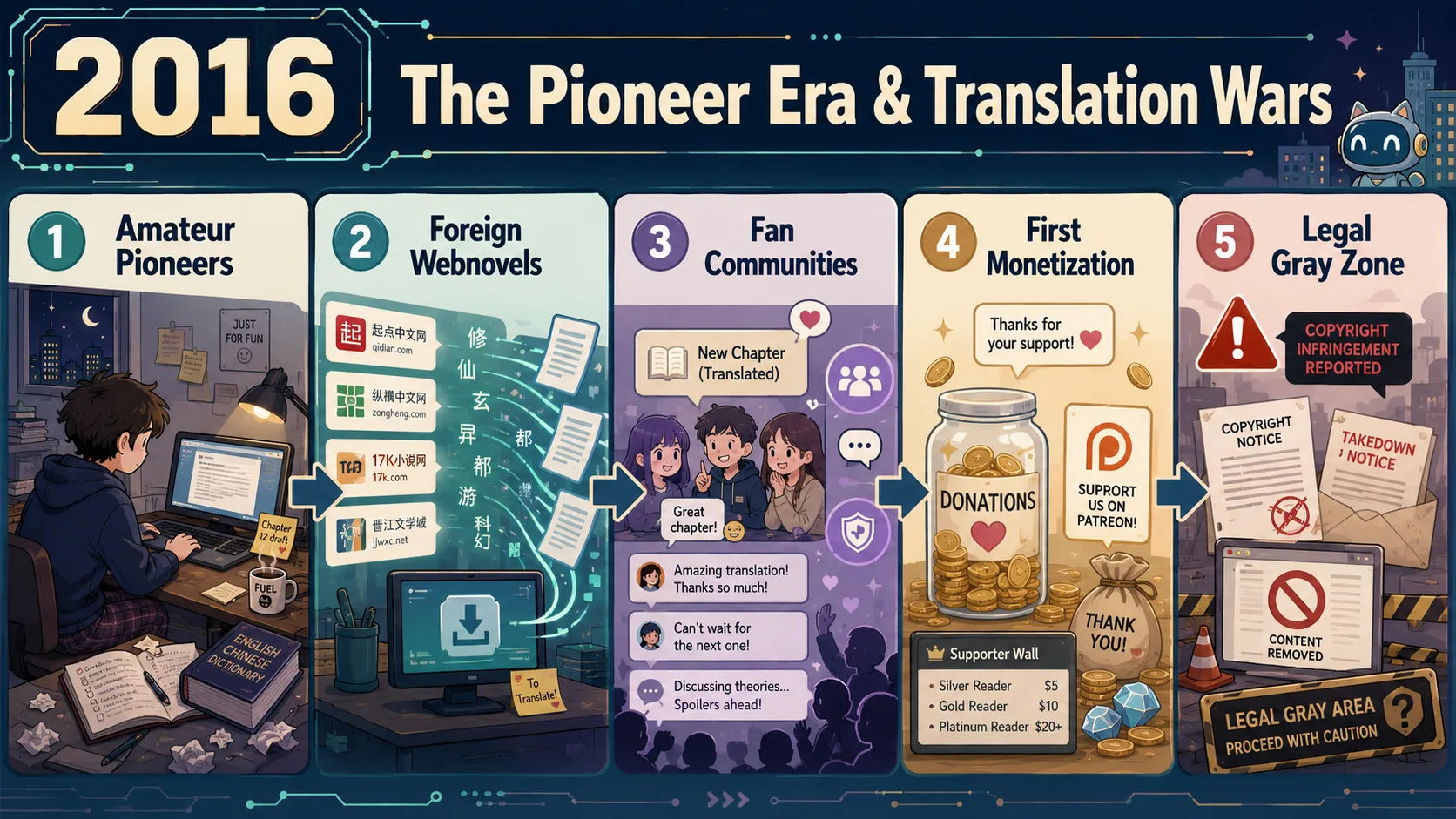
In the 2015 Genesis Era, the primary economic engine of web fiction was the Sponsored Chapter.
A reader (or a group of readers) would donate a lump sum—usually between $40 and $80—to “Unlock” a new chapter. It was a simple, direct, and emotional transaction. But by mid-2016, this model was dead. It had been replaced by the recurring, predictable, and clinical subscription model of Patreon.
This was the era of The Death of the Sponsored Chapter, the moment the “Gift Economy” was finally swallowed by the “Subscription Economy.” It was a transition that made the industry more stable, but it also destroyed the unique “High-Stake” relationship between the translator and the donor.
—
Part 1: The Volatility of the Tip-Jar
The primary reason for the death of the sponsored chapter was Volatility.
In 2015, a translator’s income was entirely dependent on the whims of a few wealthy donors. One month, a “Whale” might donate $1,000 to clear a queue; the next month, that whale might disappear, leaving the translator with zero income.
This made it impossible for the hubs (Wuxiaworld, Gravity, etc.) to professionalize. They couldn’t hire full-time staff or sign long-term server contracts if their revenue fluctuated by 80% every month. They needed Recurring Revenue.
Patreon provided the “Smoothing” effect the industry needed. It allowed the hubs to see exactly how much money they would make next month. It turned “Donations” into “Projections.” By mid-2016, every major hub had “De-prioritized” the sponsored chapter in favor of Patreon tiers. The lump-sum donation became a relic of the amateur past.
—
Part 2: The “Queue Exhaustion” Crisis
The second factor was Queue Exhaustion.
As novels became more popular, the “Donation Queue” would often stretch to 100+ chapters. A translator who could only produce 14 chapters a week suddenly found themselves “Owed” to the community for the next two months.
This created a Psychological Debt Trap. The translator had already spent the money, but they still had to do the work. The pressure to “Clear the Queue” led to the first massive wave of Translator Burnout. They were no longer artists; they were “Debt-Slaves” to their own audience. Some translators would wake up to find $400 in their PayPal and feel dread instead of joy, because they knew it meant another 10 hours of grueling labor they hadn’t planned for.
Furthermore, the queue model was Inflexible. If a translator got sick or had a family emergency, the “Sponsored Chapters” would just pile up. By the time they returned, they might owe 50 chapters—a backlog that would take months to clear. This lack of “Life-Balance” was the primary reason the veteran translators of 2015 began to retire in 2016. They were trading their health for $50 increments, and the math simply didn’t work long-term.
Patreon solved this by separating “Payment” from “Output.” In the Patreon model, you paid for access to the current chapters, not to unlock a specific future chapter. It removed the “Debt” from the translator’s shoulders and replaced it with a “Subscription Duty.” It was a subtle shift, but it fundamentally changed the power dynamic. The donor was no longer a “Sponsor” of a specific act of labor; they were a “Subscriber” to a continuous service.
—
Part 3: The “Free-Rider” Resentment
The sponsored chapter model suffered from a massive Free-Rider Problem.
One person would pay $50, and 50,000 people would read the chapter for free. Over time, this created a sense of resentment among the donors. They felt like they were “Subsiding” the entire community while receiving no exclusive benefit other than a “Thank You” at the top of the chapter.
Patreon introduced the “Advanced Chapter” Tier. For the first time, the people who paid got to see the content before the people who didn’t. This “Gatekeeping” was the ultimate killer of the sponsored chapter. Why would you donate $50 to unlock a chapter for everyone, when you could pay $5 to read 10 chapters ahead of everyone else?
The economy shifted from “Community Philanthropy” to “Individual Advantage.” This shift was the engine of the 2016 revenue explosion, but it also fractured the community into “Whites” (Free readers) and “VIPS” (Paying readers), a class system that would define the industry for the next decade.
—
Part 4: The “Official” Transition—Corporate Acceptance
When Qidian and other corporate entities looked at the western market in 2016, they saw the Sponsored Chapter as a “Piracy Red Flag.” It looked like someone was selling their IP one piece at a time.
The Patreon Model, however, looked like a “Membership Club.” It was easier for corporate lawyers to ignore (or eventually co-opt). By moving toward recurring subscriptions, the fan-community was inadvertently making itself more “Digestible” for the corporate giants. They were building the very paywalls that Qidian would eventually take over in 2017.
The death of the sponsored chapter was the final step in the “Sanitization” of the Webnovel Economy. It removed the “Amateur Tip-Jar” aesthetic and replaced it with a professional “Monthly Service” aesthetic that prepared the audience for the “Spirit Stone” paywalls of the future.
—
Part 5: The “Whale” Burnout—The Loss of the Mega-Donors
In 2015, the industry was kept afloat by a handful of “Super-Whales”—individuals who would drop $500 or $1,000 in a single night. These were often wealthy professionals (engineers, doctors, or business owners) who simply loved the stories.
By late 2016, these Mega-Donors were burning out.
They realized that their massive donations weren’t actually “helping” the community; they were just creating an unsustainable work-pace for the translators. More importantly, as the industry professionalized, the “Special Treatment” that these donors received (like direct chat access to the translator) became harder to maintain. When the “Star” became a “Corporate Employee,” the personal bond that motivated the whale’s generosity was severed.
The whales didn’t go away, but they stopped “Sponsoring” and started “Subscribing.” This was a net-loss for the industry’s total revenue, as a $1,000 whale was replaced by a $50-a-month “Legendary Tier” subscriber. The economy became more Democratic, but the “Top-End” peak collapsed. This peak was what allowed niche, unpopular novels to survive; without the mega-whales, the industry began to ruthlessly cut anything that didn’t have mass-market appeal. The “Era of the Passion Project” was over, and the “Era of the Profitable Project” had begun.
—
Part 6: The Transition of NovelUpdates—From “Queue” to “Release”
The death of the sponsored chapter was most visible in the NovelUpdates UI.
In 2015, every novel listing featured a “Donation Bar” or a “Queue Count.” Readers would check NovelUpdates not just for the chapter, but to see how close the community was to the next “Unlock.” It was a collaborative game.
By late 2016, NovelUpdates began removing these bars. The listing shifted to a simple “Latest Release” and “Frequency” tracker. The Collaborative Goal was replaced by a Service Expectation. The readers stopped asking “How can we help the translator?” and started asking “Where is the chapter I paid for on Patreon?”
This UI change reflected the deeper psychological shift: the community was no longer a “Co-op”; it was a “Digital Convenience Store.” The excitement of the “Unlock” was gone, replaced by the sterile reliability of the automated release bot.
—
Part 7: The “Ghost Chapters” Scams—The Final Grift
As the sponsored model died, it experienced a final, dark evolution: The Ghost Chapter Scam.
A few unscrupulous “MTL” (Machine Translation) groups realized they could exploit the donation model one last time. They would launch a “Hot” new novel, set a low donation threshold ($20 per chapter), and collect thousands of dollars in a single week.
Once the money was in their PayPal, they would post ten low-quality chapters and then Vanish.
This grift was only possible because of the “Trust” that had been built during the 2015 Genesis. These scammers burned that trust to the ground. Every “Ghost Chapter” incident pushed more readers toward the “Safety” of the corporate apps like Webnovel.com, where they knew their money wouldn’t be stolen by a disappearing blogger. Piracy and scams were the unintended “Salesmen” for the corporate monarchy.
—
Part 8: The Legacy of the “Top Contributor”—A Forgotten History
Finally, we must remember the legacy of the “Top Contributor” credits.
In the 2015 era, every chapter was dedicated to the person who paid for it. “This chapter is brought to you by [Username]” was a badge of honor. It turned the reader into a patron of the arts.
By late 2016, these credits were disappearing. Patreon supporters were too numerous to credit individually, and the “Recurring” nature of the payment made it feel less like a “Gift” that deserved a public shout-out. The Individualism of the Genesis Era was being buried by the Anonymity of the Subscription Era.
*(The clock had struck midnight. The 2016 Era was over. The wild, chaotic, and beautiful world of the ‘Corporate Invasion’ was about to be replaced by the monolithic ‘Corporate Dominance’ of 2017. But the lessons of 2016 remain: the industry belongs to those who control the traffic, the technology, and the trust of the reader. As we move into 2017 – Chapter 41: The Wuxiaworld DMCA War, we enter the modern era of web fiction).*
—
Part 9: The “Last Sponsor” Story—A Dramatic Transition
There is a legend in the 2016 forums about the “Last Sponsor.” It was a user named AzureBlade who had donated over $10,000 to a mid-sized translation project throughout 2015.
In October 2016, when the project moved to Patreon, AzureBlade posted a heartbreaking message: “I’m happy you’re going to Patreon. It’s better for you. But I’m not signing up. I liked knowing that MY $50 made that chapter happen. I liked that we were a team. Now, I’m just User #42 on a recurring bill. It feels like our friendship just became a subscription.”
AzureBlade never commented again. This story summarizes the spiritual cost of the 2016 economic shift. We gained stability, but we lost the Shared Adventure. The industry became a “Business,” and in doing so, it became slightly more efficient and significantly more lonely. It was a trade-off that the creators had to make to survive, but it left a void in the community that would never be fully filled.
—
Part 4.1: The Mathematics of the Debt Spiral
The “Sponsored Chapter” model was the original financial engine of the independent translation scene (pre-dating Patreon), but by late 2016, it had mutated into a psychological torture device for the creators.
The premise was simple: The translator promised a “base rate” of free chapters per week (e.g., 5 chapters). If the community collectively donated a specific amount of money (e.g., $80) into a PayPal pool, the translator would translate and release one “Bonus” chapter.
Initially, this worked flawlessly. But as the audience grew from ten thousand readers to fifty thousand readers, the velocity of the donations completely outstripped the physical biological limits of the human translator.
The Toxic Queue
A top-tier translator might wake up on a Monday morning to find that their community had donated $1,600 overnight. According to the contract, the translator now owed the community 20 Sponsored Chapters.
But the translator was already struggling to output the base rate of 5 chapters a week. They physically could not translate an additional 20 chapters. So, the 20 chapters went into “The Queue.”
The Queue was a public-facing ledger on the translator’s website showing exactly how much “debt” they owed the community. As the novel grew in popularity, the Queue began to spiral out of control. It was not uncommon for a popular Wuxiaworld translator in 2016 to have a Sponsored Chapter Queue of 150 chapters, representing over $12,000 in unfulfilled labor.
This created an absolutely toxic, high-stress relationship between the creator and the audience. The audience had paid for the chapters, and they felt legally and morally entitled to receive them immediately. The comment sections dissolved into endless, furious demands: “Where are the sponsored chapters? You took our money, you scammer. Translate faster.”
Part 4.2: The Quality Sacrifice and Burnout
Trapped under the crushing weight of the Sponsored Queue, the translators were forced to make a catastrophic choice: Default on the debt (which would destroy their reputation and trigger massive PayPal chargebacks), or sacrifice all semblance of quality and physical health to clear the Queue.
They chose the latter.
This was the absolute peak of the “Sleep Deprivation Meta.” Translators were pulling 16-hour shifts, heavily relying on caffeine and amphetamines, frantically typing out chapters to appease the mob. They stopped editing. They stopped localizing. They began relying heavily on raw Machine Translation (MTL) just to hit the word counts.
The prose deteriorated into barely readable, literal translations. But the community did not care about the prose; they only cared about the plot progression. The translators were being financially rewarded for producing absolute garbage, provided they produced that garbage at a machine-like pace.
Eventually, the human body simply failed. Late 2016 saw an unprecedented wave of “Translator Burnout.” Dozens of highly popular projects were abruptly abandoned as translators suffered physical and mental breakdowns, walking away from massive Patreon incomes because they simply could not look at another Chinese character without experiencing extreme anxiety.
Part 4.3: The Transition to the Paywall
The collapse of the Sponsored Chapter model forced the industry to completely redesign its financial infrastructure. The translators realized that accepting variable, infinite donations for fixed labor was a suicide pact.
They needed a system that capped their labor while maximizing their revenue. This realization catalyzed the absolute adoption of the Patreon Advanced Chapter Model.
Instead of promising to work harder when the audience paid them, the translators simply held the existing work hostage. The labor output (1 chapter a day) remained strictly fixed. The audience was no longer paying for more chapters; they were paying to skip the line and read the existing chapters early.
This was a masterful stroke of digital economics. A translator could earn $10,000 a month on Patreon while doing the exact same amount of work as a translator earning $0 a month. The financial extraction was decoupled from the physical labor.
The death of the Sponsored Chapter marked the end of the “Community Tip Jar” era and the beginning of the hyper-capitalist “Access Tollbooth” era that strictly defines the industry in 2026.
Part 5: Actionable Takeaways for the Modern Author
The transition of 2016 proves that stability is the prerequisite for scale.
1. Prioritize Recurring over Lump-Sum
Don’t build your career on “One-off” wins. Whether it’s a big book launch or a one-time donation, those events are spikes, not foundations. Build a recurring revenue stream (Patreon, Substack, Kindle Unlimited) that allows you to predict your income six months in advance. Stability allows you to take creative risks.
2. Value your “Buffer”
The sponsored chapter failed because it destroyed the “Buffer.” Never “sell” your future labor in a way that leaves you in debt to your audience. Maintain a healthy gap between what you have written and what you have released. Your buffer is your mental health insurance.
3. The Psychology of “Access”
Readers will pay more for “Access” (reading early) than they will for “Creation” (paying for you to write). In 2026, don’t ask people to “Support your Art.” Ask them to “Join the Inner Circle.” The desire to be “First” is a more powerful economic driver than the desire to be “Generous.”
4. Watch for “Subscription Fatigue”
While recurring revenue is great, the world of 2026 is reaching a saturation point (Chapter 34). To survive, you must ensure your subscription offers “Unique, Non-Reproducible Value.” If you are just a “Content Mill,” you will be replaced by a cheaper one. If you are a “Community Leader,” you are irreplaceable.
*(The Tip-Jar was empty, and the Subscription towers were rising. But as the money stabilized, the stories themselves began to mutate into something even more addictive. In Chapter 36: The OP Protagonist Dominance, we look at how the ‘Underdog’ died and the ‘God-Protagonist’ took over the front page).*
0 Comments