

2016 – 04 – The Translation Speed Wars
by EternalibChapter 24: The Translation Speed Wars—The Flesh Machine
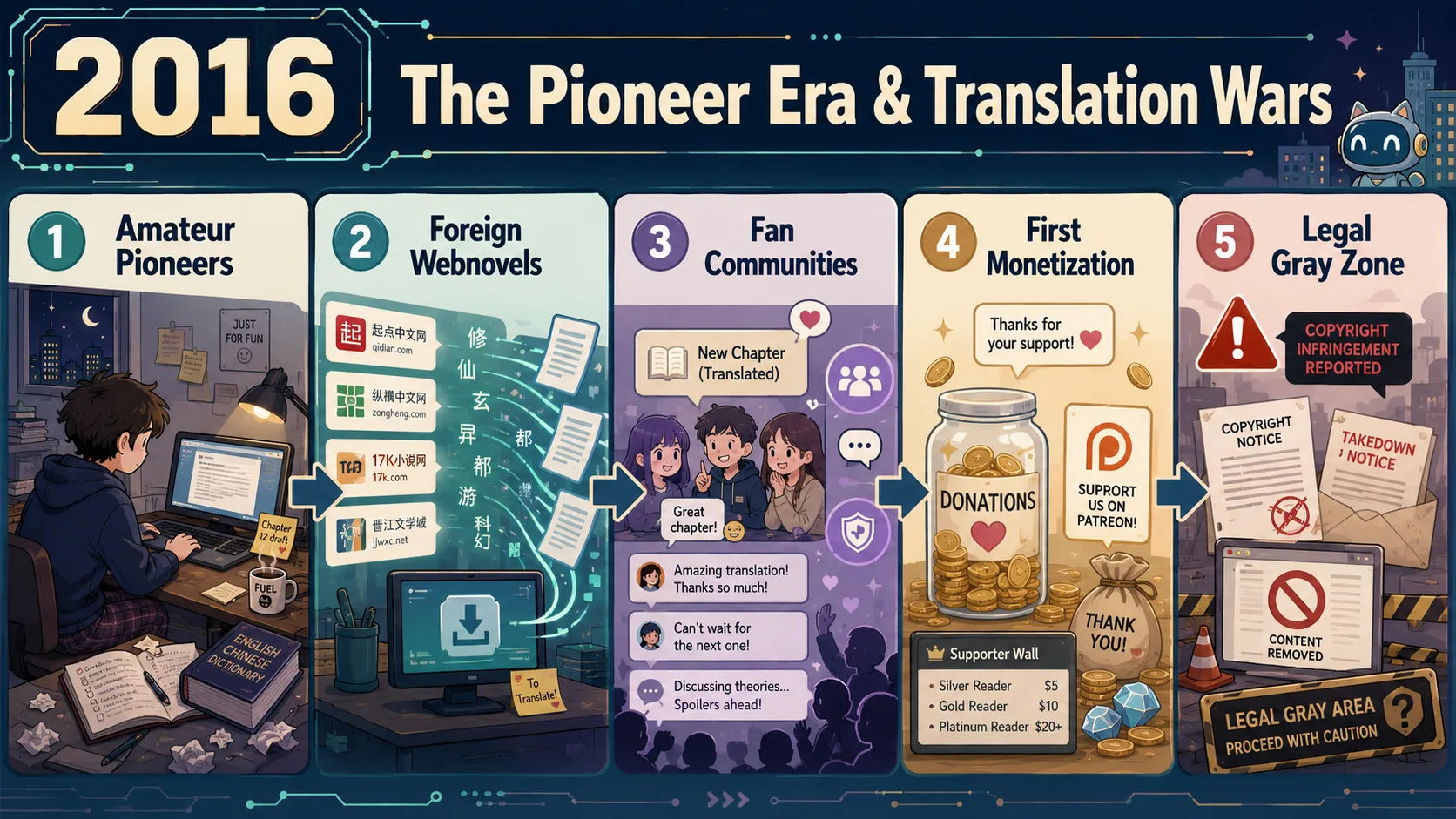
By the third quarter of 2016, the structural architecture of the independent web fiction ecosystem was fully locked into place. The Patreon Hybrid Model provided the financial engine, and the NovelUpdates directory provided the map.
But this highly optimized, hyper-capitalist infrastructure created a horrifying byproduct. It fundamentally altered the baseline expectations of the consumer.
Because the NovelUpdates algorithm exclusively rewarded the “Latest Releases,” and because Patreon subscribers explicitly paid for the right to read a continuous, unbroken stream of advanced chapters, the concept of a “weekly update” was entirely eradicated from the cultural consciousness.
The readers did not want a polished novel delivered once a year. They wanted their dopamine delivered every single day at exactly 5:00 PM EST.
To survive in this ecosystem, independent creators were forced into a brutal, unrelenting cycle of overproduction. This was the era of the Translation Speed Wars, a period where literary quality was entirely sacrificed on the altar of velocity, and the physical health of the translators was consumed as fuel for the algorithm.
—
Part 1: The Daily Upload Culture
Prior to 2016, translating a 3,000-word chapter of dense Chinese Xianxia or complex Korean LitRPG was a painstaking, highly respected process. Translators would spend hours researching specific Taoist idioms, ensuring the localization captured the poetic nuance of the original text. A release rate of three chapters a week was considered incredibly fast and was met with profound gratitude from the community.
The NovelUpdates algorithm completely annihilated this dynamic.
If a translator spent three days polishing a single chapter, they would appear on the NovelUpdates front page exactly once a week. They would be instantly buried beneath dozens of other translators who were uploading smaller, lower-quality chapters every single day.
The math was inescapable. To maintain algorithmic dominance and keep the Patreon funnel flowing, a creator had to upload daily.
* The Baseline: 1 chapter a day (7 chapters a week).
* The Competitive Edge: 2 chapters a day (14 chapters a week).
* The Extinction Event: 3+ chapters a day (21+ chapters a week).
Translators were suddenly forced to output between 15,000 to 30,000 words of translated text every single week. This is the equivalent of writing an entire, full-length commercial novel every single month, without a single break, indefinitely.
—
Part 2: The Discord Cartels
As the Speed Wars escalated, individual translators realized they could not physically survive the attrition alone. The translation process required raw translation, editing, proofreading, and uploading. Doing all of this for 14 chapters a week while maintaining a day job or attending university was a mathematical impossibility for a single human being.
To compete, the independent creators began forming massive, highly organized syndicates. These groups became colloquially known as the Discord Cartels.
Instead of a single translator operating a personal WordPress blog, groups of five to ten translators would band together, pool their resources, and launch a centralized website (similar to Wuxiaworld, but operating completely independently).
These Cartels operated with the ruthless efficiency of a corporate sweatshop.
They would find a highly anticipated Chinese novel with 3,000 raw chapters available. Instead of assigning the novel to one person, they would divide the novel among three different translators. Translator A would take chapters 1-50. Translator B would take chapters 51-100. Translator C would take chapters 101-150.
They would all translate simultaneously. Then, a dedicated editor would stitch the chapters together, homogenize the terminology so the readers wouldn’t notice the sudden shift in translation style, and schedule the chapters to automatically publish three times a day.
This allowed the Cartel to completely monopolize the NovelUpdates front page. A single website might release thirty chapters across ten different novels in a single day. Independent, solo translators were completely choked out of the algorithm; they simply could not match the raw industrial output of the syndicates.
However, the creation of these Cartels introduced a terrifying new dynamic to the community: Corporate Espionage and Sabotage.
Because these groups were fiercely competing for the exact same pool of Patreon Whales, the rivalry escalated far beyond friendly competition. The Cartels actively attempted to destroy each other. If one Cartel had a highly popular novel, a rival Cartel would intentionally translate the same novel but release their chapters five minutes earlier, explicitly to steal the NovelUpdates algorithm traffic. They aggressively poached editors and translators from each other, offering higher cuts of the Patreon revenue in secret Discord DMs.
Worse, the technical warfare became genuinely malicious. It became standard practice for rival Cartels to hire botnets to launch massive DDoS (Distributed Denial-of-Service) attacks against each other’s websites precisely during peak release hours (usually Friday evenings when Patreon updates dropped). By crashing a rival’s servers, they ensured that the addicted readers would wander over to their own functioning website for their daily fix. The translation community had fully transitioned from a collaborative fan-project into a ruthless, cutthroat digital mafia.
—
Part 3: The Burnout Epidemic
The human body is not designed to sit at a desk, staring at two monitors, translating Chinese characters into English for sixteen hours a day, seven days a week.
As the Speed Wars raged through late 2016, the ecosystem experienced a terrifying, widespread Burnout Epidemic.
Translators were not just getting tired; they were suffering severe, life-altering medical events. The sheer volume of typing required to hit a 30,000-word weekly quota led to rampant, debilitating Repetitive Strain Injury (RSI) and Carpal Tunnel Syndrome. Translators were frequently forced to go on hiatus simply because they physically could not move their hands without agonizing pain.
Furthermore, the psychological toll of the Patreon Backlog Trap (detailed in Chapter 26) compounded the physical exhaustion. Translators were functioning on three hours of sleep a night, terrified that if they stopped translating to rest their hands, their 20-chapter buffer would shrink, their NovelUpdates rating would tank, and their $10,000-a-month income would vanish overnight.
“I woke up on my keyboard again. It’s the third time this week. My right wrist is wrapped in a brace, but I have to finish Chapter 412 before the 5 PM deadline or I lose my spot on the NU trending list. My readers in the Discord are already asking where the chapter is. I haven’t seen my friends in two months. The money is incredible, but I think I am actually, literally dying.”
— Leaked Discord Log from a Cartel Translator, December 2016
The community began to normalize this horror. Readers would frequently joke about locking their favorite translators in “basements” to force them to translate faster. It was a meme, but it reflected a deeply toxic, parasocial reality: the audience viewed the creators as content-dispensing machines, completely divorced from their humanity.
—
Part 4: The Quality Collapse and the Rise of MTL
When speed becomes the absolute, overriding metric of success, quality is mathematically impossible to maintain.
As the quotas increased, translators began cutting every possible corner just to survive the daily upload schedule. They stopped researching complex cultural idioms. They stopped editing for narrative flow. They simply translated the words as literally and as rapidly as possible.
This desperation birthed the widespread integration of Machine Translation (MTL) into the independent ecosystem.
Prior to 2016, using Google Translate to translate a Chinese web novel was considered an absolute taboo. The software was primitive, and the resulting text was a completely illegible, grammatically destroyed nightmare.
However, during the Speed Wars, translators realized they didn’t need the software to produce perfect English; they just needed it to do the heavy lifting of the initial syntax parsing. A translator would dump the raw Chinese chapter into an MTL program, receive the garbled English output, and then quickly “edit” the English into something vaguely readable.
This process was known as Machine-Assisted Translation. It allowed a translator to double their output from one chapter a day to two chapters a day.
The psychological shift caused by Machine-Assisted Translation was devastating to the underlying social contract of the community. In 2014, a translator was treated with profound respect—they were viewed as a vital, irreplaceable cultural bridge. By late 2016, that prestige had completely evaporated. The audience realized the translators were essentially just human spell-checkers running sweatshop-level copy-paste operations through Google.
This loss of prestige directly eroded any remaining moral hesitation the audience felt regarding piracy. The readers reasoned that if the translator wasn’t actually putting in the hard, intellectual labor of translating the prose from scratch, why should they get paid $15,000 a month? If the product was just garbage, synthetic machine-text wrapped in a Patreon paywall, there was absolutely no moral failing in using aggregator sites to pirate the chapters for free. The translators had traded their cultural authority for raw algorithmic velocity.
The quality of the prose across the entire ecosystem plummeted. Sentences became stilted, repetitive, and devoid of any emotional nuance. Pronouns were frequently completely incorrect (the MTL would constantly confuse “he” and “she”). But the brutal reality of the 2016 market was that the readers simply did not care.
The readers were addicted to the pacing, the cliffhangers, and the dopamine rush of the power progression. As long as they could generally understand that the protagonist had successfully slapped the Arrogant Young Master, they were perfectly willing to read completely broken, machine-generated English.
This apathy toward prose quality was the final, fatal blow to the traditional craft of translation. It proved to the corporate giants like Webnovel that they did not need to hire expensive, highly skilled human translators. They just needed an algorithm and a cheap editor. The independents had inadvertently proven that synthetic content was economically viable.
—
Part 4.1: The Industrialization of the Human Translator
To fully appreciate the brutality of the Translation Speed Wars, one must analyze the physical and psychological toll exacted upon the human translators. In traditional publishing, a professional translator might translate one novel a year. In the web fiction ecosystem of 2016, a translator was expected to output the equivalent of a full novel every single month.
The algorithmic demands of NovelUpdates (which rewarded frequency above all else) combined with the extreme financial incentives of the Patreon Hybrid Model created a hyper-capitalist pressure cooker.
Translators were trapped in a permanent state of production. They could not take weekends off, because weekends were the highest-traffic periods. They could not take holidays off, because missing a Christmas release would cause a massive drop in Patreon subscriptions. The audience felt they were paying for a utility, like electricity or water. If the tap shut off, the audience became furious.
The Sleep-Deprivation Meta
The human body is simply not designed to stare at raw Chinese text for twelve hours a day, rapidly converting it into passable English prose without a break. By mid-2016, severe Repetitive Strain Injury (RSI) became an epidemic among the top-tier translators. Carpal tunnel syndrome was practically a badge of honor.
Translators began operating on polyphasic sleep schedules. If a translator was competing with a rival group to release the exact same novel, the winner was the one who could release the chapter first. If the original Chinese author dropped the raw chapter at 3:00 AM EST, the Western translator had to be awake at 3:00 AM EST. They would frantically translate the chapter, operating on zero sleep, desperate to publish their English version before the rival group published theirs.
If they published first, they secured the thousands of organic clicks on the NovelUpdates homepage. If they published second, they got absolutely nothing. The translation process ceased to be an act of literary adaptation; it became a hyper-competitive, sleep-deprived typing test where the loser faced instant financial ruin.
Part 4.2: The Rise of Machine Translation (MTL)
The physical limitations of human typing speed inevitably led to the most controversial and destructive technological shift of the 2016 era: The adoption of Machine Translation (MTL).
Initially, MTL (using primitive tools like Systran or early Google Translate) was viewed as a horrific taboo. The prose output was virtually unreadable—a disjointed mess of incorrect pronouns, shattered grammar, and literal translations of complex Chinese idioms (e.g., translating “having eyes but failing to recognize Mt. Tai” into literal gibberish).
But the sheer speed of MTL was undeniable. A human translator took two hours to carefully adapt a 3,000-word chapter. A machine took three seconds.
Desperate to win the Translation Speed Wars, less scrupulous translation groups began quietly integrating MTL into their pipelines. They would run the raw Chinese text through Google Translate, and then hire cheap, native English speakers (who did not know a single word of Chinese) to rapidly “smooth out” the broken English so it was barely readable.
This was the birth of the “MTL + Editor” pipeline.
The Quality vs. Velocity Paradox
The traditional, high-quality translators warned the community that this practice would destroy the medium. They argued that MTL completely obliterated the nuance, humor, and cultural context of the original works.
But the audience did not care.
The biological imperative of the dopamine loop had completely overridden the desire for literary quality. The readers were so deeply addicted to the progression mechanics of the narrative—they desperately needed to know if the protagonist achieved the next cultivation realm—that they were perfectly willing to read mangled, machine-generated gibberish if it meant they got the chapter today instead of tomorrow.
This created a horrifying paradox for the skilled translators: Why spend two hours carefully translating a chapter for an audience that will happily consume an instant machine-translated version? The algorithmic market actively punished quality and exclusively rewarded velocity.
Part 4.3: The Aggregator Theft Escalation
As the Translation Speed Wars accelerated the output of the ecosystem, the Aggregator Epidemic (the scraper bots detailed in earlier chapters) reached terminal velocity.
The aggregators did not care if the translation was high-quality human prose or mangled MTL. They only cared that it existed. The instant a translator hit “Publish” on their WordPress site, a bot would scrape the text and publish it on a pirate site within milliseconds.
This forced the independent translators into a brutal, unwinnable technological arms race.
Translators began implementing draconian anti-scraping measures. They used custom JavaScript to block right-clicking. They embedded hidden, zero-pixel tracking images within the text to identify which aggregator was stealing their content. Some translators even began uploading their chapters as massive, un-copyable .png image files, forcing the readers to read the text off an image just to thwart the scraper bots.
These defensive measures absolutely ruined the User Experience (UX) for legitimate readers. Mobile readers could not highlight text; visually impaired readers could not use screen readers. But the translators were desperate to protect their ad-revenue from the scraping armies.
The Poison Pill Strategy
When defensive coding failed, translators resorted to the “Poison Pill.”
Translators would intentionally release the first version of their chapter filled with violent, explicit insults directed at the aggregator websites, hidden within the HTML tags or disguised as regular text. The bots would scrape this “poisoned” text and publish it instantly. The translator would then quietly edit their own site five minutes later with the clean, actual text.
The readers on the pirate sites would suddenly find themselves reading chapters that abruptly screamed, “IF YOU ARE READING THIS, THIS WEBSITE IS STEALING FROM ME, GO TO WUXIAWORLD.”
While effective at harassing the pirates, it was an exhausting, deeply cynical war of attrition. The translators were spending 50% of their time translating, and 50% of their time fighting a shadow war against automated scripts. It was unsustainable.
Part 4.4: The Inevitable Corporate Intervention
The chaos of the Translation Speed Wars, the proliferation of terrible MTL, and the rampant piracy created the perfect justification for the corporate leviathans to finally act.
From their boardrooms in Shenzhen, the executives at China Literature watched the Western independent ecosystem tear itself apart. They saw a multi-million-dollar market operating entirely on stolen intellectual property, driven by amateur translators who were burning out and resorting to machine translation just to survive algorithmic pressure.
The independents had built the market, but they were fundamentally incapable of stabilizing it. They lacked the central authority, the legal infrastructure, and the capital to enforce order.
This systemic chaos provided China Literature with the exact narrative they needed. When Webnovel.com finally launched its aggressive, fully funded western expansion in 2017, they did not position themselves as corporate invaders. They positioned themselves as the saviors of the medium. They promised high-quality, legally licensed, officially sponsored translations. They promised to use their massive legal departments to crush the aggregators.
The Translation Speed Wars proved that the independent era was a glorious, highly lucrative, but fundamentally flawed experiment. The ecosystem was begging for stabilization, completely unaware that the stabilization would come at the absolute cost of their independence.
Part 5: Actionable Takeaways for the Modern Author
The Translation Speed Wars established the absolute baseline expectations for serialization that persist to this day. If you are an original author launching a novel on Royal Road or Amazon Kindle Vella in 2026, you are operating in the direct aftermath of this conflict. You must understand the velocity required to survive.
1. You Cannot Beat the Algorithm With Polish
If you spend two weeks writing the most beautifully polished, structurally flawless 5,000-word chapter in the history of fantasy literature, you will lose to the author who wrote five mediocre 1,000-word chapters in five days. Serialized platforms reward recency. You must permanently adjust your writing process. Lower your standard for absolute perfection, increase your output speed, and rely on pacing rather than prose.
2. The Danger of the Sprint
The authors who make $20,000 a month on their first novel almost always burn out and disappear within a year because they try to maintain a “launch speed” forever. You can write 10,000 words a week for a month to dominate the algorithms, but you cannot do it for a year. You must establish a sustainable, long-term cruising speed (e.g., three chapters a week) and strictly train your audience to accept that schedule. If you promise daily chapters, you are signing your own physical death warrant.
3. Build Your Own Cartel
You cannot do everything alone. If you are writing, editing, formatting, marketing, managing a Discord server, and handling customer support for Patreon refunds, you will burn out. Modern successful authors operate as small businesses. You must use the income from your Patreon to hire editors, community managers, and beta readers to offload the administrative burden. You must build your own infrastructure to survive the attrition.
4. Protect Your Physical Hardware
RSI and Carpal Tunnel are not jokes; they are career-ending injuries. If you are typing 15,000 words a week, you must treat your body like a professional athlete. Invest heavily in an ergonomic split keyboard, an expensive, highly supportive chair, and dictate software if necessary. If your hands break, your income permanently stops.
*(The speed wars were pushing translators to the brink, but while the Western scene was professionalizing, the source of the content was about to explode. In Chapter 25: The Chinese Author Rebellion, we look at the moment the creators in China realized their work was being monetized without their consent).*
0 Comments