

2016 – 06 – The Custom Engine Pivot
by EternalibChapter 26: The Custom Engine Pivot—The Death of the WordPress Era
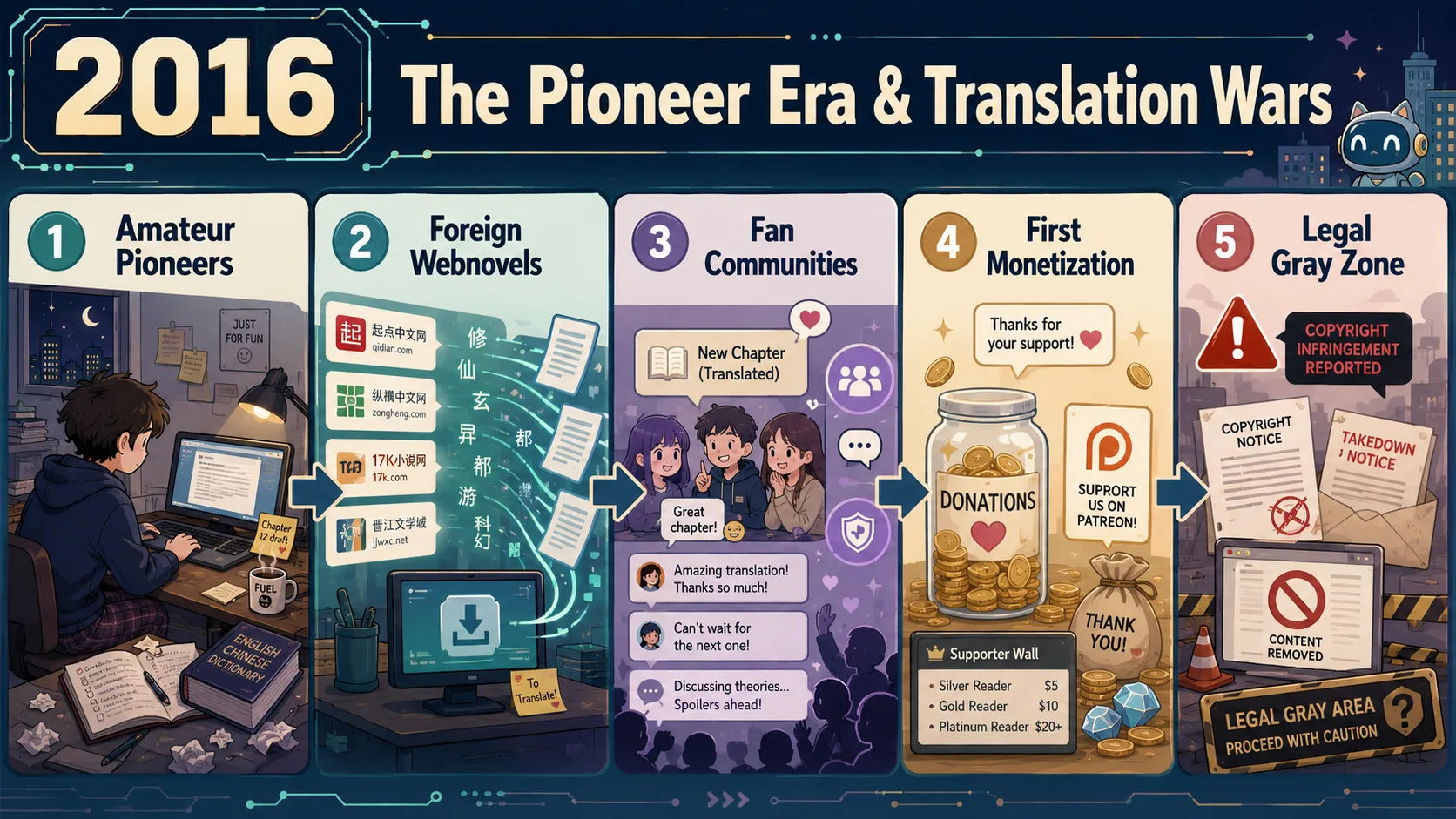
By mid-2016, the “Wild West” was undergoing a silent, expensive, and technically complex revolution. The amateur days of translating a novel on a free WordPress.com blog were effectively over. The translation hubs that had dominated the 2015 Genesis Era—Wuxiaworld, Gravity Tales, and Volare—were no longer just groups of fans; they were high-traffic media entities competing for a finite amount of reader attention and a massive amount of Patreon capital.
The problem was that the infrastructure they were built on was failing.
In 2015, WordPress was a godsend. It was free, it was easy to set up, and it allowed a translator to focus on the prose rather than the code. But by 2016, the scale of the traffic was crushing these primitive tools. A single “Advance Chapter” release on a Friday evening would frequently draw 50,000 concurrent users to a single site. Free plugins would conflict, databases would lock up, and the sites would crash for hours.
To survive, the industry had to professionalize. This was the era of the Custom Engine Pivot, a period where the leading hubs spent tens of thousands of dollars on custom-coded reading platforms, transforming the web fiction experience from a messy hobby into a slick, Silicon Valley-style product.
—
Part 1: The Infrastructure Debt
To understand the Custom Engine Pivot, you have to understand the sheer technical fragility of the early translation scene. Most sites were running on “Shared Hosting” plans that cost $10 a month. These servers were designed for small business blogs or personal portfolios, not for a global audience that was clinically addicted to refreshing a page every thirty seconds to see if a chapter had dropped.
The Infrastructure Debt was the hidden cost of the 2015 explosion. Because the growth had been so rapid, the translators had never taken the time to build a robust foundation. They were using “Table of Contents” plugins that took twenty seconds to load, and their “Dark Mode” was often just a CSS hack that broke half the formatting.
Worse, the “Friday Crash” was no longer just an annoyance; it was a symptom of a systemic collapse. In late 2016, the top-tier hubs were seeing traffic spikes that rivaled mid-sized news websites. When a popular novel like I Shall Seal the Heavens released a massive “Sponsored Chapter” batch, the sudden influx of 100,000 simultaneous requests would trigger a “cascading failure.” The database would hit its connection limit, the server would run out of RAM, and the site would simply stop existing for everyone on earth.
The costs of fixing this were astronomical for a fan-project. Moving from a $10 shared hosting plan to a dedicated, load-balanced AWS (Amazon Web Services) cluster meant jumping from $120 a year in overhead to $1,500 a month. For a solo translator making $5,000 a month on Patreon, a $1,500 “server tax” was a terrifying prospect. It was the moment many realized that they weren’t just “writing on the internet”—they were running a high-availability tech company.
“We were using a free WordPress theme meant for food bloggers. When Deathblade dropped the Chapter 600 batch, the site didn’t just go down; the database literally corrupted. I spent fourteen hours straight on a Skype call with a developer in Romania just trying to recover the user comments. I realized then that if we didn’t build our own platform, we were going to lose everything to a single database error.”
— Anonymous Hub Administrator, October 2016
The realization was brutal: If you didn’t own the code, you didn’t own the audience.
—
Part 2: The Psychology of the Domain
In the early years, a translator’s URL was almost always something.wordpress.com or something.blogspot.com. To the casual observer, this was a minor detail. To the sophisticated “Whale” reader who was prepared to spend $50 a month on advance chapters, it was a red flag.
In 2016, the Psychology of the Domain became a major factor in monetization. A standalone domain (e.g., wuxiaworld.com or gravitytales.com) signaled a level of permanence and security. It told the reader that this was a legitimate business, not a fly-by-night fan project that would disappear the moment the author got bored or received a legal threat.
The hubs began investing heavily in “Premiumization.” They weren’t just buying domains; they were building brand identities. They hired professional designers to create logos and UI layouts that mimicked the clean, professional look of the Amazon Kindle or the early Qidian apps.
This branding served a dual purpose. First, it justified the high Patreon prices. It’s easier to ask for $20 a month if the reading experience feels like a luxury service. Second, it acted as a “Trust Dividend.” When a reader entered their credit card information into a site, they wanted to feel like their data was being handled by professionals, not by a teenager in a dorm room using a free WordPress theme. This was the era where the HTTPS Padlock became a marketing feature. If your site didn’t have a secure connection, readers assumed you were a pirate site or a phishing scam. Professionalism wasn’t just an aesthetic; it was a prerequisite for survival.
—
Part 3: The Feature Arms Race
Once the custom engines were launched, the industry entered a frantic Feature Arms Race. The hubs realized that they couldn’t just offer the text; they had to offer “The Experience.”
Because they were no longer limited by the constraints of WordPress plugins, developers (often recruited from the community itself) began building highly specialized reading features that the mainstream publishing world wouldn’t adopt for another five years:
1. Native Reading History: The ability for a site to remember exactly which paragraph you were on, across multiple devices. This seems basic today, but in 2016, it was a miracle. It removed the “Friction of the Search.”
2. Sophisticated Dark Modes: Not just a black background, but “Sepia,” “Midnight,” and “OLED Black” modes designed for long-term eye health.
3. Gamified Comment Sections: Integrating “Points,” “Badges,” and “Levels” directly into the site to encourage user engagement. This turned reading into a social sport.
4. Advanced Chapter Automation: Building internal “Backends” that could automatically handle the release of chapters to specific Patreon tiers, removing the manual labor of “copy-pasting” passwords into WordPress posts.
The math was clear: Features equaled retention. A reader who had a 500-day “Reading Streak” on a specific site was significantly less likely to abandon that site for a rival. The platform itself was becoming a “sticky” product, separate from the novels it hosted.
—
Part 4: The Developer Tax
This professionalization came with a massive, hidden cost: The Developer Tax.
Running a custom site meant you couldn’t just rely on a $10/month hosting plan. You needed VPS (Virtual Private Servers), CDNs (Content Delivery Networks) like Cloudflare, and—most importantly—you needed to pay developers to maintain the code.
Top-tier developers who understood the specific needs of a high-traffic reading site were rare and expensive. Many hubs were spending 15% to 25% of their gross revenue just on server maintenance and technical staff. This was money that wasn’t going to the translators or the authors; it was going into the “Digital Pipes” of the internet.
This created a massive barrier to entry. The solo translator, who was still working on a free blog, found it impossible to compete with the feature set of the major hubs. The gap between the “Haves” and the “Have-Nots” widened into a chasm. The era of the “Independent Lone Wolf” was ending; you were either part of a professional hub with a dedicated tech team, or you were invisible to the algorithm.
—
Part 5: The Analytics Awakening—The Birth of Data-Driven Content
The final, and perhaps most impactful, result of the Custom Engine Pivot was the Analytics Awakening. For the first time, the hub owners didn’t have to guess what their readers liked; they could see the raw data.
Custom sites allowed for the integration of deep tracking tools. Hub owners could see exactly when a reader stopped reading a chapter. They could see which “Advance Chapter” tiers were the most popular and which novels had the highest “Retention Rate” from Chapter 1 to Chapter 100.
This data fundamentally changed the “Editorial” process. If the data showed that readers dropped off during a particularly slow “Training Arc” in a cultivation novel, the hub owners would pressure the translators to increase the release speed or even skip minor chapters to keep the “Engagement Curve” high.
It was the first time that web fiction was treated like a software product. The “Creative Process” was being mapped against “User Retention Data.” This paved the way for the corporate giants like Webnovel to eventually automate this process, using algorithms to dictate exactly what tropes an author should write based on what the data said “The Market” wanted. The “Art” of storytelling was being quantified, paragraph by paragraph.
“I remember looking at the Google Analytics dashboard for the first time on our new site. I could see 12,000 people reading the same chapter simultaneously. I could see them dropping off the moment a new character was introduced that they didn’t like. It was terrifying. We weren’t just translating stories anymore; we were managing a dopamine-delivery system.”
— Former Lead Developer for a 2016 Translation Site
—
Actionable Takeaways for the Modern Author
The Custom Engine Pivot proved that in a digital economy, convenience is more valuable than content. If your site is hard to use, readers will pirate your work simply to get a better reading experience.
1. Own Your Infrastructure
If you are an author in 2026, never rely solely on a platform you don’t control. Use Royal Road and Webnovel for discovery, but always maintain your own professional website and your own mailing list. You must be able to move your audience if the platform’s terms change or if the site crashes. Owning your infrastructure is the only way to insulate your career against “Platform Enshittification”—the inevitable process where a site starts prioritizing its own profits over the creators who built it.
2. The UI is Part of the Story
A cluttered, ad-heavy, or “white-background-only” site is a barrier to entry. Your reading interface should be “invisible.” Invest in a clean, mobile-optimized UI that allows the reader to focus entirely on the prose. If the reader is fighting the website, they aren’t enjoying the book. In the modern era, “Dark Mode” and “Variable Font Sizes” are not luxury features; they are accessibility requirements. If you ignore them, you are effectively barring a significant portion of your audience from ever finishing your book.
3. Build Retention Features
Use your website to build a “Reading History” or a “Community Hub.” Give the reader a reason to visit your site every day that goes beyond just reading the new chapter. Engagement tools (comment sections, polls, character wikis) are what turn a casual reader into a loyal patron. The 2016 pivot proved that readers don’t just stay for the plot; they stay for the ecosystem you build around that plot.
4. Professionalism is a Marketing Strategy
A clean domain, a professional logo, and a secure-feeling checkout process are not “vanity” costs. They are signals of quality. If your brand looks amateur, the audience will assume your writing is amateur too. High-end branding justifies high-end pricing. When you treat your writing like a business, the audience treats you like a professional. This allows you to command higher Patreon tiers and sell more premium merchandise, because you have established a “Prestige Value” that solo, amateur bloggers simply cannot match.
5. Respect the Data, But Don’t Be Its Slave
The Analytics Awakening of 2016 was a double-edged sword. Use your data to understand where you are losing readers, but don’t let it dictate every narrative beat. If you write solely for the algorithm, you will lose the “Soul” of your story, and the audience will eventually sense the synthetic nature of the content. Use the data to fix the “Pipes” of your storytelling, but keep the “Water” pure.
*(The custom engines allowed the western hubs to survive the traffic explosions of 2016, but they also made them a much more attractive target for acquisition. As the western platforms professionalized, they finally caught the attention of the ultimate corporate predator. But before the corporate war began, a new wave of fiction arrived from the East. In Chapter 27: The Korean Infiltration, we explore the rise of the “System” and the end of the Chinese monopoly).*
Part 4.1: The Absolute Failure of WordPress
To understand the “Custom Engine Pivot,” we must understand the technical architecture of the early independent era. In 2015 and early 2016, 99% of all web fiction translation groups were hosted on WordPress.
WordPress was designed for bloggers writing a few articles a month. It was fundamentally not designed to host serialized web fiction serving 50 million page views a month to an audience of hyper-addicted teenagers who aggressively refreshed the page every three seconds.
By late 2016, the WordPress infrastructure for the major translation hubs (like Wuxiaworld and Gravity Tales) was collapsing under the weight of its own success.
The Database Bloat
Every time a user left a comment on a WordPress site, it was added to a massive, centralized MySQL database. Popular chapters routinely generated upwards of 3,000 comments within the first hour of release. This meant the database tables were expanding by hundreds of gigabytes. Whenever a reader requested a page, the server had to query this massive, bloated database to render the comments, causing server load times to skyrocket.
The Plugin Nightmare
Furthermore, WordPress relied on third-party plugins for core functionality. Translators used a specific plugin to manage their “Table of Contents,” another plugin to manage their “Dark Mode,” and a third plugin to manage their Ad-Sense placements.
These plugins were often written by amateur developers and were poorly optimized. As traffic scaled to tens of millions of views, a single inefficient MySQL query in a Table of Contents plugin would lock up the entire server, taking the website offline during peak reading hours. The translators, who were supposed to be translating, were spending 40 hours a week acting as amateur System Administrators, desperately trying to keep their WordPress installations from imploding.
Part 4.2: The Anti-Aggregator Architecture
Beyond the sheer server load, WordPress was technically defenseless against the Aggregator Epidemic (Chapter 24).
Because WordPress served content in standard, easily readable HTML templates, aggregator scraper bots could effortlessly parse the site, extract the chapter text, and instantly re-publish it on a pirate site. There was no native way in WordPress to implement the aggressive, dynamic anti-scraping measures required to survive the 2016 ecosystem.
The top-tier translation hubs realized that relying on a generic blogging platform was a structural weakness. If they wanted to survive the scraper bots, manage their massive traffic, and eventually build premium paywalls that didn’t rely entirely on Patreon, they needed to build their own bespoke software.
The Birth of the Bespoke Serial Hub
In late 2016, the major hubs began quietly hiring full-stack developers (often highly skilled readers from within their own communities) to build custom web applications from scratch, utilizing modern frameworks like Laravel, React, and Vue.js.
These “Custom Engines” were engineered from the ground up specifically for serialized web fiction.
1. Headless Architecture: They separated the front-end (what the user sees) from the back-end database, using fast API calls to render pages in milliseconds, drastically reducing server costs.
2. Dynamic Anti-Scraping: The custom engines could dynamically obfuscate the HTML of the chapter text. They could render the text using complex JavaScript canvases, or inject randomized invisible characters into the HTML DOM, completely breaking the standard regex scripts used by aggregator bots.
3. The Patreon Webhook Integration: Most crucially, the custom engines allowed for direct API integration with Patreon.
Part 4.3: The Advanced Chapter Integration
Before the Custom Engine Pivot, managing the “Patreon Hybrid Model” was a manual, administrative nightmare. If a reader paid $25 on Patreon, the translator had to manually grant that reader a password, or manually invite them to a private Google Doc to read the advanced chapters. This was entirely unscalable.
The Custom Engines allowed translators to build Native Paywalls.
By integrating the Patreon API via Webhooks, a reader could log into Wuxiaworld, click “Link Patreon Account,” and the custom engine would instantly verify their subscription tier. The website would then automatically unlock the correct number of advanced chapters directly on the site.
This created a frictionless, highly premium User Experience (UX). The reader no longer had to navigate clunky Google Docs or password-protected WordPress posts. They simply paid on Patreon, and the chapters magically unlocked on the main website.
The Death of the Small Independent
However, this technological leap created a massive barrier to entry.
In 2015, anyone could start a WordPress blog for $10 a month and compete with the top translators. By late 2016, if you wanted to compete, you needed a bespoke, API-integrated Laravel web application with aggressive anti-DDoS protection and dynamic anti-scraping infrastructure. You essentially needed a $50,000 corporate website.
The Custom Engine Pivot professionalized the ecosystem, but it also fundamentally killed the “Wild West” era. The independent translation scene was no longer a collection of scattered blogs; it had consolidated into three or four massive, highly technical, corporate-structured super-hubs.
They had built the infrastructure necessary to fight China Literature, but in doing so, they had become massive corporate entities themselves.
0 Comments