

2015 – 20 – The English Original Vacuum
by EternalibChapter 20: The English Original Vacuum—The Birth of the Modern Era
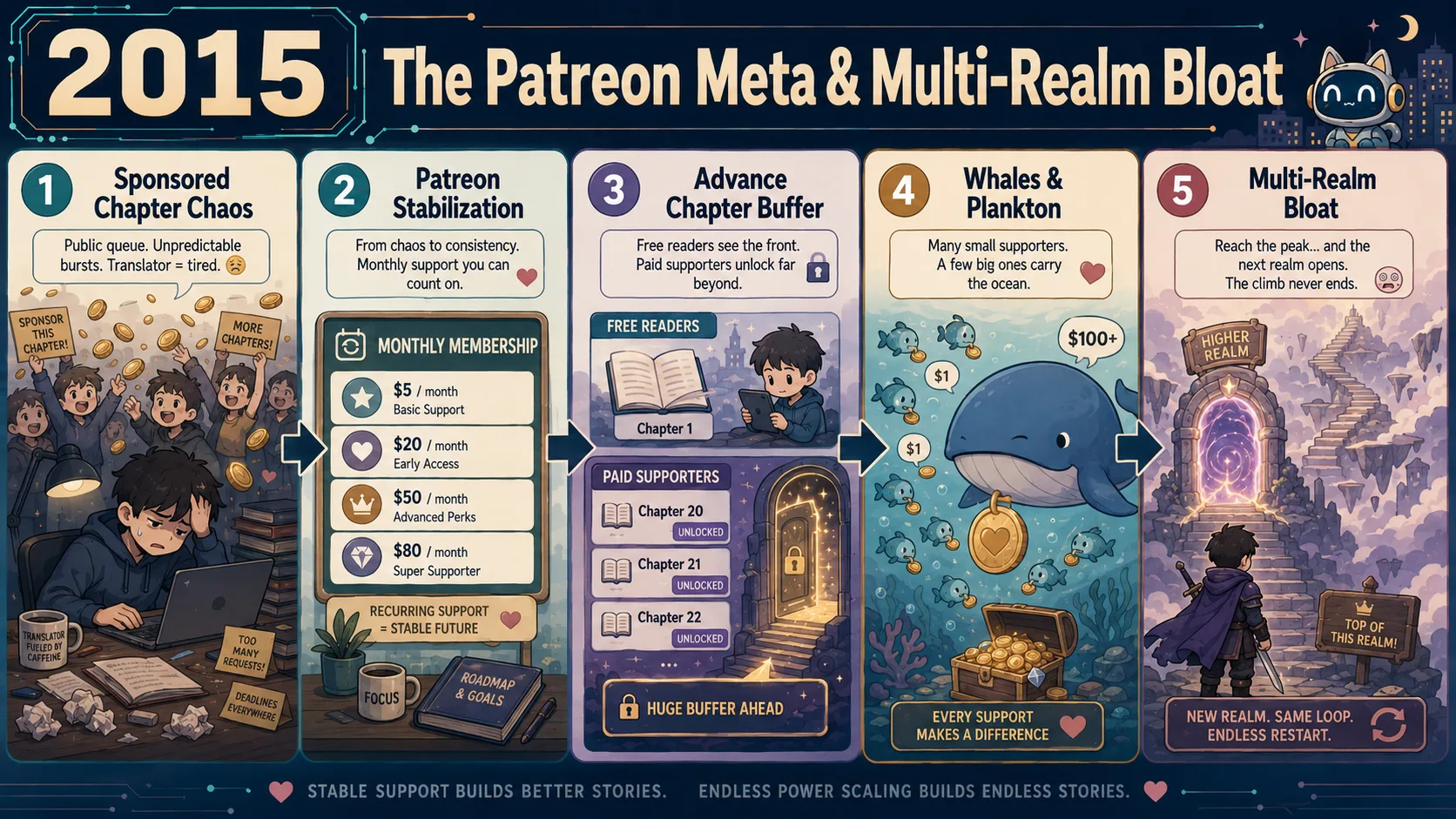
If you trace the timeline of the Genesis Era from 2014 to the end of 2015, the narrative is defined entirely by dependence. The western readership was completely dependent on amateur, overworked translators to provide the daily dopamine of progression fantasy. In turn, the translators were completely dependent on the apathy of the Chinese corporate giant, Qidian, to avoid massive international copyright lawsuits.
It was a highly lucrative ecosystem built entirely on a fragile, terrifying fault line.
As the Qidian Awakening loomed and the threat of the DMCA paralyzed the major translation hubs (detailed in Chapters 17 and 18), the underlying anxiety of the western community reached a breaking point. The readers recognized that their daily entertainment could vanish overnight. If Tencent decided to nuke Wuxiaworld tomorrow, the entire western pipeline of Cultivation novels would instantly dry up.
This terror birthed the most profound, permanent shift in the history of internet literature. The western audience looked at the massive, bloated, highly addictive Chinese Cultivation novels they were reading, analyzed the rigid, mathematical tropes that made them successful, and came to a stunning realization:
They didn’t need the translators. They didn’t need China Literature. They could just write the tropes themselves.
This was the creation of the English Original Vacuum, and it single-handedly constructed the modern era of web fiction.
—
Part 1: Deconstructing the Magic
The barrier to entry in traditional publishing is extremely high. Writing a critically acclaimed Western fantasy novel requires a deep understanding of complex prose, nuanced character psychology, and original, intricate world-building. Traditional publishers look for literary merit, thematic depth, and distinct authorial voices.
But as the western audience became deeply addicted to the pure Xianxia and LitRPG translations, they recognized that the barrier to entry for this specific genre was practically non-existent.
The Chinese Cultivation novels that dominated Wuxiaworld were not celebrated for their beautiful prose (especially when filtered through rough translations). They were celebrated for their Mechanical Architecture.
- The Cultivation tiers were just math (Qi Condensation, Foundation Establishment, Core Formation).
- The antagonists were generic, easily replicable archetypes (The Arrogant Young Master, The Corrupt Sect Elder).
- The plot was an infinitely looping cycle of being underestimated, finding a secret cheat, and violently humiliating the antagonist in public.
“I was sitting in the Wuxiaworld comment section complaining about the translation speed of ‘Martial God Asura,’ and I suddenly realized the plot was basically just a spreadsheet. The main character gets a power-up, goes to a new city, gets insulted, kills everyone, and moves to the next city. I literally thought, ‘I’m nineteen years old and I could easily write this myself.’”
— Archived Royal Road Author Confession, Early 2016
The western audience realized that the “magic” of the genre was not tied to its Chinese origins. The magic was the sheer, unrelenting escalation of power. And a teenager in Ohio could mathematically escalate power just as efficiently as an author in Beijing.
—
Part 2: The Original English Authors (OEL)
In late 2015, a massive cultural schism occurred. A demographic of highly addicted readers grew exhausted by the translation delays, the toxic community drama, and the looming corporate lawsuits, and they simply opened Microsoft Word.
They began writing their own progression fantasy novels. They completely stripped away the complex, deeply cultural Daoist philosophy of the Chinese originals, keeping only the highly addictive, mathematical mechanics: the stat screens, the cultivation realms, the endless power progression, and the brutal, active protagonists.
These were the Original English Light (OEL) novels.
When these early amateur authors posted their original works on forums like Royal Road (which had recently pivoted its infrastructure to support original content), the response was explosive.
The western audience devoured the English Originals for two massive reasons:
1. Cultural Resonance: The English authors inherently understood Western humor, pacing, and dialogue. The readers no longer had to struggle through clunky, heavily localized idioms. The protagonists felt relatable, often functioning as self-inserts for Western internet culture. The humor landed, and the dialogue didn’t sound like it was run through Google Translate. Furthermore, the readers experienced a profound sense of “Grammar Relief.” For years, the audience had conditioned themselves to ignore butchered syntax, misspelled words, and the endless repetition of translated phrases like “coughing up a mouthful of blood” or “eyes flashing with a cold light.” When they finally read an original English LitRPG, the sheer smoothness of native English prose—even if it was written by an amateur—felt like an incredible luxury. It fundamentally lowered the cognitive load required to read 3,000 words a day. It allowed the reader to completely lose themselves in the highly immersive power fantasy without constantly tripping over broken English sentence structures.
2. Legal Invincibility: If an author is writing an original story, there is no Chinese copyright holder to issue a DMCA takedown. The readers could donate to the author’s Patreon without the terrifying anxiety that the novel might be legally deleted from the internet tomorrow. The financial investment felt safe.
—
Part 3: The Mechanics of Catharsis
The early English authors quickly discovered that they didn’t just need to copy the Chinese tropes; they could optimize them for the Western palate.
In Chinese novels, the protagonist often succeeded through sheer ruthlessness and a heavily deterministic destiny (the ‘Mandate of Heaven’). Western audiences, however, craved the illusion of meritocracy and hard work. The English authors began blending the power-scaling of Xianxia with the numerical, skill-based progression of Western RPG video games (Skyrim, World of Warcraft).
This birthed the modern iteration of Western LitRPG. The protagonist didn’t just meditate to gain spiritual energy; they swung a sword ten thousand times to level up a specific “Swordsmanship” skill. The numbers went up, the dopamine hits were delivered, but the narrative felt distinctly westernized. The catharsis was immediate and deeply satisfying.
The authors also weaponized the cliffhanger. They adopted the Chinese strategy of ending chapters mid-battle or mid-revelation, perfectly conditioning the Royal Road audience to subscribe to Patreon to read the next five chapters instantly.
—
Part 4: The Royal Road Ascension
The success of the English Originals violently disrupted the power dynamics of the Genesis Era.
For two years, the translators had held an absolute monopoly on the genre. If you wanted to read progression fantasy, you had to read a translation. Suddenly, that monopoly was broken. A western reader could log onto Royal Road, find an original English LitRPG novel featuring the exact same addictive dopamine loops as a translated Cultivation epic, but with better grammar, faster release schedules, and absolute legal safety.
This was the exact moment Royal Road ceased to be a niche fan-fiction forum and violently mutated into the absolute titan of Western serialized fiction.
The money followed the safety. The massive “Whales” who had previously funded the translation Sponsored Queues began redirecting their PayPal donations to the Patreon accounts of the original English authors. They recognized that funding original creators was a sustainable investment, whereas funding gray-market translators was a highly volatile gamble.
By the end of 2015, the golden era of the translation monopoly was officially over. The translators had spent three years desperately Beta-testing a massive, highly lucrative financial ecosystem. But ultimately, they were merely the bridge. They successfully ferried the western audience across the ocean, trained them to demand daily serialized progression fantasy, and then watched helplessly as the audience walked off the bridge to build their own empire on Royal Road.
The Genesis Era was complete. The Modern Era had arrived.
—
Part 5: The First Royal Road Stars
When the dam broke and readers realized they could just write the tropes themselves, Royal Road transformed overnight. It wasn’t an immediate flood of masterpieces, but rather a frantic gold rush of experimental power fantasies. A few specific pioneers managed to perfectly capture the Cultivation/LitRPG dopamine loop, becoming the very first “Original English Light” (OEL) superstars to break the monumental 1,000-follower barrier.
While the exact follower counts are lost to archival decay, three foundational archetypes defined this early era:
1. The System Pioneer (e.g., The Arcane Emperor): This was the prototype for modern LitRPG. The author took the infinite power scaling of a Chinese Cultivation novel and explicitly mapped it onto a Western MMORPG interface. The protagonist didn’t meditate on the Dao; they looked at a glowing blue box that said [Swordsmanship Leveled Up]. It provided the exact same addictive progression but removed all the complex cultural friction.
2. The Subverted Isekai (e.g., The Zombie Knight Saga / Mother of Learning): While Mother of Learning originated slightly earlier on FictionPress before dominating Royal Road, it represented the intellectual evolution of the genre. Instead of a braindead protagonist punching through dimensions, authors began experimenting with extreme competence porn and time-loop mechanics. The progression wasn’t just physical strength; it was accumulated knowledge and flawless execution.
3. The Anti-Hero Power Fantasy (e.g., Forgotten Conqueror): Translators had trained the audience to love arrogant, ruthless protagonists. The early Royal Road stars capitalized on this by writing main characters who were unapologetically overpowered from chapter one. There was no tension regarding if the protagonist would win, only how violently they would humiliate the antagonist.
These authors proved that you didn’t need a corporate publishing deal to build an audience of ten thousand daily readers. You just needed to understand the mechanics of the dopamine loop.
—
Part 6: Actionable Takeaways for the Modern Author
The transition from translations to Original English Fiction is the foundational blueprint for how to succeed on modern serialization platforms.
1. Reverse-Engineer the Tropes
The authors who dominated the early days of Royal Road did not invent new genres. They simply analyzed exactly what made the Chinese translations successful (the power scaling, the Face-Slapping catharsis, the numbers-go-up psychology) and surgically transplanted those mechanics into Western settings. If you want to succeed today, find a highly popular, highly lucrative niche (like Otome Villainess, System Apocalypse, or Time-Loop Academy) and reverse-engineer exactly why the audience loves it. Strip the genre down to its mechanical dopamine loop, and build your original story entirely around that loop.
2. The Value of Linguistic Friction
Part of why Original English novels succeeded so rapidly was the removal of “Linguistic Friction.” Translators frequently bogged down the pacing by forcing the reader to learn twenty different Chinese martial arts terms or complex honorifics. When writing your own progression fantasy, ensure your world-building terms are immediately readable and conceptually obvious. If the reader has to check a glossary to understand how your magic system works, you have created friction, and they will drop the novel.
3. Owning Your Copyright is the Ultimate Leverage
The translators lost everything because they didn’t own the core IP. When you write an Original English novel, your copyright is your absolute, unbreakable shield. It allows you to transition your web serial into Kindle Unlimited, record it as an Audiobook for Audible, or launch a massive Kickstarter for hardcover prints. Never trade away your core IP for short-term virality on a corporate app. The ability to legally monetize your own creation across multiple platforms is the only way to build a sustainable, ten-year career in web fiction.
4. Audience Migration is Permanent
When the whales shifted their funding from translators to Original English authors, they never went back. Once an audience finds a more stable, higher-quality source for their specific niche, they migrate permanently. As an author, you must constantly maintain the quality and reliability of your releases, because if your audience finds another author providing the exact same dopamine hit but faster, they will abandon you.
(This concludes the 2015 Genesis Era sequence. The foundation has been built. The audience is addicted. The money is flowing. From here, the industry splinters into the highly localized, incredibly complex modern ecosystems of Royal Road, Scribble Hub, and the Paywall Empires).
0 Comments