2015 – 16 – The Multi-Realm Bloat
by Eternalib# Chapter 16: The Multi-Realm Bloat—The Economics of Infinity
If you want to understand why a standard Chinese Cultivation novel is three thousand chapters long, you cannot look at the author’s artistic vision. You must look at the author’s paycheck.
As established in Chapter 08, the foundational economic reality of the Chinese web fiction industry was the per-thousand-word compensation model. An author did not get paid for writing a cohesive, well-paced story with a definitive ending. They got paid purely for keeping the audience engaged in a state of perpetual, unresolved tension for as many literal years as mathematically possible. The longer the novel, the more Spirit Stones (the virtual currency of Qidian) they could extract from the readership.
This financial incentive structure collided violently with the psychological demands of the Western audience. As the readers demanded increasingly apocalyptic levels of power progression (the Wuxia Shift), the authors were forced to invent a narrative mechanism that allowed for infinite, God-tier escalation without actually breaking the plot or finishing the story.
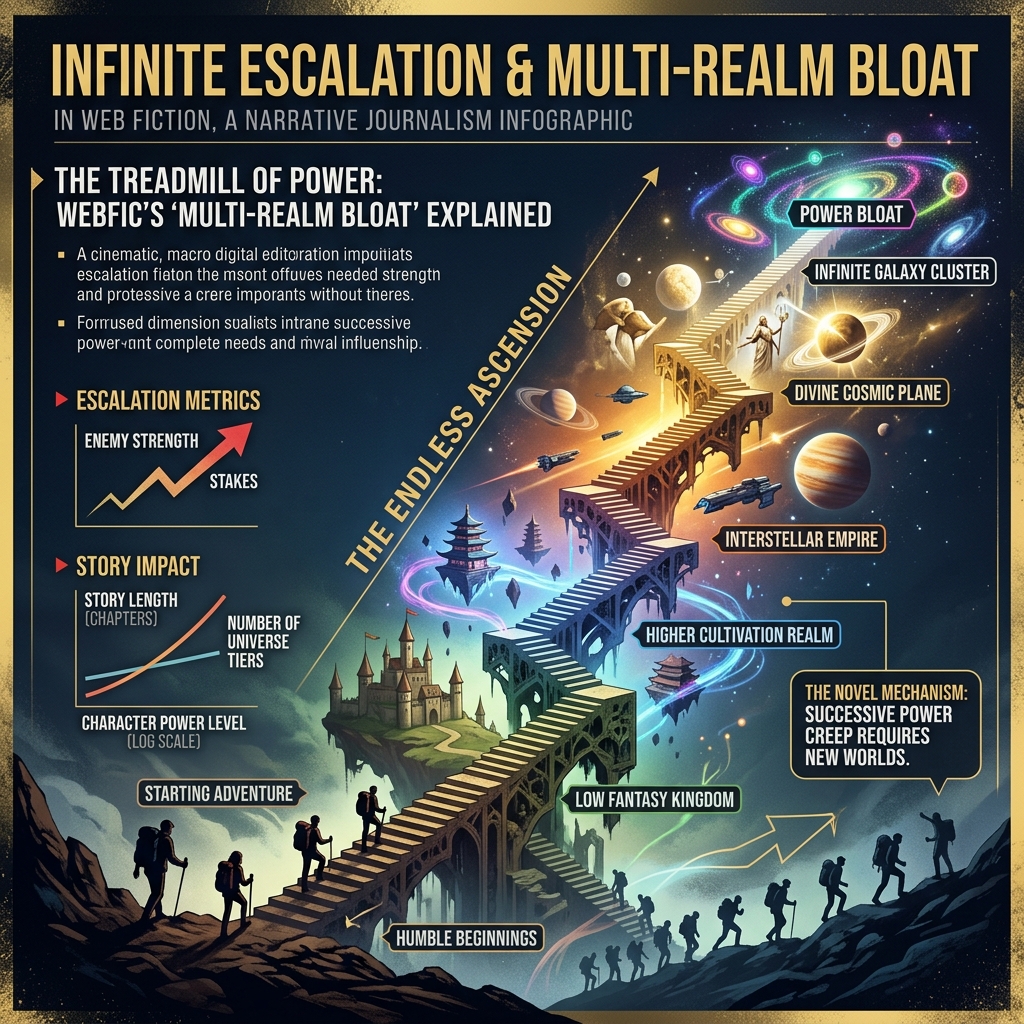
The solution they engineered was the Multi-Realm Ascension. It was a brilliant, highly addictive architectural loop that fundamentally broke the emotional stakes of the entire genre, transforming epic fantasy into an infinite treadmill of power escalation.
—
Part 1: The ‘Ascension Reset’ Mechanic
In a traditional Western fantasy novel, the protagonist starts weak, fights a series of increasingly difficult localized threats, and eventually defeats the Dark Lord to save the world. Once the Dark Lord is dead, the story mathematically has to end. The tension is resolved. The Hero’s Journey reaches its natural conclusion.
In the Cultivation genre, defeating the Dark Lord and saving the world is merely the tutorial.
Because the author needs the novel to continue generating daily revenue for another three years, they cannot let the protagonist remain the strongest entity in the universe. If the protagonist is invincible, there is no conflict. If there is no conflict, there are no cliffhangers. If there are no cliffhangers, the daily readership drops.
Therefore, the authors engineered a mandatory narrative reset. The mechanics of this reset became a rigid, almost bureaucratic trope across the entire 2015 translation ecosystem:
1. The Pinnacle: The protagonist spends 800 chapters slowly cultivating their power, engaging in brutal factional warfare, surviving assassination attempts, and eventually becoming the absolute, undisputed God of their mortal universe. They are completely invincible. They unify the continent and establish an eternal dynasty.
2. The Barrier: Having reached the absolute physical limit of their dimension, the protagonist discovers that the universe they inhabit is actually just a lower-tier “trash realm” in a much larger cosmic hierarchy. They utilize a secret, heaven-defying technique to physically shatter the boundary of space-time.
3. The Ascension: They “Ascend” to a Higher Realm (e.g., The Immortal Realm, The Divine Continent, The Upper Heavens).
4. The Reset: Upon arriving in the Higher Realm, the protagonist discovers that the “God-tier” power they wielded in the lower realm is considered absolute garbage here. A random farmer, a local town guard, or even a stray dog in the Higher Realm possesses more base spiritual energy than the protagonist.
The protagonist is instantly reverted to the absolute bottom of the food chain. All their unique abilities are suddenly common. All their legendary artifacts are useless trash. This allows the author to restart the entire 800-chapter “Face-Slapping” underdog cycle completely from scratch, while technically keeping the same protagonist.
—
Part 2: The Geography of Exhaustion
Initially, the Western audience found the Ascension Reset completely intoxicating.
When Linley Baruch (the protagonist of Coiling Dragon) ascended to the Infernal Realm, the readers were thrilled. It was a massive, terrifying new playground with higher stakes, stronger enemies, and completely new magical laws to exploit. It provided a massive dopamine rush of fresh progression, expanding the lore in a way that felt organic and necessary.
But as the translation ecosystem matured throughout late 2015, the structural reality of the Multi-Realm Bloat became agonizingly apparent.
The authors weren’t just ascending the protagonist once. Because the novels needed to reach three thousand chapters to maximize revenue, the protagonist would ascend from the Mortal Realm, to the Immortal Realm, to the Divine Realm, to the Chaos Realm, and finally to the Ancestral Origin Realm. Each realm was functionally identical to the last, just with a different color palette and a few extra zeros added to the power levels.
“I physically cannot care anymore. The MC just spent 400 chapters fighting the Blood Sect Patriarch to save his family. He finally kills him, ascends to the Higher Realm, and immediately gets beaten up by a local waiter at a restaurant because ‘the gravity in the Higher Realm is ten thousand times heavier.’ It completely invalidates the last 400 chapters of reading. I feel like I’m running on a treadmill. It’s the exact same plot, just copy-pasted into a new dimension.”
— Archived NovelUpdates Review, Late 2015
The readers began to recognize the artificiality of the loop. The infinite escalation fundamentally destroyed the narrative stakes.
The most devastating casualty of the Multi-Realm Bloat was the supporting cast. If the protagonist spends 200 chapters building an incredibly emotional, deep relationship with a supporting cast of friends, mentors, and romantic interests in the Lower Realm, that emotional investment is instantly obliterated the moment the protagonist Ascends. They leave all their friends behind because the friends are “too weak” to survive the dimensional travel. The protagonist effectively hits the reset button on their own emotional connections every 800 chapters, rendering the entire supporting cast completely disposable.
By the third ascension, the reader knows better than to care about any new characters introduced, because they know those characters will simply be abandoned in 500 chapters when the protagonist ascends again.
—
Part 3: The Dao of Filler
To sustain the Multi-Realm Bloat, authors had to perfect the art of the “Filler Arc.” They couldn’t just have the protagonist ascend immediately; they had to pad the word count to extract maximum daily payments.
This birthed the Tournament Arc Epidemic. Every time the protagonist arrived in a new realm, they inevitably had to join a local sect. To join the sect, they had to participate in an Outer Court Tournament. This tournament would last 50 chapters, featuring detailed descriptions of irrelevant side characters fighting other irrelevant side characters.
Once they joined the sect, they had to participate in the Inner Court Tournament (another 50 chapters). Then, the sect would compete in a Continental Tournament against rival sects (100 chapters).
“We literally spent the entire month of October reading about a tournament. There were chapters dedicated entirely to the peanut gallery gasping in shock at the main character’s cultivation base. The author spent 2,000 words describing the aura of a sword swing. I am paying the translator $50 a month for paragraphs of adjectives.”
— Wuxiaworld Comment Section, 2016
The “Dao of Filler” became a running joke, but it was a deeply frustrating reality. Translators would sometimes apologize in their chapter notes, acknowledging that the author was clearly stalling for word count. Some rogue translators even began quietly cutting out paragraphs of repetitive environmental descriptions to make the chapters more readable, technically violating the purity of the translation to save their audience from sheer boredom.
—
Part 4: The Sunk Cost Addiction
Despite loudly and aggressively complaining about the Multi-Realm Bloat in comment sections and Discord servers, the Western audience mathematically could not stop reading.
The authors had successfully weaponized the Sunk Cost Fallacy.
If a reader had already invested two years of their actual human life reading 1,500 chapters of a novel, they were psychologically incapable of dropping it, even if the current arc was a boring, copy-pasted repeat of an earlier tournament. They had to know how it ultimately ended. They had to see the protagonist reach the actual top of the final realm. The human brain is hardwired to seek narrative closure, and the authors held that closure hostage.
The independent translators operating Wuxiaworld and GravityTales benefited massively from this addiction. Even as the quality of the original Chinese narrative drastically degraded under the weight of its own bloat, the daily page views remained perfectly stable. The audience was no longer reading for joy; they were reading out of grim, addicted obligation. They complained in the comments every day, and then they refreshed the page the next morning for the new chapter.
It was a perfect, inescapable cycle of consumer capture.
—
Part 5: The Reader Negotiation
Faced with the psychological trauma of the recurring Ascension Reset, the most dedicated readers did not simply quit—they adapted. They developed complex coping mechanisms to emotionally survive the endless treadmill of lower realms and higher realms. This phenomenon became known as the “Reader Negotiation.”
Because the original Chinese authors frequently abandoned plot threads, forgot character names, and discarded magical artifacts the moment the protagonist ascended, the Western fan base took it upon themselves to maintain the continuity that the author had discarded.
In the Wuxiaworld comment sections and Discord servers, readers began constructing elaborate “headcanon.” If a beloved mentor character was left behind in the Mortal Realm at Chapter 800, readers would write thousands of words of speculative fan-fiction detailing what that mentor was doing while the protagonist was fighting gods in the Immortal Realm. They created comprehensive, community-maintained wikis just to track the forgotten characters, hoping against hope that the author would remember to bring them back for the grand finale.
“I’m keeping a spreadsheet of every pill recipe and jade slip Linley forgot in his spatial ring before he ascended. I swear the author forgot he even has the ‘Heavenly Ice Lotus.’ If he doesn’t use it to cure his sister’s soul poison in the next realm, I’m going to riot. We literally spent 40 chapters hunting that lotus.”
— Archived Reddit Comment,r/noveltranslations, Mid-2016
This negotiation between the text and the audience was a defense mechanism. By actively filling in the narrative potholes and pretending the author had a master plan, the readers protected their own massive sunk cost. They convinced themselves that the bloat wasn’t actually bloat, but rather “world-building.” They negotiated away their own critical standards simply to survive the length of the novel.
—
Part 6: Actionable Takeaways for the Modern Author
The Multi-Realm Bloat is the most dangerous trap in serialized fiction. Modern authors on Royal Road frequently destroy their own massive momentum by accidentally triggering the “Reset” fatigue.
1. The Danger of the ‘Hard Reset’
If you are writing a System LitRPG or a Cultivation serial, you must avoid the “Hard Reset.” You cannot spend 100 chapters establishing a cast of characters and a geopolitical conflict, only to teleport the protagonist to a new continent and completely abandon the cast. The modern reader will not tolerate it; they will simply drop the novel. If you must change locations to escalate the power scaling, you must bring the core emotional anchors (the best friend, the rival, the mentor) with the protagonist. Continuity of character relationships is more important than continuity of power levels.
2. Horizontal Progression vs. Vertical Escalation
The Chinese authors burned out their audience because they relied entirely on Vertical Escalation (constantly making the numbers bigger: Level 10, Level 100, Level 1000). To survive a long-running serial in the modern era, you must master Horizontal Progression. The protagonist doesn’t just need to punch harder; they need to learn entirely new, non-combat skills. Have them learn magical forging, political manipulation, infrastructure building, or alchemy. Horizontal progression allows the protagonist to struggle against new obstacles without requiring you to constantly invent a stronger villain or a higher dimension.
3. Ending on Your Own Terms
The ultimate tragedy of the 2015 Cultivation era was that practically none of the massive, 3,000-chapter epics had satisfying conclusions. They ended abruptly because the author finally made enough money to retire, or they simply ran out of new dimensions to invent, resulting in rushed, incomprehensible final chapters. If you are launching a web serial today, you must physically write the ending of the novel in a locked document before you ever publish chapter one. You must know exactly where the power ceiling stops, or you will accidentally write a treadmill.
4. Respecting the Reader’s Time
The modern web fiction reader is much savvier than the 2015 audience. They can immediately detect when an author is stalling for Patreon revenue. If you write a 20-chapter tournament arc that doesn’t advance the core plot or character development, your Royal Road rating will plummet. Every chapter must move the narrative forward. If you need to stall, write a side-story or an interlude, but clearly label it as such. Do not disguise filler as plot.
*(The readers were exhausted, the translators were at each other’s throats, and the content was bloating. The stage was perfectly set for a corporate invasion. In Chapter 17: The Qidian Awakening, we detail the terrifying moment China Literature finally looked West).*
0 Comments