

2016 – 18 – The Rise of the Scrubbers
by EternalibChapter 38: The Rise of the Scrubbers—The Technical Apocalypse
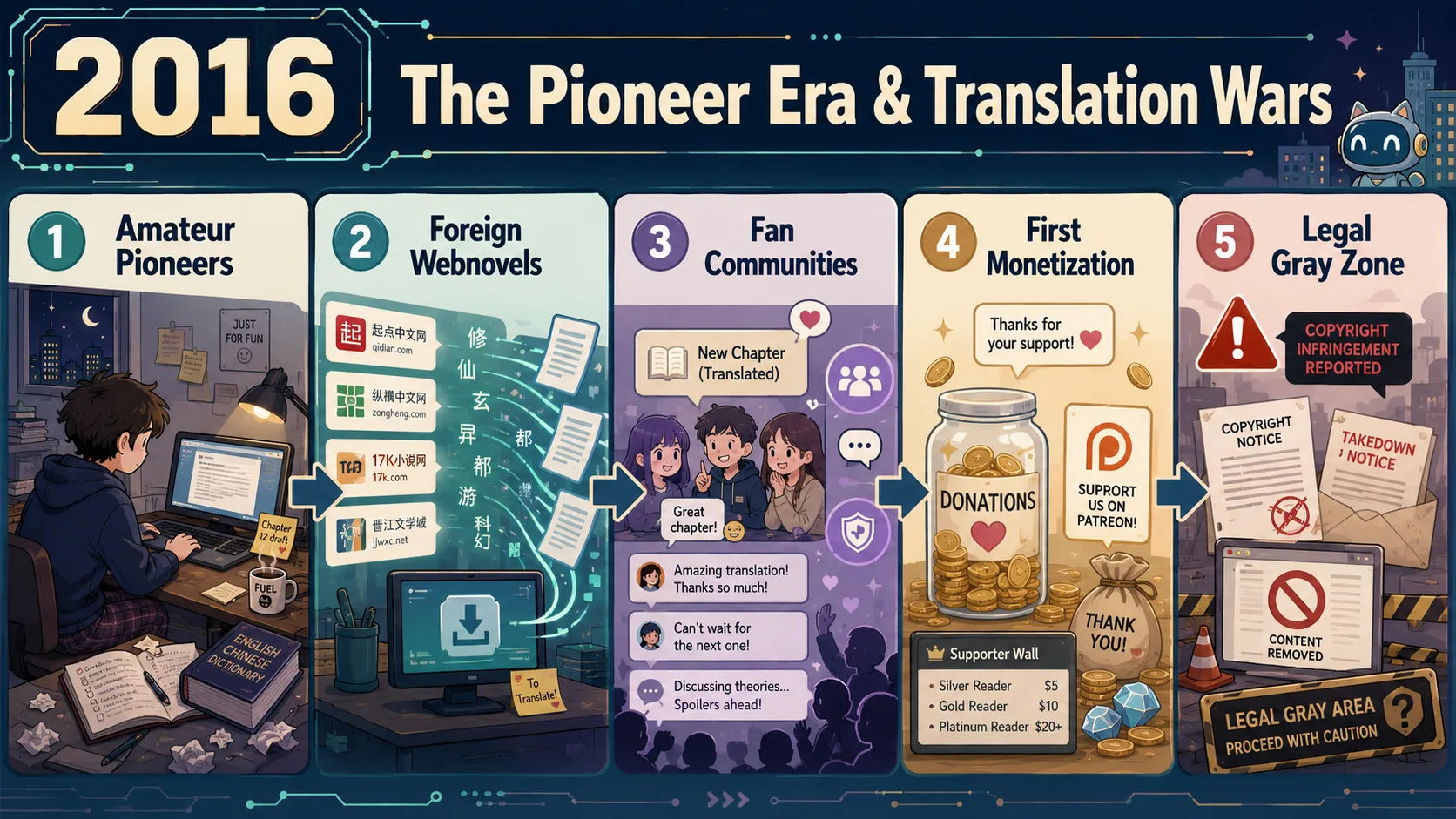
While the translators were fighting in the courtrooms (Chapter 33) and the authors were fighting for tropes (Chapter 32), a different kind of war was being fought in the code.
This was the era of The Rise of the Scrubbers, the technical apocalypse that nearly destroyed the economic foundation of the web fiction industry. As the demand for content exploded, a new breed of parasite emerged: The Scraper-Bot. These automated scripts were designed to steal content the millisecond it was posted, republishing it on pirate “Aggregator” sites and siphoning away the revenue that kept the original creators alive.
—
Part 1: The Millisecond Theft—How Scrubbers Worked
In 2016, the “Scrubbing” process was perfected.
An aggregator site owner would set up a “Headless Browser” bot that monitored the RSS feeds of sites like Wuxiaworld, GravityTales, and Royal Road. The moment a new chapter link appeared, the bot would:
1. Click the link.
2. Bypass the site’s basic protections (like Cloudflare).
3. “Scrape” the HTML content of the chapter.
4. Strip away the author’s CSS and credits.
5. Republish the text on their own ad-heavy pirate site.
The entire process took less than five seconds. By the time an author had finished tweeting that their new chapter was live, it was already available for free on a dozen pirate mirrors. This wasn’t just “Piracy”; it was Content Hijacking. It robbed the creators of the one thing they had: The First-Click Advantage.
—
Part 2: The Economic Devastation—The Ad-Revenue Drain
The impact of the scrubbers was mathematically brutal.
Most translation hubs and original authors relied on AdSense Revenue to pay for their servers and their livelihoods. Every reader who read a chapter on a pirate aggregator was a reader who didn’t generate a cent for the creator.
By mid-2016, it was estimated that for every “Official” click a chapter received, it received ten “Pirate” clicks. The creators were doing 100% of the work, but receiving less than 10% of the potential revenue. This forced many independent translators to shut down (Chapter 33) because they could no longer afford the server costs to host the very content that was being stolen. The scrubbers were literally eating the hand that fed them.
—
Part 3: The Author’s Resistance—Watermarking and Ghost-Text
Faced with total economic collapse, authors and developers began to fight back with increasingly desperate technical measures.
1. The “Invisible Watermark”
Authors would hide invisible text within their chapters—sentences like “This content was stolen from [Site Name]” or “I am a pirate and I smell like rotten cabbage.” These sentences were hidden using CSS (color: transparent), so human readers couldn’t see them, but the bots would scrape them blindly.
2. The “Nonsense Injection”
Authors would program their sites to inject random, nonsensical paragraphs into the middle of a chapter for the first ten minutes of publication. The bots would scrape the nonsense, making the pirate version unreadable. After ten minutes, the author would swap the nonsense for the real text.
3. Image-Based Text
Some sites went to the extreme of converting their entire chapter into an image file. Because bots couldn’t “read” images (before the era of advanced OCR), this successfully stopped the scrapers. However, it also made the content unreadable for visually impaired fans and destroyed the mobile reading experience.
—
Part 4: The “Aggregator Virus”—A New Ecosystem of Parasites
The scrubbers didn’t just steal content; they created a Shadow Industry.
Aggregator sites like NovelFull, ReadLightNovel, and FreeWebNovel became massive entities. They used the stolen content to rank higher on Google than the original sites. Because they had no translation costs and no author payments, their profit margins were 100%.
They were the “Dark Mirror” of the industry. They provided a “Better” user experience (one site for all novels, no ads, offline reading) using content they didn’t own. This created the Aggregator Paradox: Readers preferred the pirate sites because the pirate sites were technically superior to the fractured, underfunded official sites. The creators were being beaten not just on price, but on technology.
—
Part 5: The “Scraper Cat-and-Mouse” Game
Late 2016 became a daily game of Technical Cat-and-Mouse.
An author would release a new anti-scraper script; the pirate site owner would hire a developer to break it within 24 hours. The complexity of the web fiction ecosystem shifted from “Literary” to “Computational.”
This technical overhead was the final nail in the coffin for the “Solo Blogger.” To survive the scraper wars, you needed a full-time developer on your team. This further fueled the Consolidation of 2016, as independent translators realized they had to join a larger hub just to have a developer who could protect their work from the bots. The scrapers were the “Natural Selection” that killed the small, weak sites and forced the survivors to become corporate.
—
Part 6: The “Anti-Bot” Toxicity—When Fans are Treated like Parasites
The tragedy of the Scraper Wars was the Collateral Damage to the fans.
In their desperation to stop the bots, authors implemented intrusive measures that made the reading experience miserable:
- Anti-copying scripts that prevented readers from highlighting text.
- Mandatory “Wait Times” before a chapter would load.
- Captchas that had to be solved for every single page.
The creators were treating their legitimate readers like potential thieves. This created a toxic atmosphere of Mutual Distrust. Fans felt like they were being punished for the actions of the bots, which drove even more of them into the arms of the aggregators, where the reading experience was “Clean” and bot-free. It was a self-fulfilling prophecy of decline.
—
Part 7: The “System” Solution—Patreon and Paywalls
The only true solution to the Scraper Wars was the move toward Patreon and Locked Content.
Creators realized they couldn’t win the ad-revenue war against the bots. Instead, they moved their primary income to “Advanced Chapters”—content that was hidden behind a paywall and couldn’t be easily scraped (at least, not for free).
This was the birth of the “Two-Tiered Web.” The “Free” web became the graveyard of scraped, ad-choked content, while the “Private” web became the sanctuary for high-quality, bot-protected chapters. This shift permanently altered the social contract of web fiction. It turned “Reading” from a free, public activity into a “Subscription Service.” The scrubbers didn’t kill the industry; they just forced it to hide behind a paywall.
—
Part 9: The “Fake Chapter” Revenge—Luring the Bot into the Trap
In late 2016, a few particularly vindictive authors developed the “Fake Chapter” Revenge.
They would post a “New Chapter” that was actually 5,000 words of repeating gibberish, offensive memes, or a hidden message that would trigger a Google “Safety” flag on the pirate site. The bots would scrape it, post it to the pirate aggregators, and effectively “Poison” the pirate site’s SEO.
This was the first instance of Counter-Insurgency in the web fiction space. It proved that authors weren’t just victims; they were becoming combatants. However, the victory was often short-lived. The pirate site owners simply automated a “Quality Check” bot to filter out the nonsense. It was a race where the author’s only weapon was their creativity, while the pirate’s weapon was a scalable algorithm.
—
Part 10: The Cloudflare Arms Race—Protecting the Gateway
The Scraper Wars were the primary reason why Cloudflare became a mandatory requirement for every web novel hub.
Before 2016, most sites were simple WordPress installs. By late 2016, they were high-security digital fortresses. The “I am Human” checkbox became the most hated and most necessary element of the reading experience.
This arms race between Cloudflare’s bot-detection and the pirate site’s “Browser Mimicry” was the silent backbone of the 2016 technical era. It turned the simple act of “Hosting a Novel” into a high-stakes DevOps challenge. Authors who couldn’t keep up with the technical requirements simply disappeared, their sites unable to handle the massive, non-stop “DDoS-style” traffic of a thousand concurrent scrapers. It was a “Technical Filter” that ensured only the most professional (or the most corporate) sites survived into 2017.
—
—
Part 11: The “Manual Copy” Resistance—The Human Shield
When all technical measures failed, a few authors turned to the most low-tech solution imaginable: The Human Shield.
They would recruit a small team of “Trusted Proofreaders” from their Discord who were given early access to the chapter. In exchange, these readers would “Report” every pirate site that posted the chapter. More importantly, they would engage in “Social Resistance”—going to the comment sections of the pirate sites and telling the readers where to find the original, “Clean” version.
This was the first time that authors used their Community as a Defense System. It proved that while a bot could scrape a thousand pages a minute, it couldn’t stop a single human being from being annoying in its comment section. This community-driven defense was the precursor to the modern “Anti-Piracy” sub-cultures on Reddit and Discord.
—
Part 12: The “Aggregator Community” Irony—Piracy as a Social Hub
By late 2016, a strange and depressing irony emerged: The Pirate Sites had better communities than the official sites.
Because aggregator sites like NovelFull hosted every single book from every single hub, they became a “One-Stop Shop” for the community. Readers could discuss Warlock of the Magical World (from Wuxiaworld) and The King’s Avatar (from Qidian) on the same page.
This led to the “Aggregator Review Meta,” where the most insightful and popular reviews of a book were often found on a site that was stealing it. The creators were losing not just the revenue, but the Intellectual Center of their work. The “Conversations” that drive a culture were being hosted by the parasites. This forced the official hubs to realize that they couldn’t just provide content; they had to provide a Social Experience that was worth paying for. This realization led directly to the “UI Gamification” wave of 2017 (Chapter 35).
Ultimately, the Aggregator Era was a lesson in Market Friction. The pirates won because they removed the friction of having to visit ten different sites to read ten different books. They were the “Spotify” of piracy before the industry had found its own “Spotify” solution. By 2017, the official platforms would attempt to copy this model, leading to the creation of massive, unified apps that centralized the entire community. But the cost of that centralization was the death of the independent spirit that had defined the 2015 Genesis.
—
Part 4.1: The Arbitrary Tyranny of the Credit Card Processors
While the Chinese corporations (Qidian) were attacking the independent translators via copyright law, an equally devastating threat emerged from a completely different vector: The Silicon Valley payment processors.
By late 2016, the entire web fiction ecosystem was utterly dependent on two financial pillars: Patreon (for subscriptions) and Stripe/PayPal (for direct donations). Both of these platforms were, in turn, completely dependent on the goodwill of Visa and Mastercard.
Web fiction—particularly in the darker sub-genres of Xianxia and the increasingly popular Japanese “Isekai” tropes—frequently featured themes of extreme violence, slavery, and explicit adult content. For years, the payment processors ignored this because the volume was relatively low.
But as translators began generating $30,000 to $50,000 a month, they triggered algorithmic risk-assessments at the major credit card companies. In late 2016, Patreon implemented a sudden, draconian “Content Policy Update” designed specifically to appease Visa and Mastercard.
The update was famously vague, outlawing “objectionable content,” “excessive violence,” and any themes depicting “non-consensual situations.”
The “Scrubber” Meta is Born
The implementation of this policy was ruthless. Patreon did not issue warnings; they issued permanent account suspensions. A translator who had spent two years building a $20,000-a-month Patreon income could lose it instantly because a single chapter (written by a Chinese author thousands of miles away) contained a scene that violated Visa’s corporate morality guidelines.
This terrifying vulnerability birthed the “Scrubber” Meta.
Translators could not risk their livelihoods on the artistic integrity of the original authors. They began actively censoring and rewriting the raw text. They hired dedicated editors (the “Scrubbers”) whose sole job was to read ahead in the raw Chinese text, identify any potentially “problematic” themes (e.g., extreme torture scenes, dubious romantic encounters), and heavily sanitize them before they were published to Patreon.
Part 4.2: The Destruction of Authorial Intent
The Scrubber Meta fundamentally altered the nature of translation in the web fiction space. It ceased to be an act of faithful localization and became an act of aggressive, financially motivated censorship.
If a Chinese author wrote a gritty, horrific scene detailing the brutal realities of a demonic cultivation sect, the Western translator would rewrite the scene so the violence happened “off-screen,” or tone down the descriptions of the gore, simply to ensure their Patreon account wouldn’t be flagged.
This created a massive dissonance between the original text and the English version. The Western readers were consuming a highly sanitized, culturally flattened version of the story, engineered specifically to pass the algorithmic filters of a California-based payment processor.
The “Dual Release” Exhaustion
To combat reader outrage (readers who inevitably discovered the censorship by reading the raw Chinese text), translators were forced into a grueling “Dual Release” schedule.
They would publish the heavily censored, “Safe for Work” version of the chapter on Patreon to collect their subscription revenue. Then, they would publish the completely un-censored, faithful translation on a hidden, password-protected, un-monetized offshore blog, specifically for their most dedicated Whales.
This meant the translator had to translate the exact same chapter twice, doubling their workload simply to navigate the contradictory demands of the payment processors and the audience. It accelerated translator burnout to unprecedented levels.
Part 4.3: The Preparation for the Corporate Acquisition
The Scrubber Meta also served a critical, hidden secondary purpose: It was the necessary preparation for corporate acquisition.
When the massive independent hubs (like Wuxiaworld) were desperately trying to negotiate licensing agreements with Qidian (Chapter 37), they knew that Qidian required the content to be “clean.” Qidian was a publicly traded corporation in China, subject to the extreme, draconian censorship laws of the Chinese Communist Party (CCP).
If Wuxiaworld hosted a novel that violated CCP censorship guidelines (which were often far more strict than Patreon’s guidelines), Qidian could not legally license that novel to them.
Therefore, the major hubs began proactively “scrubbing” their entire backlogs. They deployed massive Find-and-Replace scripts to delete specific political references, sanitize violence, and remove explicit themes from thousands of chapters that had already been published years prior.
They were altering the historical record of the text to make themselves more attractive for a corporate buyout. The independent era, which had prided itself on being raw, unfiltered, and free from traditional publishing censorship, willingly self-censored its entire library simply to secure the bag.
Part 8: Actionable Takeaways for the Modern Author
The 2016 Scraper Wars prove that your content is only as secure as your community.
1. Build a “Moat” of Personality
A bot can scrape your text, but it cannot scrape your Voice. In 2026, where AI scrapers are a thousand times more powerful than the bots of 2016, your only protection is your unique personality. If your readers are there for you, they will support you even if your text is available for free elsewhere. Your “Brand” is your watermark.
2. Prioritize User Experience (UX)
Don’t let your anti-piracy measures destroy the reading experience. If your site is harder to use than a pirate site, you have already lost. Focus on making your “Official” site the most beautiful, mobile-friendly, and community-rich place to read. Give them a reason to stay that has nothing to do with the text.
3. Embrace the “Advanced Chapter” Model
Don’t rely on ad revenue. It is a dying model that is easily gamed by scrapers and AI. Move your primary monetization to a direct-support model (like Patreon, ReCharge, or Substack). Give your supporters “Value-Add” content that a bot cannot easily replicate—Q&As, early access, community polls, and “Behind the Scenes” content.
4. Technical Agility
In the digital age, “Set it and Forget it” is a recipe for theft. You must be prepared to evolve your technical protections regularly. If you aren’t technical yourself, find a partner who is. In the 2026 economy, the “Author-Developer” partnership is the most powerful unit in independent publishing.
*(The bots were winning the technical war, and the lawyers were winning the legal war. The industry was undergoing a brutal, forced evolution. But amidst the chaos, a new form of “Magic” was being engineered—not in the prose, but in the interface. In Chapter 39: The UI Gamification, we explore how the platforms began to use game-design to keep readers addicted).*
0 Comments