

2016 – 19 – The UI Gamification
by EternalibChapter 39: The UI Gamification—The App as a Video Game
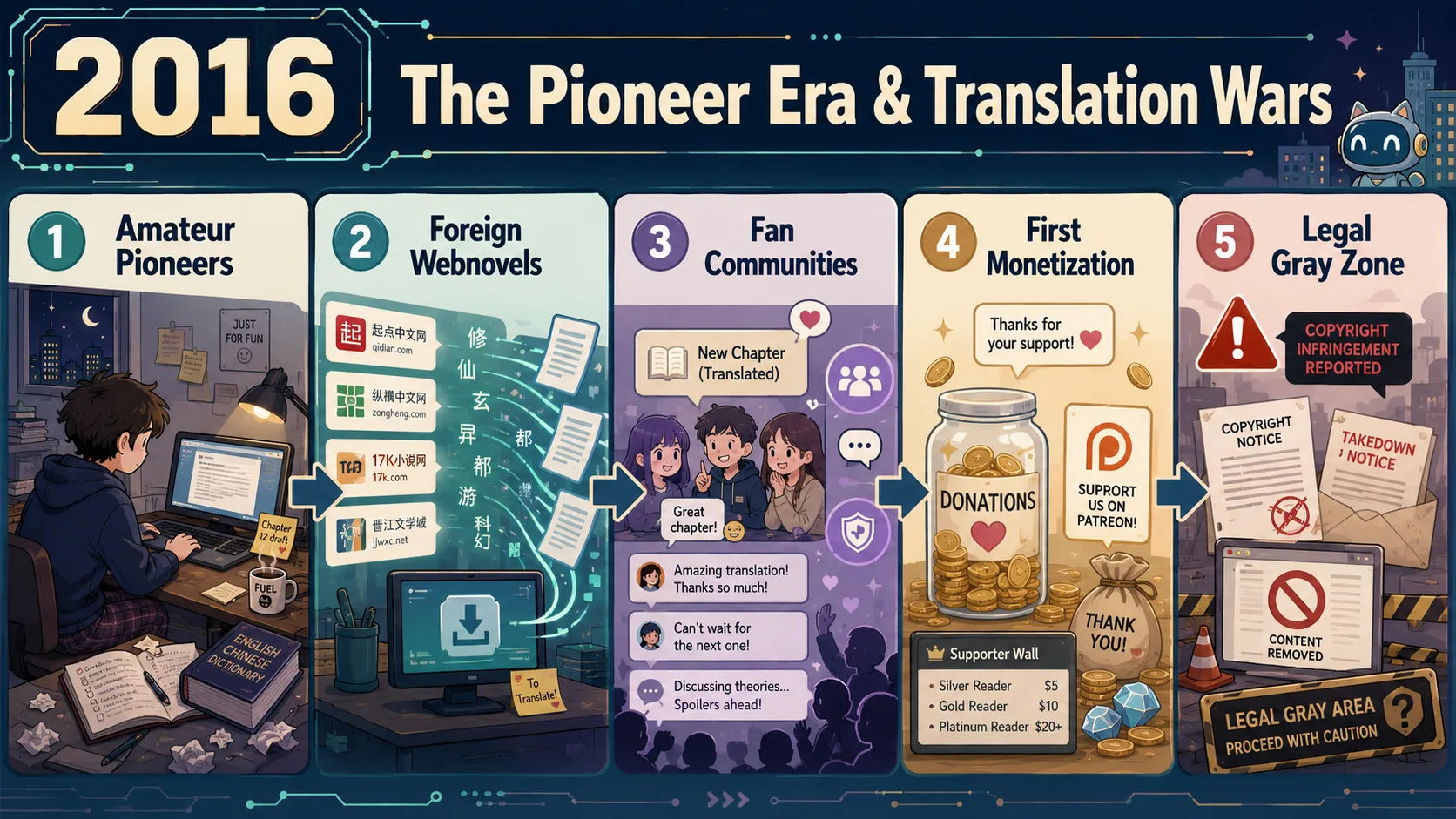
By late 2016, the corporate platforms realized that they weren’t just competing for the reader’s money; they were competing for the reader’s Dopamine.
The transition from “Independent Hubs” to “Corporate Apps” brought with it a new philosophy of user experience: Gamification. Reading was no longer just a literary act; it was transformed into a “Progress Quest.” The platform became a video game, complete with levels, experience points, daily quests, and badges.
This was the era of The UI Gamification, the moment the webfiction industry adopted the psychological manipulation tactics of the mobile gaming industry to ensure that once a reader entered an app, they never wanted to leave.
—
Part 1: The “Daily Check-in”—The Hook of Habit
The first and most effective tool of gamification was the Daily Check-in.
In 2015, you checked a site when you wanted to read. In late 2016, the apps (led by the Qidian International beta) began rewarding you for simply opening the app every day. You would receive “Spirit Stones,” “Energy,” or “Points” just for showing up.
This created a Daily Habit Loop. Even if a reader didn’t have a new chapter to read, they would open the app to “Collect their reward.” This boosted the platform’s “Daily Active Users” (DAU) metric—the most important number for venture capitalists—and ensured that the platform was always the first thing the reader saw when they looked at their phone. It turned “Reading” into a chore that offered a digital treat.
—
Part 2: XP and Levels—The Status Economy
The second pillar was the Reader Level System.
By consuming chapters, posting comments, and voting for novels, readers would earn “Experience Points” (XP) that increased their “Account Level.” Higher levels often unlocked special badges, exclusive profile frames, or the ability to vote more times in the “Power Rankings.”
This created a Status Economy within the community. Readers began to compete with each other to see who could reach the highest level. It gave the act of reading a sense of “Achievement.” You weren’t just finishing a book; you were “Leveling Up” your account. This psychological trick converted “Passive Consumption” into “Active Competition,” making it significantly harder for a reader to switch to a different platform where their “Level” would be zero.
—
Part 3: The Power Ranking—The Battle of the Fanbases
The most controversial element of UI Gamification was the Power Ranking (Voting) system.
Every week, readers were given a limited number of “Votes” (later called Power Stones) that they could give to their favorite novels. The top 10 novels on the leaderboard would receive massive visibility on the front page, leading to a flood of new readers.
This turned “Supporting an Author” into a Clan War. Fanbases would organize “Voting Parties” on Discord, coordinate “Review Bombing” against rivals (Chapter 23), and spend hundreds of dollars on extra votes to keep their favorite novel at #1. The platforms were essentially outsourcing their “Marketing” to the fans, using their competitive nature to drive engagement and revenue. The UI didn’t just host the novel; it hosted the war for the novel.
—
Part 4: Badges and Achievements—The Completionist Trap
To keep readers from getting bored, platforms introduced Badges and Achievements.
- “Reading for 100 Days Straight”
- “First 100 Comments on a New Novel”
- “Spent $100 on Coins”
These digital stickers exploited the Completionist Mindset. Readers who might have dropped a novel otherwise would keep reading just to unlock the “True Fan” badge. It was a form of “Sunk Cost” engineering. Once you have a profile full of rare badges, the emotional cost of deleting the app becomes too high. The UI was building a digital cage made of gold stars and “Good Job” notifications.
—
Part 5: The “Scroll” vs. The “Page”—Optimizing for Velocity
Beyond the psychological tricks, the literal Interface Design changed in 2016.
The move from “Page-Based” reading (clicking ‘Next’) to “Continuous Scroll” was a fundamental shift. Scrolling is a “Low-Friction” action that makes it harder for the brain to find a stopping point. By removing the “Next Chapter” button and replacing it with an infinite scroll, the platforms encouraged Binge-Reading.
They also optimized the UI for “One-Handed Reading” on mobile devices, ensuring that the “Next” button was always right under the thumb. Every millisecond of friction removed from the interface was another minute of reading time captured. The platforms were no longer designing for “Readability”; they were designing for Velocity.
This velocity was further enhanced by the “Speed-Reading” mode—a feature that highlighted keywords or automatically scrolled the text at a set pace. It was a clear signal that the industry no longer viewed books as “Art” to be savored, but as “Data” to be consumed as quickly as possible. The UI was essentially “Training” the readers to scan for keywords rather than appreciate prose, a shift that would have a permanent impact on the writing styles of the 2017 era (Chapter 41).
—
Part 4.1: The Eradication of the Passive Reader
As the Qidian Beta demonstrated the terrifying power of corporate UX (User Experience) engineering, the independent hubs realized they could no longer rely on static HTML text on a screen. If they wanted to retain their audiences against the corporate platforms, they had to stop treating their audience as “readers” and start treating them as “players.”
This triggered the UI Gamification arms race.
In traditional literature, reading is a passive, internally motivated activity. You pick up a book because you want to know what happens next. In the web fiction ecosystem of late 2016, reading became an externally motivated, highly interactive chore.
The platforms realized that relying on the author’s plot to drive retention was inefficient. An author might have a bad week and write a boring chapter, causing the reader to close the app. To prevent this, the platforms divorced retention from the prose entirely, tying it directly to the interface itself.
The Dopamine Slot Machine
Independent hubs began desperately mimicking Qidian’s architecture. They introduced complex, highly visible leveling systems for the readers themselves.
When a reader visited Wuxiaworld or a custom-built Hub, they no longer just read a chapter. They gained “Experience Points” (EXP) for simply logging in. They gained EXP for leaving a comment. They gained EXP for sharing the chapter link on Twitter.
The UI was plastered with progress bars. The reader could visually watch their account level up from “Outer Sect Disciple” to “Inner Sect Elder.” This effectively hijacked the exact same psychological progression loop that the LitRPG novels were utilizing, but applied it to the physical act of consuming the media.
A reader might hate the current arc of a novel, finding it tedious and poorly translated. But they would continue to log in every single day, scroll to the bottom of the chapter without reading a single word, and leave a generic comment just to ensure their daily “Login Streak” wasn’t broken and they didn’t lose their precious EXP.
Part 4.2: The Gacha Mechanics and Artificial Scarcity
The true malicious genius of the UI Gamification era was the introduction of Gacha Mechanics into literature.
As Patreon subscription fatigue (Chapter 34) ravaged the ecosystem, the platforms needed a way to extract money from the “Plankton” (the free readers) who refused to pay $10 a month. They did this by introducing the “Fast Pass” or “Unlock Ticket” economy.
A platform would lock the newest 20 chapters behind a paywall. However, they allowed free readers to access these chapters if they possessed a Fast Pass.
How did a reader get a Fast Pass?
1. They could buy them with real money (micro-transactions).
2. They could “earn” them by completing daily chores (watching unskippable 30-second video ads, downloading a sponsored mobile game and playing it to Level 5).
3. They could roll a daily “Gacha Wheel” which had a 1% chance of dropping a Fast Pass, and a 99% chance of dropping useless cosmetic profile borders.
The Degradation of the Text
This completely degraded the fundamental value of the text. The novel was no longer a piece of art; it was the prize inside a digital cereal box.
The authors were forced to format their chapters specifically to accommodate this economy. Chapters had to be chopped into strictly uniform, 1,000-word segments. If an author wrote a massive, sprawling 5,000-word chapter because the narrative demanded it, the platform would force them to chop it into five pieces, simply so the platform could charge five separate Fast Passes for it.
The prose itself became entirely secondary to the economic delivery mechanism.
Part 4.3: The End of Independent Innovation
The UI Gamification arms race ultimately proved fatal for the smaller, independent web fiction platforms.
Building a static WordPress blog was cheap. Building a highly responsive, API-integrated, heavily gamified web application with real-time user leveling, Gacha mechanics, and micro-transaction wallets required a massive team of full-stack developers.
The independent platforms simply could not afford to build or maintain this infrastructure. They could not compete with the frictionless, highly addictive dopamine loops of the Qidian app or the heavily funded mega-hubs.
The Gamification era proved that the best story did not win. The most addictive interface won. The authors were no longer the primary value generators for the ecosystem; the UI/UX designers were. The medium had fundamentally transitioned from literature into the mobile gaming sector, paving the absolute foundation for the algorithmic hellscape of 2026.
Part 6: Actionable Takeaways for the Modern Author
The gamification of 2016 proved that engagement is engineered, not accidental.
1. Gamify Your Community (Carefully)
You don’t need a billion-dollar app to use gamification. Use your Discord or your Patreon to create “Quests” for your readers. Reward them with exclusive roles, “Easter Egg” lore, or the ability to name a minor character if they reach a certain milestone. Make being a fan of your work feel like a game that they are winning.
2. The Power of “Streaks”
Encourage habit-building. If you release chapters on a consistent schedule (e.g., Every Monday/Wednesday/Friday), your readers will build a “Mental Streak” of reading your work. If you break that streak, you lose the “Habit Loop.” Consistency is the most powerful “Gamification” tool in an independent author’s arsenal.
3. Use Social Proof
Display your “Wins.” If your novel hits a milestone on Royal Road or Amazon, celebrate it with your readers. Let them know that they are the reason you are winning. This builds “Fanbase Pride” and encourages them to keep “Voting” for you through reviews and ratings.
4. Beware the “Empty Engagement” Trap
In 2026, it is easy to get caught up in chasing “Metrics” (likes, votes, shares). Remember that gamification is a tool to get people to Read your Book. If the “Game” becomes more important than the “Story,” you will lose your long-term readers. Use UI tricks to bring them in, but use “Prose” to keep them there.
—
Part 7: The “Spirit Stone” Psychology—The Disconnection of Value
The transition from “USD” to “Spirit Stones” was the ultimate masterstroke of gamified UI.
By forcing readers to convert their real-world money into a “Virtual Currency,” the platforms triggered a psychological phenomenon called “Monetary Disconnection.” People are significantly more likely to spend “100 Stones” than they are to spend “$1.50,” even if the value is the same.
The UI reinforced this by making the “Buy” button look like a game-interface, complete with glowing icons and “Bonus” stones for larger purchases. It removed the “Pain of Paying” and replaced it with the “Joy of Unlocking.” This was the same tactic used by casino apps, and its introduction to the webnovel world in late 2016 marked the end of the “Fair Market” and the beginning of the “Extraction Market.”
Furthermore, virtual currency allowed the platforms to “Obfuscate” the price. In 2015, you knew exactly what you were paying. In 2016, with Spirit Stones, the exchange rate was constantly fluctuating due to “Bonuses,” “Daily Rewards,” and “Check-in Credits.” This made it impossible for the reader to calculate the true cost of their hobby, leading to a massive increase in per-reader spending. The UI wasn’t just hosting the story; it was a psychological filter designed to separate the reader from their logic.
—
Part 8: The “Gacha” Elements—Randomness as a Retention Tool
In late 2016, we saw the first rudimentary Gacha (Lottery) elements in the webnovel apps.
A reader wouldn’t just buy a chapter; they would participate in a “Lucky Draw” to win Spirit Stones, or they would open a “Mystery Box” that might contain a rare profile badge. This introduced the element of Variable Rewards—the same psychological mechanism that makes slot machines addictive.
The reader wasn’t just coming for the story; they were coming for the “Chance” to win something. This made the app “Sticky” in a way that a simple website could never be. It transformed the reader from a “Patron” into a “Player,” and once the player was hooked on the gacha, the quality of the novel became secondary to the thrill of the “Roll.”
—
Part 9: The Notification Warfare—The Battle for the Lock Screen
The 2016 apps turned the Push Notification into a psychological weapon.
In the 2015 era, you found out about a new chapter by checking your email or RSS feed. In 2016, the app would “Scream” at you the moment a new chapter was live.
- “Hurry! Your favorite novel just updated!”
- “You’re losing your rank in the Power Rankings!”
- “Daily reward expiring in 1 hour!”
This constant bombardment was designed to create FOMO (Fear of Missing Out). It ensured that the app was always at the top of the reader’s mind, effectively “Crowding Out” other forms of media. If a reader had 30 seconds of free time at a bus stop, the notification would ensure that they spent those 30 seconds in the app rather than looking at the world around them. It was a total colonization of the reader’s attention span.
—
Part 10: The Review-Bomb Defense—Gamifying Truth
As “Review Bombing” (Chapter 23) became a major problem in 2016, the platforms used the UI to “Gamify Truth.”
They introduced “Verified Reader” badges, which ensured that only people who had actually spent money on a novel could post a review. They also added a “Helpful” voting system for reviews, where readers could “Level Up” their reviewer profile by writing popular critiques.
While this did stop some of the trolls, it also created a “Toxic Positivity” loop. Because the system rewarded “Helpful” reviews, and fanbases only found positive reviews “Helpful,” the critical voices were effectively silenced by the algorithm. The UI wasn’t just organizing the community; it was “Filtering” the community to ensure that only the most profitable (positive) sentiment reached the front page.
—
Part 11: The “Engagement Metric” Dark Side—The Mental Toll on Authors
The final, and perhaps most tragic, result of gamification was its impact on the Authors’ Mental Health.
Before 2016, an author judged their success by their fan-letters and their prose. In 2016, they were given a Real-Time Dashboard of their “Power Ranking,” “Collection Count,” and “Retention Rate.”
Watching these numbers fluctuate in real-time turned the creative process into a High-Stakes Stress Test. If an author wrote a slow, character-driven chapter and saw their “Rank” drop by 5 spots, they would feel a sense of panic and “Course-Correct” toward cheap action in the next chapter to win back the numbers. The UI was essentially “Training” the authors to be slaves to the metric. It replaced “Artistic Vision” with “Algorithmic Compliance,” leading to the homogenized, “Fast-Food” style of webnovels that would dominate the 2017 Corporate Era.
—
Part 12: The “Social” UI—The Pressure of the Crowd
The final layer of gamification was the Social Interface.
Platforms integrated real-time chat rooms and “Danmu” (floating comments) directly into the reading experience. While this made the app feel alive, it also created a Pressure of the Crowd.
If a novel had 10,000 “Active Readers” chatting in the bottom bar, a new reader felt a psychological need to join in, which required them to catch up to the latest chapter as quickly as possible. The UI used “Social Validation” to drive “Consumption Speed.” You weren’t just reading a book; you were trying to keep up with a global conversation. If you stopped reading for a week, you were “Out of the Loop.” This social gamification turned the solitary act of reading into a high-pressure social event, ensuring that the app’s retention rates remained sky-high.
—
*(The reader was level 50, they had 10 badges, and they had checked in for 300 days straight. They were addicted. The 2016 Era was ending with the community firmly trapped in a digital loop. But as the year reached its final seconds, the quiet of the ‘Midnight’ arrived. In Chapter 40: The Midnight of 2016, we take one last look at the legacy of the ‘Wild West’ before the Corporate Dawn of 2017).*
0 Comments