

2017 – 04 – Reincarnation Fatigue
by EternalibChapter 44: Reincarnation Fatigue—The Decay of the Second Chance
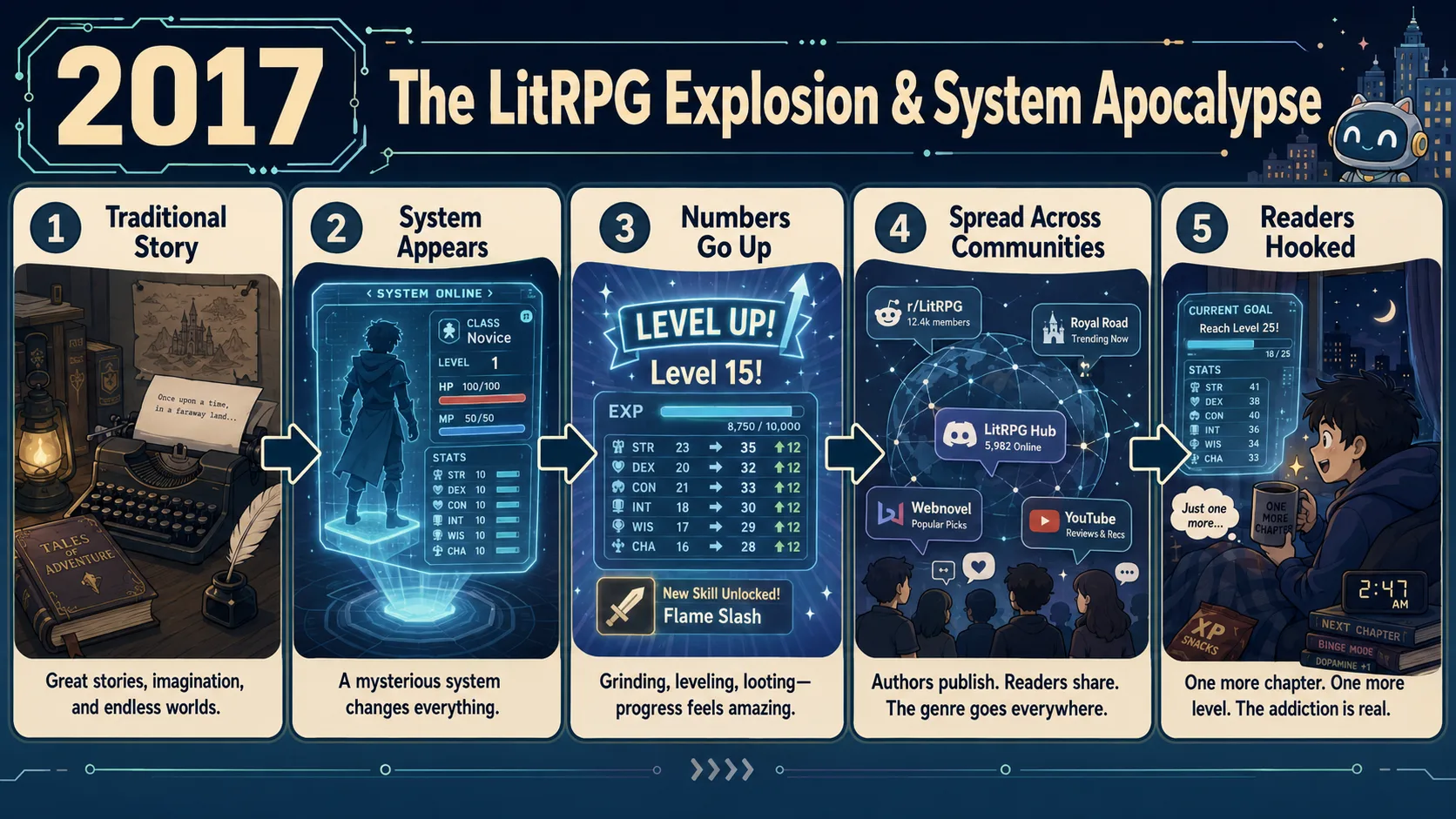
By mid-2017, the western web novel community was drowning in the past. The “Reincarnation” or “Regression” hook—where a protagonist dies and wakes up in their younger body with a decade of future knowledge—had become the absolute, non-negotiable standard for a “Trending” novel.
But as the 2017 Corporate Monarchy began to standardize the market (Chapter 41), it triggered a phenomenon known as Reincarnation Fatigue. The very hook that had birthed the genre was now the weight that was dragging it into a state of creative stagnation. This chapter explores the rise, the peak, and the inevitable decay of the “Second Chance” meta, and how it permanently altered how readers interact with fictional tension.
—
Part 1: The “Spit-Take” Era—The Formulaic Opening
In 2017, you could open any novel on the NovelUpdates “Trending” list and predict the first five chapters with 95% accuracy.
- Chapter 1: The protagonist dies in a tragic betrayal or a final stand.
- Chapter 2: They wake up in their teenage bedroom, staring at a calendar from ten years ago.
- Chapter 3: They check the “Status Window” or realize they are back before the “Great Calamity.”
- Chapter 4: They do a “Spit-Take” in the mirror and resolve to “Change Everything.”
- Chapter 5: They use their “Future Knowledge” to buy a low-level cultivation herb or invest in a “hidden” asset that will eventually be worth billions.
This was the Formulaic Opening. It was designed to provide the reader with an immediate, high-dose hit of “Superiority.” The reader knew something the world didn’t. But by 2017, the audience had seen this play out so many times that the “Superiority” was replaced by Boredom. The “Spit-Take” became a joke, a checkbox that authors felt they had to tick before the “real” story could begin.
—
Part 2: The “Knowledge Gap” Problem—The 200-Chapter Wall
The most significant structural flaw of the regression trope was the Knowledge Gap.
A regression protagonist is essentially a “Spoiler” for their own universe. They know exactly where the hidden treasure is, exactly who the traitor is, and exactly when the villain will strike. This is great for the first 50 chapters, as it provides a sense of fast-paced progression.
However, by Chapter 200, most regression novels hit a “Wall.” The protagonist has used up all their “Future Knowledge.” They have successfully changed the timeline so much that their memories are no longer accurate. At this point, the story becomes a standard, linear fantasy.
Readers in 2017 began to recognize this wall. They would read the first 100 chapters of a novel, enjoy the “Regression Payoff,” and then Drop the Novel the moment the protagonist was forced to fight on equal footing with the world. The regression trope was “Front-Loading” the excitement, leaving the middle and end of the novel in a state of narrative drought.
—
Part 3: The Korean Influence—The “Tutorial” and the “Regression”
While the Chinese market was perfecting the “Urban Regression” (Chapter 37), the Korean market was exporting a different flavor: The Tutorial Regressor.
Series like The Tutorial Is Too Hard and Everyone Else is a Returnee introduced a much more “Video Game” style of regression. In these stories, the regression wasn’t just a “restart”; it was a “New Game Plus.” The protagonist brought back not just knowledge, but skills, levels, and “System” permissions.
This Korean influence “Hardened” the trope. It made the protagonist even more overpowered (OP) and the world even more like a game. This satisfied the “Power Fantasy” (Chapter 36) but it effectively Killed the Stakes. If the protagonist can “Save and Reload” or “Regress” at will, why should the reader care if they fail? The 2017 audience was becoming “numb” to the danger, leading to a demand for even more extreme forms of “Face-Slapping” (Chapter 40) to keep them engaged.
—
Part 4: The Birth of “Meta-Regression”—The Parody Phase
When a trope reaches peak fatigue, the only way forward is Meta-Commentary.
In late 2017, we saw the birth of novels that actively parodied the regression meta. We saw stories where:
- The protagonist regresses, but discovers that everyone else in the world also regressed.
- The protagonist is the villain who has to deal with a “Regressor Hero” who keeps trying to kill them.
- The protagonist regresses into a “Mob” character who just wants to avoid the “Main Character’s” drama.
These stories were a breath of fresh air, but they were also a symptom of the End-Stage Trope. They required the reader to be “in on the joke.” If you hadn’t read fifty standard regression stories, the parody didn’t work. The genre was becoming “In-Bred,” catering to a shrinking pool of hardcore veterans while becoming increasingly impenetrable to new readers.
—
Part 5: The Psychological Toll—The “Spoiled” Reader
Reincarnation fatigue didn’t just affect the stories; it affected the Readers.
The 2017 reader was “Spoiled.” They expected the protagonist to win every battle instantly using future knowledge. If a protagonist struggled, the readers would flood the comment sections with complaints: “Why didn’t he remember the trap from the future?” or “He’s supposed to be a Regressor, why is he being so dumb?”
The trope had created an Entitled Audience that viewed “Difficulty” as a “Plot Hole.” Authors were trapped. If they made the protagonist too smart, there was no tension. If they made them “forget” things to create tension, the readers would riot. This psychological deadlock is one of the primary reasons why the “Quality of Prose” (Chapter 42) began to decline—authors stopped trying to write “Art” and started trying to write “Safe Formulas” to avoid reader backlash.
—
Part 6: The “Regression to the Modern World” Sub-Genre
The only area where the trope remained fresh was the Modern Urban Regression.
In these stories, a middle-aged office worker with a failed life regresses back to their high school self in 1990s or 2000s China/Korea. Instead of fighting dragons, they fight the Stock Market. They use their “future knowledge” to buy Bitcoin, invest in Tencent/Alibaba, and “out-smart” the bullies by becoming a billionaire.
This sub-genre was “Regression for the Working Class.” It touched on the real-world anxieties of the 2017 audience—the feeling that they had missed their chance at financial freedom. It turned the “Second Chance” from a fantasy into a Financial Dream. By 2017, the most popular stories on the Chinese charts weren’t about killing gods; they were about a 40-year-old man waking up in 1995 and buying the land that would eventually become the Beijing central business district.
This was the “Ultimate Face-Slap.” The protagonist wasn’t stronger than the bully; he was richer than the bully’s father. This economic shift in the trope reflected a community that was maturing. The readers who had grown up on Dragon Ball Z were now adults with mortgages and stagnant salaries. They didn’t want a “Dantian”; they wanted a “Dividing Dividend.” This bridge between the “Xianxia” geeks and the “General” audience was vital for the corporate platforms like Webnovel.com, as it allowed them to market to a much broader, wealthier demographic than the “Core” fantasy fans.
—
Part 4.1: The Eradication of Stakes and the “Second Chance” Meta
As the sheer volume of translated and original web fiction exploded in 2017, the market faced a profound narrative crisis: How do you establish tension in a genre where the protagonist is mathematically required to be completely invincible? (The OP Protagonist Dominance, Chapter 36).
The industry’s universal solution was the complete, suffocating standardization of the “Reincarnation” and “Isekai” (Transmigration) tropes.
In traditional literature, reincarnation is a profound philosophical or spiritual exploration. In the 2017 web fiction ecosystem, Reincarnation was simply a narrative cheat-code used to reset the game board while allowing the protagonist to retain their end-game stats.
The “Knowledge as Power” Loop
The dominant narrative arc of 2017 was the “Returner.”
A protagonist would reach the absolute pinnacle of the cultivation world (or survive the apocalyptic LitRPG system for ten years), only to be betrayed and killed by their closest allies. Instead of dying, they are miraculously transported back in time to their 16-year-old body, retaining all their future knowledge.
This completely eradicated the concept of “discovery” from the narrative. The protagonist never had to struggle to learn a martial art, because they had already mastered it in their past life. They never had to face a difficult moral choice, because they already knew exactly who was going to betray them ten years in the future.
The readers became addicted to the immense, cathartic superiority of this premise. The protagonist was essentially playing a video game on “New Game Plus” mode, brutally executing their future enemies before the enemies had even committed a crime.
Part 4.2: The Disconnect from Reality (The Escapism Black Hole)
The psychological implications of the Reincarnation/Isekai saturation were deeply unsettling.
The protagonist in these stories usually began as a complete failure in the “Real World” (a burned-out salaryman, an unemployed gamer, a bullied high school student). Their “Real World” existence is utterly discarded within the first chapter, usually via a sudden, violent death (famously referred to in the community as “Truck-kun”).
The narrative explicitly argues that the “Real World” is irredeemable, unfixable, and not worth saving. The only path to success, power, and happiness is to literally die and be reborn into a fantasy universe (or a video game system) where the rules are mathematically fair and effort is guaranteed to result in a level-up.
This resonated terrifyingly well with the Western audience. A generation of young readers, facing crippling student debt, economic stagnation, and the chaotic unpredictability of the 2017 socio-political climate, completely rejected traditional, grounded fiction. They sought refuge in the “Reincarnation” fantasy—the desperate wish for a clean slate, a reset button, and a universe governed by visible, understandable logic (stats and levels) rather than the unfair chaos of reality.
Part 4.3: The Standardization of the “System”
As the audience demanded ever-increasing efficiency in their power fantasies, the Reincarnation trope evolved into its final, most mechanized form: The integration of the “System.”
Authors realized that establishing a complex fantasy world with deep lore required too much exposition, which slowed down the pacing and hurt Patreon conversions. To solve this, they outsourced the world-building entirely to a literal, in-universe Artificial Intelligence—the System.
When the protagonist reincarnated, they did not have to explore the world to understand it. A blue screen simply materialized in front of their eyes, explicitly listing their stats, generating precise “Quests,” and dispensing immediate “Rewards.”
The Death of Subtext
The System eradicated the need for subtext, internal monologue, or character development.
If the author wanted the reader to know the protagonist was getting stronger, the author did not have to write a complex scene demonstrating their new skills. The author simply wrote: [Strength +5].
This reduced the act of reading into the act of monitoring a spreadsheet. The prose became entirely utilitarian, serving only as the connective tissue between the highly anticipated, dopamine-triggering System prompts. Reincarnation Fatigue set in not because the stories were bad, but because the stories had ceased to be stories. They had become algorithms executed in text format, endlessly repeating the exact same “Level Up” loop until the author burned out or the Patreon revenue dried up.
Part 7: Actionable Takeaways for the Modern Author
Reincarnation fatigue proves that no hook lasts forever. To survive as a modern author, you must treat your “Second Chance” not as the story, but as the starting line.
1. The “Knowledge Depletion” Strategy
Do not rely on “Future Knowledge” for the entire novel. Use the regression to set up the protagonist’s initial advantage, but then introduce a “Timeline Divergence” as early as possible. Once the future changes, the protagonist is back in a state of uncertainty. This restores the narrative tension and prevents the “200-Chapter Wall.”
2. Focus on “Character Growth,” Not just “Wealth Growth”
A regressor might have the skills of a god, but they usually have the Trauma of a survivor. Focus on the psychological weight of being “the only one who remembers the end of the world.” If your protagonist is just a walking database of future tips, they are a boring character. If they are a broken man trying to save the people he failed, they are a compelling protagonist.
3. Subvert the “System” Expectations
If you are writing a “Tutorial” or “Regression” story in 2026, your readers already know the rules. Break them. Give the “System” a personality that hates the protagonist, or have the “Future” be a lie planted by the villain. Use the reader’s “Fatigue” against them to create genuine shock.
4. Regression is a “Thematic” Tool
Ask yourself: What is the theme of my second chance? Is it about “Regret”? Is it about “Justice”? Is it about “Greed”? If your regression has no thematic purpose other than “making the MC strong,” it is a generic story. The most successful modern regressors (like Omniscient Reader’s Viewpoint) use the trope to explore the nature of stories themselves.
*(The tropes were decaying, but the platforms were thriving. While authors struggled to find new hooks, the corporate giants were launching the ultimate delivery system for the ‘Spit-Take’ meta. In Chapter 45: Webnovel.com Launch, we look at the ‘UI Shock and Awe’ that captured the global market).*
—
Part 8: The “Cheat Code” vs. “Strategic” Regression
A major point of contention in the 2017 community was the transition from Strategy-based Regression to Cheat-based Regression.
In early regression stories (like Rebirth of the Thief Who Roamed The World), the protagonist’s advantage was his Skill. He was a pro-player who remembered the mechanics. He still had to work hard, dodge attacks, and lead his team.
By 2017, the meta had shifted toward the “God-Gift” Regression. The protagonist didn’t just remember the game; they regressed with a “System” that gave them infinite mana or a “Double-Drop Rate” from birth. This effectively removed the “Game” part of the story. The regression was no longer a “Second Chance to be Better”; it was an “Execution order for the Rest of the World.”
This shift reflected the Instant Gratification demands of the mobile app audience (Chapter 45). Readers didn’t want to see a protagonist “grind” for 500 chapters using future knowledge; they wanted to see the protagonist “Win” by Chapter 10. The “Strategy” was replaced by the “Stat-Screen,” and the “Pro-Player” was replaced by the “Administrator.”
—
Part 9: The “Butterfly Effect” Paradox—Writing Yourself into a Corner
For authors, the regression trope was a Logical Minefield. It required a massive amount of “Future-Planning” that most web novel authors—writing on a daily, unedited schedule—could not maintain.
This led to the Butterfly Effect Paradox. If the protagonist saves their parents in Chapter 5, the entire future of the world should change. The “Villain” who killed their parents won’t be in the same place at the same time ten years later.
However, many authors were too lazy (or too rushed) to account for these changes. They would have the protagonist “remember” a secret treasure at Chapter 150, even though the protagonist’s actions in Chapter 5 should have made that treasure disappear or be found by someone else.
The audience in 2017 became incredibly “Pickey” about these inconsistencies. They would post detailed “Timeline Audits” in the comment sections, pointing out that the protagonist’s memories were logically impossible given the current plot. This pressured authors to keep the world “Static,” forcing them to ignore the consequences of their own trope just to keep the plot moving. The “World-Building” was being sacrificed on the altar of the “Protagonist’s Cheat.”
—
Part 10: The “Regressor’s Guilt”—The Author’s Internal Crisis
Finally, there was a hidden “Author Experience” (Chapter 42) associated with reincarnation fatigue: The Guilt of the Repeat.
By 2017, many professional translators and original authors felt like they were “plagiarizing” themselves. They were writing the same “Spit-Take” chapter for the tenth time across three different pen names.
They began to feel a deep sense of Creative Nihilism. They knew that if they wrote a unique, complex fantasy without regression, it wouldn’t trend. But if they wrote a generic regression story, it would hit the Top 10 in a week.
This created the “Mercenary Author” mindset. Authors stopped trying to create “Art” and started treating their writing like an “Asset Management” job. They would “Spin” a regression hook, milk it for 200 chapters until the “Fatigue” set in, and then “Drop” the novel to start a new regression story with a slightly different “System.” The 2017 era was the moment that the Long-Term Epic (Chapter 01) began to be replaced by the Seasonal Fast-Food Novel. The industry had optimized for the “Hook,” and in doing so, it had forgotten how to write the “Story.”
—
0 Comments