
2016 – 20 – The Midnight of 2016
by EternalibChapter 40: The Midnight of 2016—The End of the Wild West
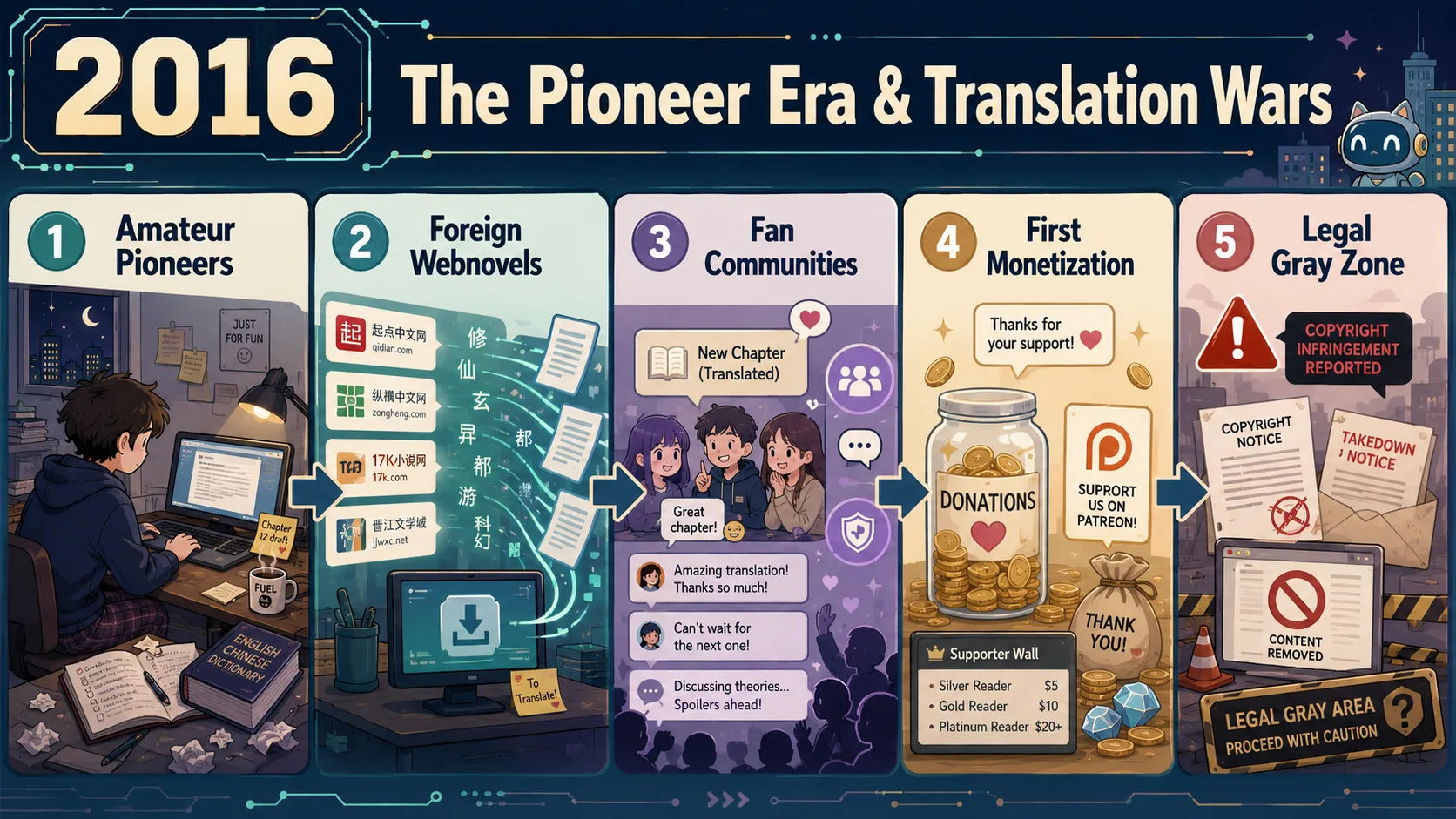
As the clock struck midnight on December 31, 2016, the web novel industry looked nothing like the chaotic, passionate hobbyist scene of 2015. In just twelve months, the “Corporate Invasion” had transformed the landscape from a series of independent city-states into a consolidated, professionalized, and data-driven marketplace.
The “Wild West” was officially closed.
This was The Midnight of 2016. It was the final moment of transition—the quiet breath before the storm of 2017, when the corporate giants would fully unveil their “Pay-to-Read” systems and the “Golden Age of the Fan-Translator” would end forever. In this final chapter of the 2016 Era, we look at the legacy of this pivotal year and the state of the community on the eve of its most significant transformation.
—
Part 1: The New Normal
By December 2016, the “New Normal” was firmly established. If you were a reader entering the scene for the first time, you didn’t see the “Messy WordPress Blogs” of the past. You saw polished platforms like Wuxiaworld, Gravity Tales, and the early Qidian International beta.
The user experience was slick. You had apps, you had accounts, you had Discord communities, and you had a predictable release schedule. The industry had “Stabilized.”
But this stability came with a hidden cost: The Death of Unpredictability. In 2015, you never knew what the next “Big Hit” would be. It could be a weird cooking novel, a philosophical mystery, or a classic Wuxia. By late 2016, you knew exactly what the next hit would be—it would be a “System” novel with “Infinite Progression” and a “Sentence-Long Title.”
The “Algorithm” (Chapter 31) had won. The industry was now a machine designed to produce “Predictable Yields” for its corporate masters. The “Discovery” had been replaced by “Recommendations.” The “Fan” had been replaced by the “Subscriber.”
—
Part 2: The Nostalgia for 2015
As 2016 ended, a sense of Nostalgia began to permeate the community. The older readers—those who had been there since the Spcnet days (Chapter 01)—began to talk about 2015 as a “Lost Paradise.”
They missed the “Wildness” of it all. They missed the days when a translator would post a 5,000-word rant in the after-chapter notes about their life, their dog, and their favorite ramen. They missed the feeling of being part of a “Secret Club” that was discovering a new world together.
In late 2016, the industry felt… professional. It felt like a job. The translators were no longer volunteers sharing their passion; they were contractors meeting their quotas. The “Community” had become an “Audience.”
This nostalgia wasn’t just about the stories; it was about the Vibe. 2015 was about “Discovery”; 2016 was about “Optimization.” The transition was necessary for survival, but it was spiritually exhausting for those who had loved the chaos. The industry had gained “Value,” but it had lost “Wonder.”
“I remember when Wuxiaworld was just a site where a guy translated some cool books for free. Now, it’s a ‘Company.’ I have to log in, I see ads everywhere, and the comments are full of people complaining about ‘Spirit Stone math.’ I’m happy for the translators—they’re finally getting paid—but I miss the days when it felt like we were all just friends hanging out on a forum. Now, I feel like a customer at a digital bookstore. The magic is gone, replaced by efficiency.”
— Archived Forum Post, NovelUpdates, December 2016
—
Part 3: The State of the “Big Three”
The “Big Three” (Wuxiaworld, Gravity Tales, Volare) ended 2016 as the masters of the western scene. They had survived the Great Realignment (Chapter 32), they had defended themselves against the Aggregator Virus (Chapter 28), and they had professionalized their UIs (Chapter 26).
They felt invincible.
They were generating millions of page views a month and hundreds of thousands of dollars in Patreon revenue. They had “Star Translators” who were more famous than traditional authors. They were the “Gatekeepers” of the Western web novel world.
But their foundations were built on a Legal Paradox. They were still operating in a “Grey Market.” While they were negotiating with Qidian, they didn’t yet have a total, bulletproof legal claim to the IP. They were “Legalizing” as fast as they could, but they were in a race against a corporate giant that could change the rules at any moment.
The “Big Three” were empires built on rented land. And the landlord (Qidian/Tencent) was about to come home.
—
Part 4: The 2017 Storm Warnings
As 2016 drew to a close, the “Storm Warnings” for 2017 were everywhere.
The Qidian International beta was growing more aggressive. The “Spirit Stone” model was being refined. The “Translator Hostage” contracts (Chapter 30) were becoming the industry standard.
The corporate giant was no longer “Invading”; it was Installing.
The industry was bracing for the official launch of Webnovel.com in May 2017. Everyone knew that this launch would change everything. It would be the moment that the “Grey Market” would have to choose: Submit or Die.
The independents knew they couldn’t compete with the capital and the IP-ownership of the giant. They were preparing for a 2017 that would be defined by “Buy-outs,” “Lawsuits,” and the final consolidation of the entire western market under a single corporate banner. 2016 was the “Corporate Invasion,” but 2017 would be the “Corporate Monarchy.”
—
Part 5: The Legacy of 2016
What was the ultimate legacy of 2016?
It was the year that proved Web Fiction was a Viable Industry. It was the year that the “Passion Economy” (Chapter 03) was successfully scaled into a “Professional Economy.”
In 2015, the question was: “Can we translate these books?”
In 2016, the question was: “How much money can we make translating these books?”
This shift in the question changed the soul of the industry. It attracted investors, it attracted corporations, and it attracted professional authors. It created the infrastructure that would eventually support millions of readers and thousands of creators.
2016 was also the year of the Financialization of Leisure. It was the moment corporations realized that “Fandom” wasn’t just a group of people liking a story; it was a quantifiable and harvestable resource. They learned that if they could control the access point (the hub) and the currency (Spirit Stones/Patreon), they could extract consistent value from the reader’s free time. Fandom was no longer a community; it was an “Addressable Market.” This realization would drive every major platform decision for the next ten years, turning web fiction into a high-efficiency extraction machine.
—
Part 6: The Final Roll Call—The Casualties of 2016
Before we leave 2016, we must acknowledge the ones who didn’t make it to the other side. Every great realignment has its casualties.
The end of 2016 saw the closure of hundreds of small translation groups, the abandonment of thousands of niche projects, and the retirement of some of the industry’s most creative pioneers. Sites like Gravity Tales (in its independent form) and dozens of solo WordPress blogs were either absorbed or simply vanished into the digital void.
This was the “Price of Maturity.” For the industry to grow, the “Hobbyists” had to be professionalized or purged. As we look at the slick, corporate platforms of 2017, we should remember the names of the small groups that laid the groundwork. They were the ones who proved that the market existed, only to be replaced by the ones who knew how to scale it.
—
Part 7: The Trope Legacy—The Face-Slap Engineering
We cannot leave 2016 without discussing the dominant literary trope that defined the year’s end: The Face-Slap Engineering.
As we saw in Chapter 36 (OP Protagonists), the audience was craving instant catharsis. This led to the perfection of the “Face-Slapping” plot beat—a high-efficiency cycle where an arrogant minor character insults the protagonist, only to be immediately and brutally humiliated in public.
In late 2016, this wasn’t just a trope; it was an Engineering standard. Authors were being told by their editors (and their metrics) to include at least one “Face-Slap” every ten chapters to maintain reader retention. It was the “Sugar Hit” of the webnovel world. This engineering of tropes marked the final transition of the industry from “Storytelling” to “Engagement Optimization.” The Face-Slap was the perfect weapon for the 2017 Corporate Era: it was easy to write, easy to translate, and guaranteed to keep the “Coins” flowing. 2016 was the year the soul of the story was mapped by an algorithm.
“I’m looking at my bookmarks folder and half of them are dead links. These were groups that were posting three chapters a week in January. Now, they don’t even have a ‘Goodbye’ post. They just stopped. I feel like I’m watching a small town get bulldozed to build a shopping mall. The mall is great—it has everything I want—but I miss the quirky little shops that used to be there. 2016 was the year the mall moved in.”
— Archived Forum Comment, NovelUpdates, December 31, 2016
—
Part 4.1: The Consolidation of Capital
As the clock ticked down to the midnight of 2016, the defining characteristic of the web fiction ecosystem was not the prose, or the tropes, or the translation speed. It was the absolute, terrifying consolidation of capital.
In January 2015, the “economy” of web fiction consisted of a few thousand dollars scattered across dozens of random PayPal accounts. It was a decentralized, chaotic, largely passion-driven hobby.
By December 2016, the economy was generating tens of millions of dollars annually, but that wealth was concentrated into an incredibly small, highly militarized oligarchy.
The “Sect Leaders” (the founders of Wuxiaworld, Gravity Tales, and the massive Patreon translators) had transitioned from passionate fans into ruthless CEOs. They were managing payrolls, negotiating international licensing agreements, and actively destroying their smaller rivals through aggressive poaching and SEO monopolization.
The democratization of publishing that the internet had promised was entirely dead. The independent ecosystem had successfully bypassed the traditional New York publishing gatekeepers, only to immediately construct a new, significantly more brutal set of digital gatekeepers.
Part 4.2: The Loss of the “Community” Illusion
The midnight of 2016 was the exact moment the community collectively realized that they were no longer a community; they were a demographic.
For two years, the readers had operated under the illusion that they were part of a grand, rebellious underground movement. They believed they were funding “the little guy” against the corporate machines. They actively participated in the “Translation Speed Wars” and the “Review Bombing Metas” because they felt a profound, parasocial ownership over the ecosystem.
But as the platforms introduced aggressive Gacha mechanics, as the translators locked their content behind increasingly expensive “Whale Tiers,” and as the independent hubs eagerly signed licensing deals with the very Chinese corporations they used to despise, the illusion shattered.
The readers realized they were not “Sect Members.” They were Data Points.
They were numbers on a spreadsheet, optimized for Patreon conversions, Ad-Sense clicks, and Daily Active User (DAU) metrics. The translators they idolized were writing 1,000-word chapters filled with repetitive filler not because of artistic vision, but because the NovelUpdates algorithm mathematically required it.
The Deep Cynicism of the Audience
This realization bred a deep, permanent cynicism within the Western readership. The innocence of the Spcnet forums was gone forever.
Readers stopped trusting the translators. They stopped viewing the authors as artists and started viewing them as content vendors. The relationship became purely transactional and highly antagonistic. If the author did not deliver the exact dopamine hit the reader paid for, the reader would immediately cancel their subscription and leave a toxic, 1-star review.
The “Cult of Personality” was replaced by the “Cult of the Consumer.”
Part 4.3: The Looming Shadow of 2017
As 2016 ended, the board was set for the bloodiest corporate war in the history of the medium.
The independent hubs had built the infrastructure, proved the viability of the Western market, and consolidated the audience into easily identifiable Walled Gardens. They had done all the hard, chaotic work of birthing a new industry.
And China Literature (Qidian) was waiting perfectly in the wings, backed by the infinite capital of Tencent, preparing to launch the official Webnovel.com application and systematically dismantle the entire independent scene they had just finished building.
The independents had built the kingdom, but they did not own the land. As the calendar rolled over to 2017, the original creators of the IP were arriving to collect their rent, and they were bringing an army of lawyers, algorithmic engineers, and infinite micro-transaction infrastructure with them.
The Wild West was officially over. The era of the Corporate Leviathan was about to begin.
Actionable Takeaways for the Modern Author
The Midnight of 2016 proved that every industry eventually consolidates. To survive as a modern author, you must be prepared for the “Corporate Phase” of your career.
1. The Adaptability Mindset—The Survival of the Flexible
The authors and translators who survived 2016 were those who were willing to adapt. They didn’t cling to the “Old Ways” of WordPress blogs and volunteer work. They professionalized, they joined hubs, they started Patreons, and they learned the “Algorithm.” In 2026, the market will change again. Your ability to pivot—to learn new platforms, new technologies (like AI assistance), and new marketing tactics—is your only true job security. Resistance to change is the first step toward obsolescence in a high-velocity digital market.
2. Recognize the “Consolidation Peak”—Choosing Your Side
In every industry, there is a moment where “Growth” turns into “Consolidation.” This is the moment where the small players are bought out or crushed. If you see your industry reaching this peak (look for mergers, centralized platforms, and standardized pricing), it is time to choose your side. Do you want to be an “Independent Rebel” (harder, but potentially more rewarding) or a “Platform Professional” (safer, but less autonomous)? Make your choice before the market makes it for you. Being caught in the middle is where you get crushed.
3. Build Your “Independent Brand” Early—The Asset of Voice
The only people who had any bargaining power during the 2016 consolidation were those who had a Direct Relationship with the Reader. If your readers follow you for Your Voice, you can move from platform to platform. If they follow you for the Novel you translate, you are disposable. In 2026, focus on building your personal “Author Brand.” Your brand is the only asset you take with you when the platform dies or gets bought out. Quality of prose is the baseline; quality of connection is the multiplier.
4. The “Sunk Cost” Trap—Sustainability over Sprints
The “Burnout Generation” of late 2016 proved that sometimes, the “Professional” dream is actually a nightmare. Don’t fall into the “Sunk Cost” trap of working yourself to death just to maintain a “Buffer.” If the industry has become a treadmill that you can’t keep up with, it is better to step off and find a new “Wild West” than to burn out and lose your love for the craft. Longevity is built on sustainability, not on sprinting until you collapse. A career is a marathon; don’t let the 2016 “Speed War” convince you that every day has to be a sprint.
5. Document Your History—The Preservation of the Self
The nostalgia of late 2016 showed how quickly a community’s history can be erased by corporate consolidation. Document your journey. Keep copies of your early drafts, your fan-interactions, and your personal milestones. When the “Corporate Giant” eventually paves over your “Small Town,” your records will be the only thing that proves it ever existed. Your history is your legacy, and in a data-driven world, your personal story is the only thing that cannot be commodified.
6. The “Platform Exit” Plan
Always have an exit strategy. The lessons of the “Great Realignment” teach us that platforms are transient. Whether you are on Royal Road, Webnovel, or Amazon, you must have a plan for how you will survive if that platform suddenly changes its terms or collapses entirely. Diversification is not just a financial strategy; it is a creative survival strategy. Never let a single entity own 100% of your access to your readers.
*(The clock had struck midnight. The 2016 Era was over. The wild, chaotic, and beautiful world of the ‘Corporate Invasion’ was about to be replaced by the monolithic ‘Corporate Dominance’ of 2017. But the lessons of 2016 remain: the industry belongs to those who control the traffic, the technology, and the trust of the reader. As we move into 2017 – Chapter 41: The Wuxiaworld DMCA War, we enter the modern era of web fiction).*
0 Comments