2017 – 11 – The Return of the Original
by EternalibChapter 51: The Return of the Original—The Birth of the Western Web Novel
By late 2017, a profound, structural shift was quietly occurring within the Western web fiction community. After three intense years of exclusively consuming Chinese-translated Cultivation novels, the global readership was beginning to experience terminal Content Fatigue. They were increasingly exhausted by the endless parade of “Arrogant Young Masters,” the repetitive “Face-Slapping” tropes, and the homogenized prose required by the corporate content mills.
This chapter explores the Return of the Original—the pivotal historical moment when Western authors residing on platforms like Royal Road, ScribbleHub, and personal WordPress blogs realized that they didn’t merely want to read progression fantasy; they possessed the tools to write it themselves. It was the birth of the “Western Web Novel” identity, a grassroots, decentralizing movement that would eventually challenge the Eastern corporate monopolies for absolute dominance over the English-speaking market.
—
Part 1: The “Mother of Learning” Effect and Content Fatigue
If the 2017 Corporate Monarchy was fundamentally defined by the sheer, relentless “Speed” of its output (as analyzed in Chapter 47), the emerging Western Original movement was defined entirely by its desperate return to “Craft.”
As the translation hubs transitioned into algorithmic content mills, the quality of prose universally plummeted. Western readers, initially captivated by the novelty of Eastern Daoist philosophy, began to realize they were reading the exact same story, slightly remixed, fifty different times. The market was critically saturated.
The most historically significant antidote to this fatigue was “Mother of Learning” by the pseudonymous author nobody103.
While the Chinese translation factories were ruthlessly pumping out fourteen chapters a week of raw, hybrid-MTL prose, Mother of Learning was operating on an entirely different paradigm. The author released one massive, highly polished, 10,000-word chapter approximately every three to four weeks.
The explosive, undeniable success of Mother of Learning served as a Strategic Proof of Concept for the entire Western community. It definitively proved that Western readers were perfectly willing to wait an entire month for a single chapter update, provided the world-building was meticulously deep, the character psychology was complex, and the internal logic of the magic system was perfectly consistent. It demonstrated that “Quality” was the only viable weapon a solo Western author possessed to effectively compete with the “Speed” of the corporate manufacturing lines.
This single novel became the “North Star” for an entire generation of independent authors. It proved that you did not have to emulate the Chinese quota system to capture the audience; you simply had to write a story that respected the reader’s intelligence.
—
Part 2: The LitRPG Explosion and the Westernization of Tropes
While Chinese web fiction relied heavily on the culturally specific tropes of “Xianxia” (immortality cultivation, Daoist philosophy, and tribulation lightning), Western authors struggled to authentically replicate those themes without sounding derivative. Instead, they discovered their own “Golden Goose” in a subgenre that perfectly aligned with Western cultural touchstones: LitRPG (Literary Role-Playing Games).
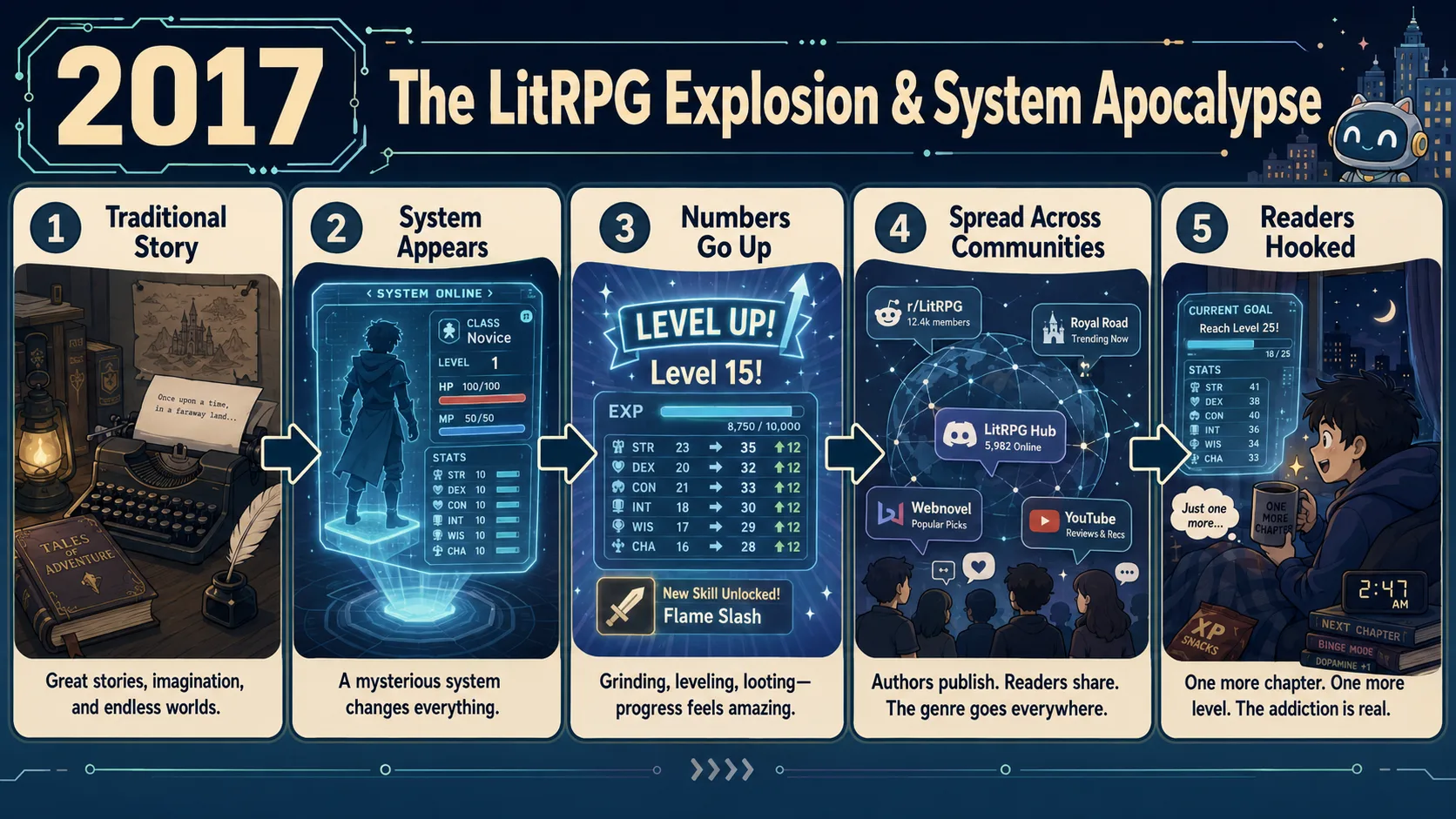
Western readers, predominantly millennials and Gen Z, had grown up fundamentally immersed in the mechanics of video games—World of Warcraft, Dungeons & Dragons, Diablo, and Skyrim. The concept of a protagonist progressing through numerical “Levels,” allocating “Stat Points,” and unlocking “Skill Trees” was deeply embedded in their cultural DNA.
The breakthrough innovation of the Western LitRPG movement was the “Blue Screen” Aesthetic. By explicitly incorporating actual “System Prompts” and numerical “Character Sheets” directly into the text, Western authors created a highly addictive “Second-Layer Narrative.” The reader wasn’t merely passively reading a story; they were subconsciously “playing” it vicariously alongside the protagonist, calculating optimal stat distributions in their own heads.
This tapped into the profound Gamification of Reading. While the Chinese “Spirit Stone” economy (Chapter 49) cynically gamified the act of spending money, the Western LitRPG movement gamified the act of consuming the narrative. This was a vastly more sustainable, creative, and ethical form of engagement.
Furthermore, as the Western movement matured, authors began to aggressively “Subvert” the very Eastern tropes that had initially inspired them. Instead of relying on the “Murder-Hobo” protagonist who slaughters entire bloodlines over a perceived minor insult, Western authors reintroduced Moral Complexity. They wrote about flawed heroes who struggled deeply with the ethics of their immense power, protagonists who valued genuine teamwork and party mechanics over individual, arrogant dominance, and characters who possessed meaningful platonic relationships rather than merely collecting two-dimensional “Jade Beauties” for a harem.
This “Cultural Synthesis” became the secret sauce of the Western web novel. It stripped the highly addictive “Bones” of the Eastern progression system and covered them with “Western Flesh”—infusing them with Western character arcs, humor, and pacing. It created a product that was intimately relatable to English-speaking audiences while remaining fundamentally “Un-Put-Down-Able.” By 2018, LitRPG and “Progression Fantasy” had become the dominant cultural forces on independent platforms like Royal Road, creating a thriving, native ecosystem that existed completely outside the gravitational pull of the Chinese corporate platforms.
—
Part 3: The “Royal Road + Patreon” Model and the Sovereign Creator
The most important philosophical driver of the Western Original movement wasn’t merely the desire for creative expression; it was an absolute demand for “Sovereignty.”
Western authors and translators had watched the brutal “Slave Contract” scandal unfold on Webnovel (Chapter 48). They had witnessed the devastating “GravityTales Secret Buyout” (Chapter 46) and the subsequent destruction of that community. They realized a terrifying structural truth: if they signed their rights away to a centralized corporate platform, they were essentially building a beautiful house on a landlord’s shifting sand.
This realization led directly to the widespread adoption of the “Royal Road + Patreon” Model.
The architecture of this model was brilliantly simple and highly resilient:
1. Royal Road (The Discovery Engine): Authors published their serialized chapters entirely for free on Royal Road (and later, ScribbleHub). They utilized the platform’s organic algorithm and massive, hungry user base strictly for “Discovery” and “Community Building.”
2. Patreon (The Monetization Engine): Authors simultaneously ran a Patreon campaign, offering their most dedicated readers “Advanced Chapters” (early access) in exchange for a monthly subscription.
This dual-platform model was revolutionary because it allowed the author to maintain 100% Legal Ownership of their Intellectual Property. They did not need to negotiate a predatory contract with a faceless executive. They did not need a “Sign-on Bonus” that secretly contained a “Work-for-Hire” kill switch. They were actively building their own “Direct-to-Consumer” digital empires.
This was the true birth of the Sovereign Creator. The Western authors realized they did not need the “Official” blessing of a Tencent subsidiary to be financially successful. They could cultivate a direct, unmediated financial relationship with their readership. This independence was fortified by the creation of massive, author-owned Discord Servers. Unlike the desperate begging in corporate “Author Notes,” Western authors became “Community Leaders.” They hosted 24/7 chat rooms, directly interacting with their fans, discussing lore, and building deep relational value. You can write a script to scrape and steal a novel’s text, but you cannot mathematically steal a community’s loyalty.
—
Part 4: The “Hybrid Pipeline” and the Kindle Unlimited Pivot
The final, crucial evolution of the 2017 Western Original movement was the strategic crossover into Traditional Digital Publishing.
As Western authors accumulated massive backlogs of serialized chapters on Royal Road, they realized they were sitting on highly lucrative, unmonetized assets. This led to the discovery of the Amazon Kindle Unlimited (KU) ecosystem.
Independent authors quickly identified that the highly addictive “Progression” hooks of web fiction worked perfectly in synergy with the Kindle Unlimited algorithm. If an author bundled 100,000 words of their serialized web novel into a professionally edited “Volume 1” and published it on Amazon, KU readers would voraciously “Binge” the entire book in a single weekend, generating a massive, secondary payout from Amazon’s “Page Reads” pool.
This discovery created the definitive “Hybrid Publishing” Pipeline that dominates the industry today:
1. Draft and Serialize: Post the raw chapters publicly on Royal Road to build a massive, free audience and capture organic marketing.
2. Monetize Early Access: Funnel the most dedicated 5% of that free audience to Patreon, generating a stable, monthly salary via advanced chapters.
3. Bundle and Retail: Take down the oldest, finished arcs from Royal Road, professionally edit them, commission high-quality cover art, and publish them on Amazon Kindle Unlimited to generate long-term residual income and capture the mainstream eBook audience.
This pipeline was the “Holy Grail” of 2017. It allowed an independent author to earn money at every single stage of the creative lifecycle. It was the absolute antithesis of the corporate “Slave Contract” model. In the corporate model, you received one opaque royalty check and permanently lost your global rights. In the Western hybrid model, you received three distinct paychecks from three different platforms, and you kept everything.
This profound economic realization was the precise moment the Western “Hobbyist” matured into a “Business Owner.” The “Corporate Monarchy” had optimized entirely for the “App Store” micro-transaction. The “Western Rebels” had successfully optimized for the “Career.” This foundational, strategic divergence is the primary reason why the Western independent scene is currently more robust, more creative, and more financially healthy than the corporate-owned translation scene in 2026.
—
Part 4.1: The Death of the Translation Meta
The defining shift of late 2017 was the realization that the era of the “Fan-Translator” as the absolute king of the industry was permanently over.
For three years (2014-2016), the translations of Chinese Xianxia and Korean LitRPG were the sole economic engines of the Western web fiction scene. But the events of 2017—the DMCA wars, the Gravity Tales buyout, the abysmal MTL quality of Webnovel.com—had rendered the translation space a toxic, legally radioactive wasteland.
If a creator wanted to build a sustainable, $10,000-a-month Patreon income, they could no longer rely on translating someone else’s IP. Qidian would simply DMCA them and steal their audience.
This legal reality forced the massive capital migration toward Original English Literature (OEL).
The “Return of the Original” was not driven by a sudden burst of artistic inspiration in the West. It was a purely pragmatic, survivalist evolution. The independent creators recognized that the only impenetrable defense against corporate lawsuits was 100% undisputed ownership of the copyright. You cannot issue a DMCA strike against a creator who invented the characters in their own bedroom.
The Cultural Synthesis of OEL
However, the OEL boom of late 2017 did not resemble traditional Western fantasy. The authors on Royal Road did not revert to writing Lord of the Rings clones or urban fantasy.
They had spent three years translating and consuming highly optimized Chinese and Korean power fantasies. They had reverse-engineered the exact psychological mechanisms that drove Patreon conversions: The endless progression loop, the explicit stats, the “Face-Slapping” tropes, and the OP Protagonist (Chapter 36).
The Return of the Original birthed a unique, localized cultural synthesis: Western Progression Fantasy.
Authors took the hyper-addictive pacing of Korean LitRPG and the power ceilings of Chinese Xianxia, but stripped away the confusing cultural idioms, the stilted translation grammar, and the extreme, culturally specific misogyny that often plagued the translated works. They localized the dopamine hit.
They wrote stories about Western teenagers who were suddenly thrust into gamified universes, utilizing familiar Dungeons & Dragons mechanics, but executing them with the brutal, daily serialization pace of a Chinese content mill.
Part 4.2: Royal Road’s Ascendency
As the translation hubs (Wuxiaworld, Gravity Tales) became bogged down in corporate warfare and licensing disputes, Royal Road quietly emerged as the undisputed capital of the independent ecosystem.
Royal Road had originally been built as a fan-fiction site for a specific Korean novel (Legend of Moonlight Sculptor). But by 2017, it had pivoted entirely into hosting Original English fiction.
Crucially, Royal Road did not demand IP rights from its authors. It operated as a pure discovery engine (similar to NovelUpdates). It hosted the text, provided a highly functional “Trending” algorithm, and allowed authors to freely link to their own external Patreon accounts.
For the authors who had survived the Webnovel “Slave Contract” rebellion (Chapter 50), Royal Road was a sanctuary. It allowed them to retain total ownership of their work while still accessing an algorithmic megaphone that could drive tens of thousands of readers to their Patreon funnels.
The Amazon Kindle Pivot
The Return of the Original also opened up a massive, highly lucrative secondary revenue stream that was completely unavailable to the translators: Amazon Kindle Unlimited (KU).
Translators could never publish their work on Amazon because they didn’t own the copyright. But the OEL authors on Royal Road realized that once they finished a “Volume” (roughly 100 chapters), they could easily pull those chapters down from Royal Road, package them into an eBook, and sell them on Amazon.
The LitRPG audience on Amazon was massive and ravenous. Authors discovered that they could make $10,000 a month on Patreon while serializing the novel, and then make an additional $20,000 in a single month when they launched the compiled eBook on Kindle Unlimited.
This dual-revenue stream (Patreon + Amazon) proved that the independent model was not just surviving the corporate invasion; it was actively evolving past it. The authors had successfully cut the Chinese corporations out of the supply chain entirely, proving that the true value of the ecosystem was not the Chinese Intellectual Property, but the serialized progression format itself.
Part 5: Actionable Takeaways for the Modern Author (2026)
The “Return of the Original” in 2017 serves as the ultimate historical blueprint for Market Differentiation and Creator Sovereignty.
1. Identify “Trope Fatigue” and Subvert It
In 2026, the market is heavily saturated with “System Apocalypses,” “Dungeon Cores,” and generic “Isekai” narratives. You must actively look for audience fatigue. What are readers tired of? What is the “Missing Element” in the current top 10 rankings? Your greatest commercial opportunity lies in “Trope Subversion.” Do not write a slightly better clone of the current number one novel; write the brilliant “Anti-Clone.” Give the audience the progression they crave, but wrap it in the emotional depth they have been starved of.
2. Craft is Your Ultimate Competitive Advantage
Corporate “Content Mills” and modern Artificial Intelligence tools can produce “Competent” prose at infinite speed. They cannot, however, produce “Deep, Thematic World-Building” or “Genuine Emotional Resonance.” If you wish to survive the AI-generated era, you must lean heavily into your “Human Craft.” Write the deeply specific, culturally nuanced story that requires a human heart to conceptualize. That is the only asset that cannot be mathematically industrialized.
3. Build Your “Discovery Engine” on Open Platforms
Platforms like Royal Road remain the greatest arenas in the world to find your first 1,000 true fans. Do not hide your debut work behind a paywall from day one. Utilize the “Free” platforms strictly as a Top-of-Funnel Marketing Engine. Give the readers a compelling reason to fall in love with your world for free, and they will happily follow you to the “End of the World” (or, more practically, to your Patreon checkout page).
4. Direct Ownership is the “Forever” Play
Never sign away your permanent global rights for the illusion of “Corporate Prestige.” The “Official” title is almost always a gilded trap. The only metric that matters in a thirty-year career is Who holds the deed to the IP. If you maintain ownership of your work, you can adapt it to new formats, license it for audio, sell it to Hollywood, or keep it forever. If you don’t own it, you are merely a “Temporary Tenant” working on an assembly line inside your own imagination. Be the Sovereign Landlord.
*(The Western authors had discovered their native voice, and the original stories were rising rapidly in popularity. But to transition this movement from a ‘Hobby’ into a sustainable ‘Career,’ they required a financial infrastructure that bypassed the corporate paywalls. In Chapter 52: The Patreon Salvation, we deeply examine the decentralized economy that made the rebel author possible).*
0 Comments