

2017 – 13 – The Great Mainstream Migration
by EternalibChapter 53: The Great Mainstream Migration—The Kindle Unlimited Bridge
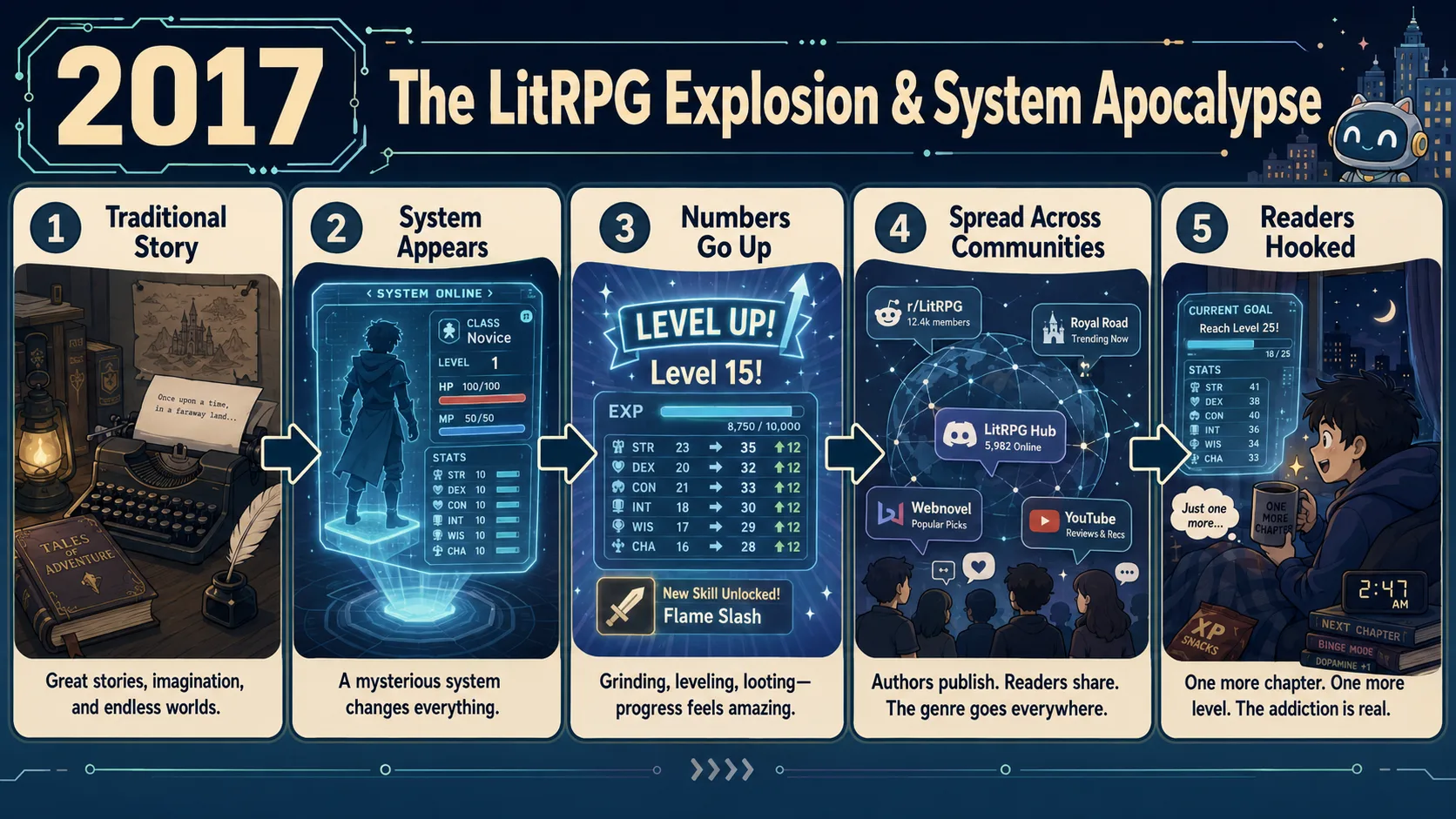
By late 2017, the “Corporate Monarchy” (Chapter 45) had successfully annexed the translation territory. Platforms like Qidian and Webnovel had turned an underground, passionate hobby into a highly optimized, billion-dollar data-mining operation. But as the corporate walls grew higher in the East, the “Rebel” authors of the West (Chapter 51) discovered a highly lucrative backdoor into the largest, most profitable entertainment market in the world: Amazon Kindle Unlimited (KU).
This was the Great Mainstream Migration, the definitive moment when web fiction ceased to be a mere “niche internet subculture” and began a massive, uncoordinated assault on the traditional publishing world. It is the historical account of how the adrenaline-fueled “Web Novel Pacing” violently collided with the “Amazon Algorithm,” creating a brand-new class of self-made millionaires who bypassed the traditional gatekeepers of both New York publishing houses and Beijing corporate conglomerates.
—
Part 1: The “Page-Read” Economy and the Algorithm of Addiction
To fundamentally understand why web fiction suddenly exploded on the Amazon marketplace in late 2017, one must understand the unique architecture of the “Page-Read” Economy.
Unlike a traditional brick-and-mortar bookstore (or even the standard Amazon retail store) where a consumer pays a flat fee for a book once, the Kindle Unlimited subscription program pays authors from a global fund based strictly on the number of individual pages read by subscribers. For the web novel industry, this was the ultimate “Smoking Gun.”
Web novels are inherently, structurally designed for “Binge-Reading.” They are overflowing with cliffhangers, constant power progression, and massive, unbroken character arcs (Chapter 4). While a prestigious, traditional “Literary” novel might consist of 80,000 words of slow-burn prose designed to be savored over a month, a standard web novel volume is often 150,000 words of pure, unadulterated “Hook” content designed to be devoured in a single weekend.
The Amazon recommendation algorithm, heavily optimized by Seattle data scientists to promote “High Consumer Engagement,” suddenly detected an anomaly. It realized that a highly specific group of books—mostly LitRPG and Western Progression Fantasy—were generating unprecedented engagement metrics. Readers weren’t merely downloading these books; they were “Binging” every single page from cover to cover in one sitting, and then immediately downloading the sequel. Because KU pays per page, the financial payouts for these independent web authors were astronomical. The aggressive “Serial Pacing” that the corporate apps utilized to extract micro-transaction “Spirit Stones” (Chapter 49) was the exact same pacing that allowed Western authors to conquer the Amazon Kindle bestseller lists.
In 2017, word began to spread like wildfire through the Royal Road forums and Reddit communities: “Western Originals” were quietly making $10,000 to $30,000 a month in passive income through Kindle Unlimited page reads. This rumor triggered the “Amazon Gold Rush.” Authors who had previously been thrilled to earn a supplementary $500 a month via Patreon (Chapter 52) suddenly realized they were sitting on a massive “Backlog” of serialized chapters that was fundamentally worth a fortune.
—
Part 2: The “Web-to-Print” Pipeline and Professional Packaging
However, the Amazon Gold Rush was initially a “Passive Income” Mirage. While the massive payouts were mathematically real, the labor required to capture them was immense. Unlike a decentralized web platform like Royal Road where an author can comfortably “Draft in Public” (Chapter 3), the Amazon marketplace demanded a rigorous level of “Finish” that most amateur web authors were entirely unprepared to deliver.
The Gold Rush wasn’t won by the fastest typists; it was decisively won by the authors who first understood the “Packaging” Meta. They realized that on Amazon, you were no longer merely serializing a “Story”; you were manufacturing and selling a highly competitive “Product.” The era of the pure “Hobbyist” was officially over. If you wanted the Amazon paycheck, you had to transform yourself into a Professional Publisher.
This forced the first major “Quality Filter” upon the web novel community. On a free web platform, readers are highly forgiving. They willingly accept typos, meandering “Filler” chapters, and inconsistent pacing as part of the “Live, Interactive” experience. On Amazon, however, a single prominent 1-star review complaining about “Poor Grammar” or “Confusing Formatting” could permanently destroy a book’s momentum and bury it in the algorithm.
This reality led to the rapid development of the “Web-to-Print” Pipeline. Successful authors began actively hiring professional copy-editors and proofreaders. This created a definitive Bifurcation of Quality:
1. The “Live” Draft (Royal Road): Raw, fast, interactive, and entirely community-driven.
2. The “Canonical” Volume (Amazon): Polished, structurally tightened, professionally edited, and mainstream-ready.
This professionalization was heavily visually driven by the “Cover Art” Revolution. In 2015, a web novel “Cover” was generally a piece of uncredited, stolen anime art or a blurry, royalty-free photo pulled from Google Images. In the 2017 Amazon migration, commissioning professional Cover Art became a mandatory $1,000 Investment.
Authors quickly realized that Amazon was a ruthless visual marketplace. If your book lacked a custom-illustrated cover that looked like a “Triple-A” video game or a Marvel movie poster, the mainstream reader simply wouldn’t click the link. This massive influx of capital created the definitive “Genre Aesthetic” (e.g., blue neon screens and glowing swords for LitRPG; dramatic landscapes and flowing robes for Cultivation). The “Web Novel” was no longer just a wall of text; it had evolved into a premium visual brand.
—
Part 3: The Box Set Meta and the Canonical Split
The ultimate financial weapon of the 2017 migrant author was the deployment of the “Box Set.”
Because serialized web novels are effectively infinite, an author who had been writing consistently for two years might possess enough content for ten traditional “Volumes.” Once the initial “Release Hype” and algorithm boost for Book 1 died down, the author would strategically bundle Books 1, 2, and 3 into a single, massive “Box Set” file, offering it at a discounted retail price or as a single, monumental KU download.
This became the ultimate “Residual Income” Machine. Book 1 acted as the “Lead Magnet” (often aggressively priced at $0.99 or given away for free). Books 2 through 5 provided the “Full Price” retail revenue. The Box Set captured the hyper-voracious “Binge-Readers” who wanted the absolute maximum value for their monthly KU subscription. This strategy allowed web fiction authors to utterly dominate the “Long-Tail” Market. While a traditional author’s sales might crater after the first thirty days, a web novel author could generate consistent, high-volume revenue for years, because their backlog was effectively a “Digital Real Estate” portfolio that paid monthly algorithmic rent.
However, as this migration matured, a fascinating narrative phenomenon emerged: The Canonical Split.
Authors discovered that the “Infinite Bloat” characteristic of a serialized web novel (Chapter 47) frequently ruined the pacing of a traditional 400-page book. To make the story “Mainstream-Ready,” authors began executing significant, structural changes during the editing process. They ruthlessly cut entire “Filler” arcs, combined secondary characters to simplify the plot, and actively rewrote the underlying “Numbers” in their LitRPG systems to ensure the math actually made logical sense under scrutiny.
This created a Two-Tier Narrative Reality. There was the “Web Version” that the hardcore, original fans on Patreon had read, and the distinctly different “Published Version” that the mainstream Amazon audience consumed. This split was the first definitive sign of the “Genre Maturation” of web fiction. It was no longer a raw digital diary; it was becoming a Transmedia IP that structurally adjusted its form to perfectly fit its commercial container.
—
Part 4: The Exclusivity Trap and the Review Culture Shock
While the Amazon migration generated unprecedented wealth, it also introduced a massive Loss of Direct Sovereignty.
When an independent author moved their primary monetization pipeline to Amazon, they were fundamentally trading their “Community Gating” (Chapter 52) for a “Corporation’s Algorithm.” To access the lucrative “Page-Read” payouts, Amazon strictly required authors to enroll their books in KDP Select. This legal agreement mandated total digital exclusivity; the author could not publish that specific volume on any other digital platform—not Apple, not Google, not Kobo, and critically, not Royal Road.
For the web novel author, this created a massive Strategic Crisis. If they kept the story free on Royal Road, they legally violated the Amazon exclusivity agreement and risked losing their KU income. If they removed their story from the open web, they instantly lost their massive “Discovery Engine” (Chapter 51).
This agonizing dilemma led to the invention of the “Stubbing” Meta. Authors would “Stub” their novels, meaning they would permanently delete the majority of the chapters from the free platforms once the book was published on Amazon, leaving only a small “Free Sample” behind to serve as a marketing hook. This was the exact historical moment the web novel community first truly felt the Pain of Centralization. Authors were being financially coerced into choosing between “Community Reach” and “Amazon Revenue.” The “Exclusivity Trap” turned Amazon into a financial “Black Hole” that slowly sucked the free content out of the open web.
Furthermore, the migrating authors faced a brutal Collision of Review Cultures.
On a platform like Royal Road, a “3-star review” was generally considered a polite, constructive critique from a dedicated fan. On Amazon, a “3-star review” was a Death Sentence. Because of the aggressive way the Amazon algorithm weighted user ratings, any book that dropped below a 4.2-star average became algorithmically “Invisible.”
Web authors, who were intimately accustomed to the “Iterative Improvement” of the web (where they could simply fix typos based on immediate reader comments), suddenly faced the terrifying “Permanent Record” of Amazon reviews. Traditional book reviewers, accustomed to high-brow literary fiction, would stumble upon a LitRPG novel and give it 1 star simply because “The math was too confusing.” This forced authors to develop a defensive “Thick Skin” and a “Defensive Editing” style, intentionally smoothing out the “Weird” creativity of the web to appease the demands of the mainstream marketplace.
—
Part 4.1: The Amazon Kindle Collision
By late 2017, the Original English (OEL) authors on Royal Road had perfected the LitRPG formula. They possessed massive, highly engaged audiences, and they were generating significant revenue through Patreon. But the true inflection point of the industry occurred when these authors began migrating their serialized works onto the traditional retail monolith: Amazon Kindle.
This migration caused a massive, highly disruptive collision with the traditional publishing industry.
When a top-tier LitRPG author published Volume 1 of their serialized web novel on Amazon Kindle Unlimited (KU), they did not launch it into a vacuum. They launched it with the algorithmic backing of 5,000 highly mobilized Patreon subscribers.
On release day, the author would direct their entire Patreon Discord server to download the book on Amazon and leave a 5-star review. This massive, concentrated spike in downloads instantly broke Amazon’s visibility algorithm. The web novel would immediately rocket to the #1 spot in Amazon’s “Epic Fantasy” and “Science Fiction” categories, completely displacing traditional, traditionally published, New York Times bestselling authors.
The Cultural Shock of the Traditional Industry
The traditional publishing industry was entirely blindsided by this. They could not understand how a self-published book, often featuring a bizarre anime-style cover, minimal editing, and prose that read like a video game manual, was suddenly dominating their carefully curated bestseller lists.
Traditional publishers viewed LitRPG as amateurish, unmarketable garbage. They fundamentally failed to understand that the web fiction authors were not selling traditional narratives; they were selling highly optimized dopamine delivery systems.
The traditional authors, who spent two years agonizing over a single 90,000-word manuscript, watched in horror as a web fiction author released a 150,000-word novel every three months, generating tens of thousands of dollars in Kindle Unlimited page-reads while absolutely crushing them in the algorithmic rankings.
Part 4.2: The Kindle Unlimited “Page Read” Exploit
The architecture of Amazon’s Kindle Unlimited (KU) program was uniquely vulnerable to the web fiction meta.
KU pays authors based on the number of pages a reader actually reads, rather than a flat fee per book purchase. The payout is fractionally small (often less than half a cent per page).
However, web fiction authors were already trained by the 10,000-Word Mandate (Chapter 47). They were accustomed to writing incredibly long, heavily padded, massive epics. A standard web fiction “Volume” published on Amazon was often 1,000 pages long.
If a reader devoured a 1,000-page LitRPG novel on Kindle Unlimited, the author earned roughly $4.50. Because the web fiction audience was trained to read at incredible speeds (often skimming the filler to find the stat blocks), they would routinely read three or four of these massive volumes a week.
The web fiction authors had successfully ported their high-volume, industrialized production model directly into Amazon’s payout structure, effectively strip-mining the KU global fund.
Part 4.3: The Dual-Pipeline Supremacy
The Great Mainstream Migration established the absolute supremacy of the “Dual-Pipeline” business model.
An independent creator no longer chose between serialized web fiction OR traditional publishing. They utilized both, synergistically.
1. The Royal Road / Patreon Pipeline: The author serialized the novel chapter-by-chapter, building a massive community, refining the pacing based on real-time feedback, and generating a highly stable monthly income.
2. The Amazon Kindle Pipeline: The author bundled those chapters into formal eBooks and audiobooks, utilizing their Patreon audience as an algorithmic battering ram to conquer the Amazon bestseller lists and access the mainstream, non-forum-dwelling consumer.
This model created unprecedented wealth for independent creators. Authors who had been translating Chinese novels for $1,500 a month in 2016 were suddenly generating $50,000 a month in 2017 by writing their own LitRPG epics and dominating both Patreon and Amazon simultaneously. The mainstream migration proved that the web fiction ecosystem was no longer a fringe hobby; it was the most ruthlessly efficient, mathematically optimized sector of the modern publishing industry.
Part 5: Actionable Takeaways for the Modern Author (2026)
The 2017 Mainstream Migration definitively proved that pacing is a web author’s most valuable narrative asset, but professional packaging is their only commercial protection.
1. Execute the “KU-First” Drafting Strategy
In 2026, do not merely write “Chapters” into the void; write “Volumes.” Every 100,000 words, you must engineer a “Major Narrative Climax” that can structurally serve as the satisfying ending of a standalone book. If you design your web serial with the eventual “Amazon Volume” in mind from Day 1, your eventual editing costs and structural rewrites will be reduced by 80%. Pacing for the “Binge” is exactly how you pace for the “Payout.”
2. Professionalism is Not “Selling Out”
A professional cover and a clean, typo-free edit are not “Corporate Requirements.” They are Reader Requirements. In a modern market heavily saturated with AI-generated sludge and low-effort serials, a “High-End Finish” is the only reliable way to visually signal quality. Invest heavily in your packaging. If your book aesthetically looks like a “Top 10” bestseller, the algorithm is significantly more likely to treat it like one.
3. Master the “Stubbing” Balance
When you are legally required to “Stub” your novel for Amazon KU, do not delete everything. Always leave the first 10-15 chapters on the free platforms. These remaining chapters act as your permanent “Lead Magnet.” They are the highly optimized “Free Sample” that hooks the new reader and drives them directly to the paid version on Amazon. In 2026, giving away “Free Content” is not a “Financial Loss”; it is your single most effective “Marketing Spend.”
4. Direct Ownership vs. The Algorithm
Never rely 100% on Kindle Unlimited for your survival. It is an incredibly powerful tool, but it is a tool owned by a trillion-dollar corporation that fundamentally does not care if you succeed or fail. Always aggressively maintain a “Direct” revenue stream (a Patreon, a personal Shopify site, or Kickstarter) alongside your Amazon presence. The “Amazon Money” should be viewed as your “Expansion Capital,” while your direct “Community Money” is your unshakeable “Survival Capital.”
*(The Western authors had successfully conquered the text-based markets of Amazon, but the true, ultimate global explosion of the medium required something more: Visuals. In Chapter 54: The Webtoon Synthesis, we explore the historical moment when ‘Reading’ transformed into ‘Watching’ through the rise of the high-production comic funnel).*
0 Comments