0000 – 00 – Prologue – The TLDR
by EternalibPrologue: The Complete Webnovel Timeline (2014 – Present)
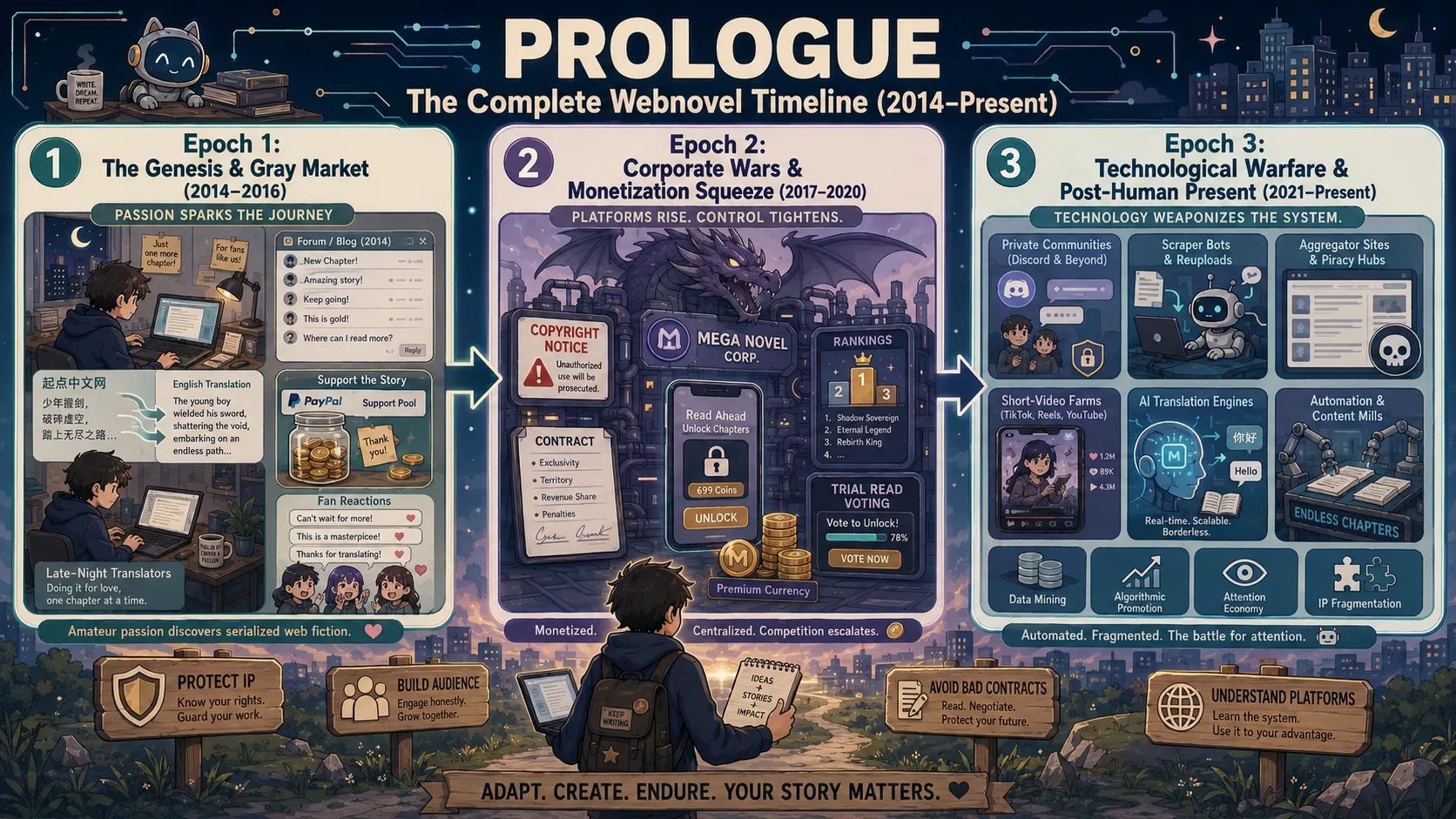
If you want to trace the evolution of the modern internet economy—specifically the intersection of micro-transactions, parasocial creator dynamics, and hyper-addictive content serialization—you do not look at Silicon Valley. You do not look at traditional New York publishing houses. You look at a decentralized, legally terrifying, and relentlessly chaotic ecosystem that started on an obscure television drama forum in 2014.
This is the definitive, macro-historical summary of the Webnovel Trends era. It is the story of how an army of amateur bilingual college students accidentally built a multi-million-dollar pirate empire, how a Chinese corporate titan violently dismantled that empire to build a global monopoly, and how the readers desperately fought back against the ever-tightening grip of algorithmic paywalls.
If you are a modern web-serial author publishing on Royal Road, Webnovel, or Kindle Vella today, this timeline is your foundational history. You are operating inside an architecture built from the blood, burnout, and lawsuits of the last decade. Every monetization tier, every cliffhanger strategy, and every algorithmic anxiety you experience today was beta-tested by a teenager translating a Chinese martial arts novel at three in the morning in 2015.
This is the complete timeline, broken down into the three major epochs that defined the industry.
—
Epoch 1: The Genesis and the Gray Market (2014 – 2016)
Defining Theme: Passion over Profit, and the Discovery of the Dopamine Loop.
To understand the absolute insanity of the early web fiction ecosystem, you must first understand that it was built entirely by accident. In 2014, the Western publishing market was a barren wasteland for high-pacing progression fantasy. Traditional publishing was dominated by trilogies; readers were conditioned to wait an entire calendar year for a new 400-page fantasy book. Fan-fiction websites existed, but they were largely constrained by existing Western pop-culture IPs (Harry Potter, Twilight) and lacked rigorous, numbers-based power scaling.
Meanwhile, on the other side of the planet, Chinese platforms like Qidian were operating on a radically different axis: serialized, daily progression fantasy (Cultivation/Xianxia). Authors were writing 3,000 words a day, every single day, for years. These stories featured ruthless protagonists, mathematically rigid power tiers (Qi Condensation, Foundation Establishment), and an endless cycle of “Face-Slapping”—where an arrogant antagonist underestimates the hero and is violently, publicly humiliated.
When a passionate bilingual fan known as RWX (Ren) began translating the Chinese megahit Coiling Dragon on the SPCnet television drama forums, he introduced the Western audience to this daily serialization model. The cultural impact was explosive. The Western audience, starved for high-pacing progression fantasy, became instantly, biologically addicted to the daily dopamine hit of “numbers going up.”
2014: The Birth of Wuxiaworld and the Donation Model
The demand rapidly outpaced the capacity of a simple forum. The SPCnet servers routinely crashed under the weight of thousands of readers mashing the refresh button waiting for the next Coiling Dragon chapter. In late 2014, RWX launched Wuxiaworld.com, a dedicated WordPress hub specifically for hosting these translations. It became the absolute epicenter of the movement.
Because the translators were working entirely for free, providing high-quality localizations of incredibly complex Chinese Daoist idioms, the community desperately wanted to incentivize them to translate faster. This birthed the most important financial invention of the early era: the Sponsored Chapter Queue.
The mechanics were flawlessly simple. Readers would dump money into a public PayPal pool. Every time the pool hit a certain threshold (e.g., $50), the translator owed the community an extra, immediate chapter release. This transformed the translators from casual hobbyists into highly paid, hyper-stressed content engines. Translators were suddenly making $5,000 to $10,000 a month in untaxed, unregulated donations. College students were skipping their midterms to translate chapters of Against the Gods and Martial God Asura because the financial incentive was simply too massive to ignore. The audiences weaponized their own disposable income to essentially enslave the translators to their keyboards, funding marathon translation weekends where 20 chapters would drop in 48 hours.
2015: The Patreon Meta and the Multi-Realm Bloat
By 2015, the Sponsored Queue had become physically unsustainable. Translators were suffering from massive psychological burnout and sleep deprivation from the unpredictable influx of cash. To stabilize their income, they migrated en masse to a relatively new platform called Patreon.
Here, the translators engineered the Advance Chapter Meta, an economic blueprint that fundamentally dictates all web fiction monetization today. Instead of scrambling to translate a chapter the moment someone donated $50, translators built a hidden “buffer.” They would translate twenty chapters in secret, publish one for free on Wuxiaworld, and lock the remaining nineteen behind escalating Patreon tiers. Readers could pay $50 a month simply for the privilege of standing closer to the finish line than the free audience.
This dual-pronged strategy was a masterclass in behavioral economics. It captured the “Plankton” (thousands of readers paying $5 for two chapters) and the “Whales” (addicted power-readers paying $80 for twenty chapters). This effectively created a highly stable, highly lucrative monthly subscription model. Wuxiaworld’s traffic exploded, breaking into the top 1,500 websites on the global internet, generating massive ad-revenue alongside the Patreon subscriptions.
However, as the money flowed, the narrative quality began to suffer catastrophically. 2015 was defined by the Multi-Realm Bloat. Because Chinese authors were paid per-thousand-words by their domestic platforms, they refused to end their stories. When a protagonist reached the absolute peak of power and conquered the world, the author would simply invent a “Higher Realm,” strip the protagonist of all their power, and restart the entire 800-chapter plot loop from scratch.
The Western readers complained bitterly. They hated the repetitive tournament arcs, the forgotten side-characters, and the paragraphs of useless filler adjectives. But driven by the Sunk Cost Fallacy, they mathematically could not stop reading. They were no longer reading for joy; they were reading out of grim, addicted obligation. They complained in the comments every day, and then they refreshed the page the next morning.
2016: The GravityTales Rivalry and the Golden Age
As 2016 arrived, the translation ecosystem had formalized into a massive, multi-million-dollar unregulated industry. Wuxiaworld was the undisputed king, but a massive rival emerged to challenge the throne: GravityTales.
The competition between these two independent hubs drove the Golden Age of translations. Translators began aggressively poaching each other’s highly-rated novels, offering better revenue splits and superior editing teams. Communities tribalized, weaponizing review scores on aggregate sites like NovelUpdates to actively sabotage rival translation projects. If GravityTales launched a new novel, Wuxiaworld loyalists would flood the NovelUpdates page with 1-star reviews to tank its SEO visibility. It was a chaotic, toxic, and incredibly vibrant Wild West.
Crucially, this entire economy was highly illegal. The independent translators were generating millions of dollars off of intellectual property completely owned by Chinese conglomerates. For two years, the translators survived under the delusion of the “Fan-Fiction Exemption,” assuming the corporate owners in Beijing didn’t know or care about the English-speaking market. They believed that because they were operating on the American internet, they were shielded from Eastern copyright law.
They were catastrophically wrong. The sheer volume of money and traffic passing through Wuxiaworld had finally triggered the analytics algorithms in Shenzhen. A multi-million dollar pirate bay cannot hide in plain sight forever. The dragon had finally opened its eyes, and the amateur Golden Age was about to end in a brutal, highly litigious corporate bloodbath.
—
Epoch 2: The Corporate Wars and the Monetization Squeeze (2017 – 2020)
Defining Theme: The Weaponization of Copyright and the Architecture of Addiction.
If the Genesis Era was defined by the chaotic, organic passion of community fan-translations, the Corporate Wars were defined by cold, calculating capital extraction. In 2017, China Literature (the massive publishing conglomerate backed by the infinite war chest of Tencent) finally executed its strategy for the Western market. They did not attack Wuxiaworld and the independent translators with an immediate barrage of international lawsuits. That would have alienated the readers. Instead, they attacked with corporate sabotage, psychological warfare, and venture capital.
This era represents the violent transition from a messy, community-driven gray market into a hyper-optimized, legally ironclad corporate monopoly.
2017: The Qidian Awakening and the GravityTales Buyout
The corporate giant did not discover the western market through an elaborate corporate espionage operation. They discovered it through standard Google Analytics. Wuxiaworld was generating tens of millions of page views a month, completely dwarfing mid-tier American media networks. Worse, the translators had spent two years loudly boasting about their Patreon incomes. China Literature realized they were bleeding massive amounts of international revenue. A rogue network of American college students was successfully monetizing Qidian’s billion-dollar intellectual property portfolio.
Qidian initiated their invasion through deceptive outreach. They sent friendly, enthusiastic emails to the top independent translators, dangling the prospect of “official partnerships” and legitimate employment. This was a masterclass in corporate destabilization. By offering legitimacy, Qidian instantly fractured the independent community into two warring ideological camps.
The Legitimists believed that the gray market was mathematically doomed and that cooperating with Qidian was the only way to avoid prison and keep the websites online. The Pirates correctly identified that Qidian only cared about capturing the audience and that any official contract would instantly strip the translators of their independence and Patreon revenue.
While the translators tore each other apart in toxic Reddit threads and leaked Discord logs, the true horror of the DMCA Terror materialized. Qidian began issuing targeted Digital Millennium Copyright Act (DMCA) takedowns against smaller independent hubs. They demonstrated that they didn’t need to hire an international legal team; they could wipe a pirate site off the internet with a single, standardized email to a server host. Translators lived in absolute terror, waiting for the axe to fall on their Patreon accounts.
The killing blow, however, was a secret corporate buyout. To break Wuxiaworld’s monopoly, Webnovel quietly purchased GravityTales (the second-largest translation hub) entirely in cash. They utilized strict Non-Disclosure Agreements (NDAs) to hide the buyout from the community until the transition was complete. When the readers finally discovered that their beloved independent hub had been secretly assimilated into the Tencent corporate machine, the illusion of safety shattered. The independent translators realized they had absolutely zero leverage. They were forced to either migrate to Webnovel’s proprietary app or face total legal annihilation.
2018: The Spirit Stone Economy and the Paywall Creep
Having successfully crushed the independent opposition and captured the readership within their proprietary mobile app, Tencent began the true monetization squeeze. They launched Webnovel.com and immediately introduced the Spirit Stone, a premium digital currency.
This was a profound evolution in behavioral economics. By forcing readers to convert real dollars into an abstracted digital currency, Webnovel completely disconnected the reader from the true cost of their addiction. Spending 50 “Spirit Stones” to unlock a cliffhanger felt like spending video game tokens, not real money.
Initially, the paywalls were soft. Webnovel promoted a “Free Forever” illusion, allowing readers to unlock chapters by watching unskippable Video Ad-Walls, siphoning the Daily Active Users from the remaining pirate sites. But by late 2018, Webnovel slammed the gates shut. Top-tier translated novels were brutally paywalled. A reader might get the first 100 chapters for free to get hooked, but the remaining 2,000 chapters required Spirit Stones. Mathematically, it began costing upwards of $400 in micro-transactions to read a single completed web novel.
The Western readers, deeply accustomed to Wuxiaworld’s free model, erupted in fury. They launched massive, coordinated boycotts on Reddit, pledging to never spend a single dollar on the Webnovel app. The boycotts failed completely. They failed because Webnovel’s algorithms had correctly identified the “Whales”—the top 1% of high-income readers who were so severely addicted to the power progression loops that they would gladly pay thousands of dollars a month to unlock chapters. The platform didn’t need the vocal, angry minority on Reddit; they only needed the Whales to fund the entire ecosystem.
2019: The English Original Vacuum and the Slave Contracts
As the translation market became suffocatingly expensive and heavily corporate, a massive segment of the audience broke away. They realized that the “magic” of Chinese Cultivation novels wasn’t the Chinese culture; it was the mechanical dopamine loop of power scaling. They didn’t need to pay Tencent $400 to read about an arrogant young master getting slapped in the face.
Western readers began writing the tropes themselves. This triggered the explosive rise of Original English Light (OEL) fiction on platforms like Royal Road. Authors stripped away the complex Daoist philosophy, mapped the progression onto Western LitRPG and MMORPG stat screens (e.g., The Arcane Emperor), and created an entirely new, legally invincible sub-genre. Because these authors owned their own Original IP, they could safely monetize via Patreon without fearing Qidian’s lawyers.
Webnovel immediately recognized this massive structural threat to their monopoly and attempted to capture the Western authors. They launched massive writing contests (The Webnovel Spirity Awards), offering $10,000 prizes to amateur Western authors. However, the fine print of these contracts was incredibly predatory. Authors who signed with Webnovel essentially signed away the absolute, perpetual intellectual property rights to their universes. They could not publish their books on Amazon Kindle, they could not record Audiobooks, and Webnovel legally owned their pen names. These became known infamously in the community as the “Slave Contracts,” leading to massive backlash and permanently establishing Royal Road and Patreon as the definitive safe havens for Western independent serialization.
2020: The Trial Read Bloodbath and the Extortion Economy
By 2020, Webnovel’s corporate architecture was fully optimized, but the volume of content required to feed the algorithm was staggering. To maximize capital efficiency and outsource editorial decisions to the audience, Webnovel introduced the “Translation Queue” (The Trial Read).
The mechanics were brutal: Webnovel would release the first 40 chapters of ten different novels and force the community to vote on which two novels would receive full translations. The losing eight novels were permanently abandoned, regardless of their quality or the cliffhangers they ended on.
This engineered scarcity triggered massive toxicity across the platform. Fanbases, terrified that their favorite novel would be permanently canceled, engaged in aggressive Bot-Farming to artificially inflate the votes. Translators and authors, recognizing the desperation of the audience, began holding chapters hostage. They explicitly refused to upload the next chapter unless the audience provided a specific number of 5-star reviews or “Power Stones” (a voting currency).
The entire ecosystem devolved into a high-stress extortion economy. The platform successfully pitted the readers against the creators in a desperate battle for algorithmic visibility, ensuring that Webnovel reaped the maximum financial reward while absorbing none of the community backlash. The human element of web fiction had been entirely gamified.
—
Epoch 3: The Technological Warfare and the Post-Human Present (2021 – Present)
Defining Theme: The Death of the Amateur and the Automation of Fiction.
As the industry entered the 2020s, the battle lines shifted entirely. It was no longer a nostalgic war between independent translators and a corporate giant. Webnovel had won that war definitively. The new era was defined by a war between algorithmic corporate architectures and an increasingly hostile, highly technologically sophisticated reader base.
The human element—the passionate amateur translator who started the entire movement on a television drama forum in 2014—was systematically phased out, replaced by ruthless automation, machine-learning models, and black-market software.
2021: The Privilege Tier Mutiny and the Discord Cartels
Webnovel’s monetization strategy reached its absolute zenith (and its ultimate breaking point) with the introduction of the Privilege Tier (The Double Lock).
To extract the maximum possible capital from the “Whales” (the top 1% of spenders), Webnovel introduced a secondary layer to their paywall. Readers now had to pay real money (often up to $50 a month) simply to purchase the license to unlock advanced chapters. Crucially, the $50 did not buy the chapters; it only bought the right to spend standard Spirit Stones on those chapters. You were paying a massive subscription fee just to be allowed to spend more money.
The community fractured violently. Even the most dedicated Whales reached their absolute financial and psychological limit. Enraged by this extreme extortion, highly sophisticated readers retreated from the Webnovel app into private, heavily encrypted Discord servers.
These “Discord Cartels” pooled their money together. A cartel of fifty readers would crowdsource the $50 Privilege pass for a single account. They would then use custom-built API scraper scripts to instantly rip the DRM-protected text from the Webnovel servers the absolute millisecond it was uploaded. The script would automatically format the stolen text into flawless, perfectly typeset EPub files and distribute them to the entire Discord server for free. The pirate ecosystem had evolved from amateur WordPress blogs into highly militarized, decentralized distribution networks that were practically immune to traditional DMCA takedowns.
2022: The Aggregator Epidemic and the Harmonization Purge
Webnovel recognized that they could not completely destroy the encrypted Discord Cartels, so they turned their corporate fury toward the massive, highly public “Aggregator” websites (like BoxNovel and NovelFull). These sites used automated bots to steal Webnovel chapters and host them for free, generating massive ad revenue without paying a cent in licensing or server costs for the original translations.
Because the Aggregators provided a completely frictionless, free reading experience without aggressive video ads or Spirit Stone pop-ups, they were absolutely destroying Webnovel on Google SEO. If a new reader searched for a popular novel, the pirate site appeared significantly higher on Google than the official Tencent app.
Webnovel unleashed massive international litigation. They successfully petitioned Google to explicitly delist specific aggregator domains from the global search index. This triggered the “Whack-A-Mole” domain shift wars. When BoxNovel.com was legally delisted, the pirates simply registered BoxNovel.net, migrated their entire massive database in three hours, and continued operating seamlessly. It was an unwinnable technological arms race.
Simultaneously, readers on the official Webnovel app suffered a massive, unannounced blow to their content: The Harmonization Purge. Massive domestic censorship shifts in Beijing forced China Literature to sanitize their entire intellectual property portfolio. Thousands of translated chapters featuring explicit content, anti-government themes, or specific forms of violence were abruptly deleted from the Western Webnovel servers without warning. This structurally broke the logical narrative of countless published translations, enraging Western readers who had paid hundreds of dollars for novels that no longer made chronological sense.
2023: The Reverse Plagiarism Discovery and the TikTok Meta
The piracy was not a one-way street. By 2023, Western authors writing Original English LitRPG on Royal Road discovered a horrific new reality: massive Chinese syndicates were using advanced web-scrapers to steal their English novels. The syndicates would run the English text through sophisticated Machine Translation engines to convert it into Mandarin, and then illegally sell the stolen Western novels back to the Chinese mainland audience. The ecosystem had come full circle.
To combat this, Western authors engineered the “Fake Spoiler Meta.” Because they had no legal recourse in Chinese courts, they resorted to cyber-warfare. Authors began hiding explicit anti-government phrases, banned political trigger words, and references to censored historical events deep within the hidden HTML tags of their Royal Road chapters. When the Chinese bots blindly scraped the text and posted it to the mainland, the Chinese national firewall algorithms would instantly detect the banned words and permanently ban the pirate bot’s account. It was a brilliant, highly localized defense mechanism.
Simultaneously, a new form of completely untouchable piracy emerged in the West: The TikTok Content Farm. Unregulated accounts began using advanced Text-to-Speech (TTS) AI models to narrate entire stolen webnovel chapters. They layered the AI audio over highly stimulating, generic video game footage (like Subway Surfer or Minecraft parkour) and uploaded them in 3-minute chunks to TikTok and YouTube Shorts. This bypassed text-based plagiarism algorithms entirely, hooking an entirely new generation of young mobile users who treated webnovels as background noise rather than literature.
2024 and Beyond: The Post-Human AI Automation
The ultimate endgame of the Webnovel Trends era arrived with the commercial viability of Large Language Models (LLMs) like ChatGPT.
For a decade, the entire industry had relied on grueling human labor to translate the 3,000-word daily chapters from Mandarin to English. But humans require salaries, sleep, and editing. In the pursuit of absolute capital efficiency, Webnovel and other mega-platforms began quietly phasing out their human translation workforce.
They implemented heavily customized LLMs to translate chapters instantly. The speed was unparalleled—a machine could translate 50 chapters in the time it took a human to translate one—but the quality plummeted. The AI models struggled profoundly with the nuanced, highly specific cultural slang of Chinese Daoism and Cultivation tropes. The “Dao of Heaven” became generic, sterile corporate prose. Humor was lost. Cultural context was eradicated.
The Whale readers, who were still paying massive $50 Privilege fees, immediately noticed the terrifying drop in quality. They realized they were paying premium human prices for unedited, soulless bot-script. Massive chargeback campaigns were initiated, and review sections became warzones, but the corporate math had already been calculated. The financial savings generated by firing the human translation workforce vastly outweighed the revenue lost to angry Whales. The era of the amateur translator was officially, permanently dead.
The Final Takeaway
The Webnovel industry of today is a flawless, accelerated reflection of the modern internet. It was birthed by incredible, unregulated human passion on a forum in 2014. It was structured and expanded by brilliant community innovation. And it was ultimately devoured, optimized, and entirely automated by corporate capital.
If you are a modern author launching a web serial today, you are entering an active battlefield. The corporate algorithms view you as an expendable content generator. The Aggregator bots view you as free inventory. The AI models view you as training data.
To survive the modern era, you cannot simply write a good book. You must intimately understand the architecture of the platform you are publishing on, you must legally protect your own intellectual property from predatory exclusive contracts, and you must fiercely cultivate a deeply human, un-automatable connection with your audience.
The corporate dragon is awake, and the AI bots are scraping the text. But if you know how the system was built, you can still survive the game.
0 Comments