

2017 – 17 – The Rise of the System Apocalypse
by EternalibChapter 57: The Rise of the System Apocalypse—The Collision of Tropes
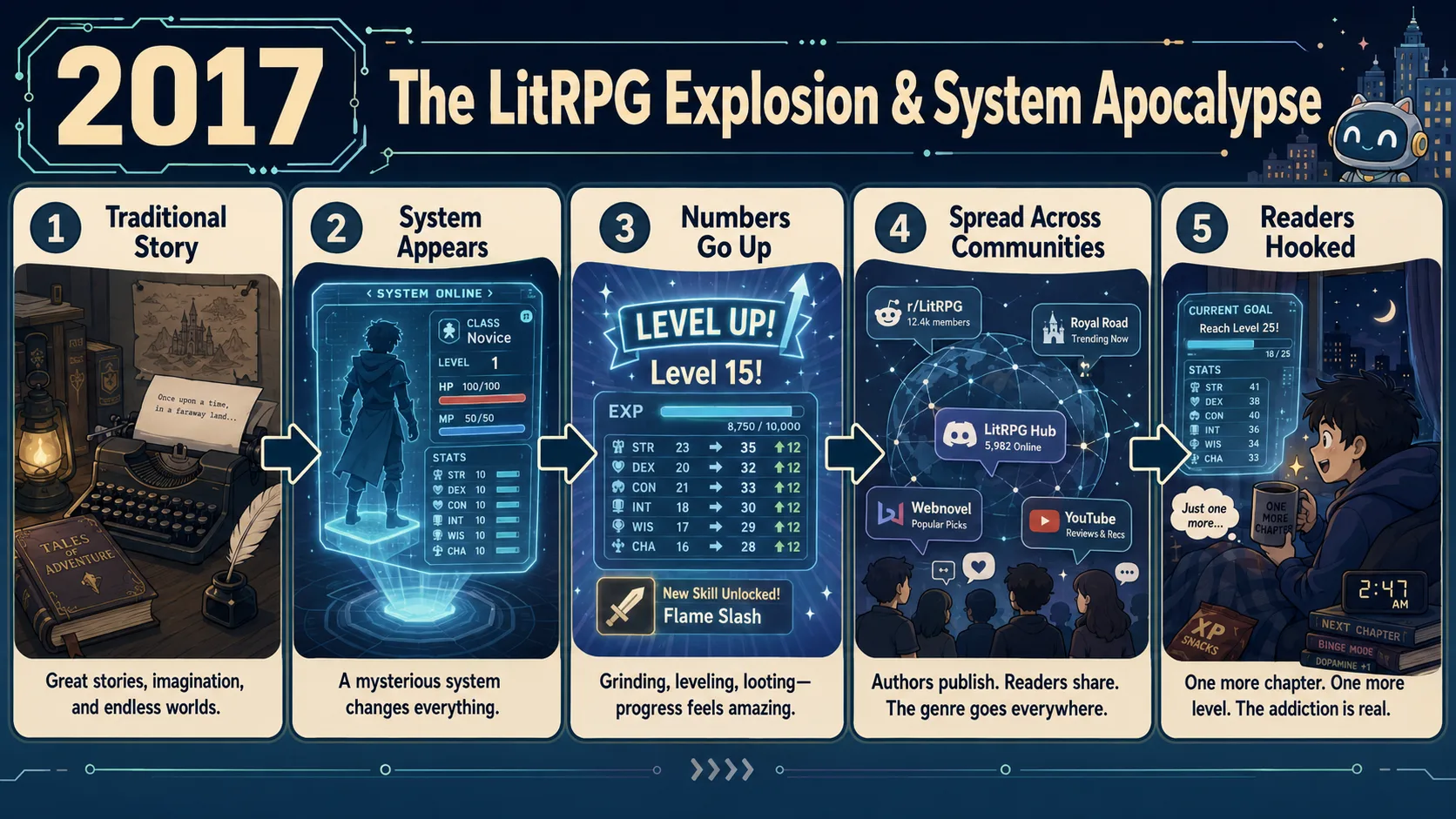
As the massive structural upheavals of 2017 tore through the business mechanics of the industry—the corporate monopolies (Chapter 45), the Discord isolation (Chapter 55), and the relentless MTL aggregators (Chapter 56)—a quiet, massive narrative revolution was occurring simultaneously on the independent frontiers of Royal Road and Amazon.
The Western authors, who had spent the previous two years frantically absorbing both the deep, philosophical power-scaling of Eastern Xianxia and the hyper-gamified, stat-heavy mechanics of Russian LitRPG, finally synthesized the two into a singular, highly optimized narrative engine.
This chapter explores the birth and absolute dominance of the System Apocalypse sub-genre. It was a narrative formula so potent, so perfectly tailored to the psychological anxieties of the 2017 internet audience, that it briefly eclipsed almost every other genre in the web fiction space, established a multi-million-dollar publishing meta, and ultimately triggered one of the most controversial trademark wars in the history of independent publishing.
—
Part 1: The Collision of Tropes—LitRPG Meets Cultivation
To understand the sheer narrative power of the System Apocalypse, you must first understand the two massive genre pillars it ruthlessly combined.
Pillar 1: LitRPG (Literary Role-Playing Game). Originally popularized in Russia and adopted heavily by the West, LitRPG brought absolute, undeniable Mathematical Logic to power fantasy. Characters possessed blue holographic screens, hit points, strength stats, and inventory slots. It provided the reader with immediate, dopamine-inducing feedback. When the protagonist swung a sword, the reader saw a “+10 EXP” notification. However, traditional LitRPG often felt hollow, heavily restricted by “Game Balance” and the inherent lower-stakes reality of a virtual world (VRMMO).
Pillar 2: Xianxia/Cultivation. The Eastern fantasy titan brought staggering Cosmic Scale and Philosophical Depth. Cultivators absorbed spiritual energy, formed golden cores, and literally defied the heavens to achieve immortality. The stakes were absolute life and death, and the power ceilings were infinite, allowing characters to eventually punch planets in half. However, Cultivation power levels were often maddeningly vague (“He reached the late stage of the nascent soul realm”) and lacked the satisfying, granular clarity of a level-up.
The brilliant, defining innovation of 2017 was the Synthesis.
Authors realized that if they merged the Cosmic Scale of Cultivation with the Mathematical Clarity of LitRPG, they possessed the ultimate progression formula. The “System” (the blue boxes) was no longer just a virtual reality game interface; it was a vast, omnipotent, multi-dimensional cosmic law that governed the entire universe, forcibly quantifying spiritual energy and magic into easily digestible numbers for the reader.
—
Part 2: The “Earth Integration” Meta and the Death of the Isekai
The second defining innovation of the System Apocalypse was its setting. Prior to 2017, the default narrative vehicle for transporting a modern protagonist into a fantasy world was the Isekai (the portal fantasy or reincarnation trope, Chapter 44). The protagonist was hit by a truck and woke up in a medieval village.
The System Apocalypse violently inverted this trope. Instead of the protagonist going to the magic, the magic came to the protagonist.
This became known as the “Earth Integration” Meta.
In Chapter 1, Earth is suddenly, brutally annexed by the multi-dimensional “System.” The laws of physics are instantly rewritten. Electricity stops working. Skyscrapers crumble as magical dungeons erupt from the pavement in downtown Manhattan or London. A blue screen appears in the sky, announcing to all eight billion humans that the “Tutorial” has begun, and the vast majority of the population is instantly slaughtered by the initial wave of goblin and orc incursions.
This framing was incredibly powerful for three distinct reasons:
1. Immediate, Visceral Stakes: Unlike a low-stakes virtual reality game, the protagonist was fighting for literal survival in the ruins of their own hometown.
2. The Competence Porn Appeal: The protagonist (often a socially awkward gamer, prepper, or combat veteran) possessed the specific “Nerd Knowledge” required to exploit the new RPG rules, instantly elevating them above the bewildered politicians, billionaires, and military generals who were useless in the new reality.
3. The Societal Blank Slate: It allowed the author to violently wipe away the frustrating complexities of modern society (taxes, social media, corporate jobs) and replace them with a pure, brutally meritocratic hierarchy based entirely on violence and leveling up.
—
Part 3: The Societal Reset and the Appeal of the Apocalypse
Why did the 2017 internet audience connect so deeply, and so financially, with the complete, violent destruction of modern society? The answer lies in the Psychological Alienation of the millennial and Gen Z readership.
The typical web novel reader in 2017 was often trapped in the exact same crushing realities that birthed the “Corporate Monarchy” (Chapter 45): stagnant wages, massive student debt, unaffordable housing, and a deep, pervasive sense of powerlessness against global algorithms and political gridlock.
The System Apocalypse functioned as the ultimate, highly therapeutic Societal Reset Button.
It was a power fantasy that specifically targeted the anxieties of late-stage capitalism. When the System arrived, it violently leveled the playing field. Jeff Bezos’s billions and a politician’s connections were instantly rendered mathematically useless against a Level 5 Orc. The protagonist, who was a frustrated, underpaid barista in Chapter 1, could become a literal King by Chapter 50 simply by working hard, exploiting the rules, and killing monsters.
It was the purest, most brutal form of the American Dream, repackaged into a litRPG stat sheet. The genre promised the reader that if the arbitrary, unfair rules of modern society were suddenly replaced by the objective, mathematical rules of a video game, they would finally be the ones to succeed. The System Apocalypse wasn’t just a fantasy about having magical powers; it was a fantasy about living in a world where effort actually guaranteed a quantifiable reward.
—
Part 4: The Tao Wong Controversy and the Trademark Wars
While the genre was a massive cultural success, its legacy was permanently scarred by one of the most bitter, highly publicized legal conflicts in the history of independent publishing.
In late 2017, a highly successful independent author named Tao Wong published a wildly popular series titled Life in the North, which served as the inaugural volume of his massive “System Apocalypse” franchise. Wong’s series was heavily instrumental in codifying the specific tropes of the genre (the blue screens, the ruined Earth, the integration mechanics), and it became a massive financial success on Amazon KU (Chapter 53).
The controversy erupted several years later when it was revealed that Tao Wong had successfully filed and received a legal Trademark for the term “System Apocalypse.”
In traditional publishing, you cannot copyright a genre (like “Cyberpunk” or “High Fantasy”). However, because Wong had used “System Apocalypse” as the specific branding/title of his series, the United States Patent and Trademark Office granted him the trademark.
Wong subsequently began issuing “Cease and Desist” notices and aggressively requesting Amazon to take down books by other independent authors who utilized the term “System Apocalypse” in their titles, blurbs, or Amazon keywords to describe their own works.
The web fiction community, which had historically operated on the open-source sharing of tropes and concepts (Chapter 5), erupted into absolute, visceral fury.
The community argued that “System Apocalypse” was a broad, descriptive genre term, much like “LitRPG” or “Isekai,” and that a single author trademarking the term was a monopolistic betrayal of the indie spirit. Wong and his defenders argued that he had legally established the brand, that other authors were unfairly profiting off his specific SEO (Search Engine Optimization), and that he was simply protecting his intellectual property in a ruthless Amazon marketplace.
The Trademark War permanently fractured the LitRPG community. It resulted in massive boycotts, toxic review bombings (Chapter 24), and highly polarized subreddits. It also forced the community to hastily invent alternative, clunky sub-genre names (like “LitRPG Apocalypse” or “System Integration”) to avoid Amazon takedowns. The controversy served as a grim reminder that as the web fiction industry transitioned from an underground hobby to a multi-million-dollar business, the collaborative, open-source spirit of 2015 had been permanently replaced by the cutthroat legal realities of corporate publishing.
—
Part 5: The Algorithmic Dominance and the Genre Pacing
Despite the legal toxicity, the narrative architecture of the System Apocalypse proved to be algorithmically flawless. It was the single most perfect genre ever designed to exploit the Kindle Unlimited “Page-Read” economy (Chapter 53).
The genre inherently solved the two greatest challenges of a serialized web novel: Pacing and Power Creep.
- Infinite Escalation: Because the “System” was cosmic, the author never ran out of antagonists. After the protagonist conquered Earth, the System could simply transport them to a higher-tier planet, then a galactic empire, and finally the multiverse. The story could theoretically run for 3,000 chapters without ever breaking its own logic.
- The Dopamine Loop: The author could perfectly control the pacing by utilizing the “Status Sheet.” If the narrative was dragging, the author simply had the protagonist find a new skill book or trigger a level-up notification, providing the reader with an immediate, satisfying jolt of dopamine.
The blue holographic screen became the ultimate narrative crutch and the ultimate narrative weapon. It allowed authors to write massive, sprawling epics at breakneck speed, because the “System” mathematically justified every plot contrivance. The System Apocalypse wasn’t just a story; it was a highly optimized, extremely addictive reading engine that printed money on Amazon.
—
Part 4.1: The Weaponization of Existential Dread
While the “Reincarnation” trope (Chapter 44) offered a complete escape from reality, the defining sub-genre of late 2017—the System Apocalypse—offered something far more cathartic: The violent restructuring of reality.
In a System Apocalypse novel, the protagonist does not die and wake up in a fantasy world. Instead, the fantasy world violently invades Earth. A ubiquitous, gamified “System” descends upon the planet, initiating a global cataclysm. Cities are destroyed, billions of people die, and the surviving population is forced to operate under RPG mechanics (levels, classes, stats).
This narrative framework resonated terrifyingly well with the Western audience of 2017. The demographic was largely composed of young adults experiencing profound socioeconomic anxiety: Stagnant wages, impossible housing markets, and a chaotic political climate.
The System Apocalypse trope validated their existential dread. It explicitly stated that the current societal structure was irreparably broken, and the only way to fix it was for a cosmic entity to hit the “Reset” button.
The Meritocracy Fantasy
More importantly, the System Apocalypse introduced a brutal, but mathematically pure, meritocracy.
In the “Real World,” success is often dictated by generational wealth, nepotism, and systemic advantages. The readers felt powerless. But when the “System” arrives in these novels, all terrestrial wealth and social status are instantly vaporized. The billionaire CEO and the minimum-wage retail worker are both reset to Level 1.
The protagonist (usually a gamer or a social outcast) suddenly thrives because they understand the mechanics of the new world better than the societal elites. The power fantasy is not just about shooting fireballs; it is about the intense, vindictive satisfaction of watching the architects of the old world brutally fail in a system where only pure, measurable stats matter.
Part 4.2: The “Tutorial” Attrition
The System Apocalypse genre standardized a highly specific, psychologically intense narrative arc: The Tutorial.
When the System initiates the apocalypse, the protagonist is usually trapped in a confined space (a subway car, a university classroom) with a group of regular people. The System issues a “Tutorial Quest,” often requiring the participants to kill a monster—or each other—within a time limit.
The Tutorial serves a critical structural purpose: It rapidly culls the cast, ensuring the protagonist does not have to deal with complex, emotionally draining social dynamics. The “weak” characters (those unwilling to embrace violence) are immediately killed by the System.
The protagonist is forced to abandon traditional morality and become a ruthless pragmatist (The OP Protagonist Dominance, Chapter 36) in order to survive. The audience did not view this as tragic; they viewed it as highly satisfying optimization. The Tutorial was the crucible that burned away the protagonist’s “Real World” constraints, preparing them for the hyper-violent, stat-driven progression loop that would dominate the next 1,000 chapters.
Part 4.3: The Localization of the Apocalypse
The System Apocalypse was the ultimate realization of the Original English (OEL) boom (Chapter 51).
While the concept originated heavily in Korean LitRPG, the Western authors on Royal Road perfected the localization. Instead of navigating the confusing cultural geography of Seoul, the Western audience could read about a protagonist desperately fighting goblin hordes in the parking lot of a Walmart in Ohio, or defending a barricaded Starbucks in downtown Seattle.
This localization grounded the absurdity of the LitRPG stats in familiar, visceral reality. It made the progression fantasy feel tangible. The System Apocalypse proved that the independent Western authors were no longer just imitating Asian web fiction; they had successfully synthesized it, creating a unique, highly lucrative sub-genre that would eventually dominate both Royal Road and the Amazon Kindle bestseller lists for the next decade.
Part 6: Actionable Takeaways for the Modern Author (2026)
The rise of the System Apocalypse proves that the most successful genres are those that brilliantly synthesize existing, proven mechanics while tapping directly into the psychological anxieties of the current cultural moment.
1. Synthesize, Don’t Invent
In 2026, the absolute hardest path to commercial success is attempting to invent a completely new genre from scratch. The most lucrative path is Synthesis. Look at the two most popular, seemingly disconnected genres in the current market, and figure out how to structurally combine their most addictive elements. The System Apocalypse was merely the mathematical progression of LitRPG applied to the cosmic scale of Xianxia. What is the next synthesis?
2. The Power of the “Earth Context”
If you want the reader to care deeply about the stakes of your power fantasy, anchor the destruction in reality. An alien dragon destroying a fictional elven city is a standard fantasy trope; an alien dragon destroying the Starbucks in downtown Chicago where the protagonist used to work is Visceral. Grounding your apocalypse in the mundane realities of Earth instantly increases the emotional resonance and the “Competence Porn” appeal of the survival mechanics.
3. Protect Your Branding, but Respect the Ecosystem
The Tao Wong trademark controversy remains a highly sensitive, radioactive case study in community relations. In 2026, you absolutely must aggressively protect your specific IP, your pen name, and your unique character designs. However, attempting to legally monopolize a broad, community-generated trope or genre identifier will result in a permanent, catastrophic loss of goodwill. In the highly networked, community-driven web fiction ecosystem, alienating your peers and the core readership is a financial death sentence that no amount of legal trademark protection can cure.
4. Quantify the Progression
Even if you are not writing a strict LitRPG, you must internalize the fundamental lesson of the System: Readers love quantifiable progression. If your protagonist gets stronger, the reader needs to explicitly understand how much stronger. Whether you use a literal blue screen with numbers, a Cultivation realm system, or a rigid magical hierarchy, you must provide clear, objective milestones. Vague, unearned power-ups frustrate the modern audience; mathematically justified progression keeps them addicted for 1,000 chapters.
*(The authors had perfected the narrative engine, merging LitRPG and Xianxia into a multi-million-dollar publishing juggernaut. But as they conquered the text-based markets of Amazon, a massive, entirely new demographic of consumers was opening up on their daily commutes. In Chapter 58: The Audio Book Frontier, we explore the moment the web novel expanded into the multi-sensory realm, and how a good narrator became just as valuable as a good author).*
0 Comments