

2015 – 02 – The Volunteer Translator
by EternalibChapter 02: The Volunteer Translator—Golden Handcuffs and the Burnout Machine
If you scroll through a Webnovel author forum today, the primary source of existential dread is the Algorithm. Authors write hyper-optimized forum posts complaining about broken recommendation systems, disappearing Power Stones, or their novel failing to hit the Golden Tier threshold.
But in early 2015, the core psychological terror driving the web fiction industry had absolutely nothing to do with artificial intelligence or corporate recommendation feeds. The terror was entirely human. It was the terrifying, crushing weight of the Parasocial Audience.
To understand the intense, toxic loyalty that defined the Spcnet migration, you have to look at the people providing the drug. The internet was addicted to daily serialized progression fantasy, and the only people capable of supplying that drug were independent college students willing to sacrifice their mental health for internet points.
—
Part 1: The Artisanal Monopoly
Before machine translation algorithms hit industry-standard fluency and completely ripped the bottom out of the labor market, translating Chinese literature into English was brutal, artisanal labor.
Mandarin is not a structurally parallel language to English. A translator cannot simply map words one-to-one. Chinese Cultivation novels—Xianxia—are heavily steeped in ancient Daoist philosophy, classical idioms, and poetic martial arts nomenclature. An author might describe a character moving “like a dragon shedding water,” but an English translator has to determine if the author means the character is moving elegantly, violently, or imperceptibly, and then rewrite the entire paragraph so it actually flows for a western reader.
This localized nuance created an incredible bottleneck. At the beginning of 2015, the massive demand for Eastern fantasy was funneled almost exclusively through a tiny, hyper-stressed cartel of deeply passionate, bilingual nerds.
“I started translating Martial God Asura mostly just to practice my Mandarin reading comprehension between classes. I posted thirty chapters on a free WordPress blog. Two months later, I had forty-five thousand people checking the website every single day, and I was actively skipping my biology lectures just to make sure I got the daily chapter out by 5:00 PM.”
— Archived Translator Discord Confession, Mid-2015
Because the translators held an absolute monopoly on the content, they were functionally worshipped. Readers treated translators like religious figures. They showered them with praise, defended them rabidly in comment sections against anyone complaining about the prose, and, crucially, they began throwing money at them.
—
Part 2: The Invention of the Golden Handcuffs
Initially, the money wasn’t a business model. It was a literal survival mechanism to pay for the massive Amazon Web Services (AWS) bills generated by the terrifying volume of organic web traffic breaking their servers.
Translators set up simple PayPal tip jars at the bottom of their WordPress blogs, asking readers to “buy them a cup of coffee.” But the readers didn’t just want to say thank you. They wanted more content, and they realized that if they threw enough money at the college student translating the novel, they could effectively bribe that student into translating faster.
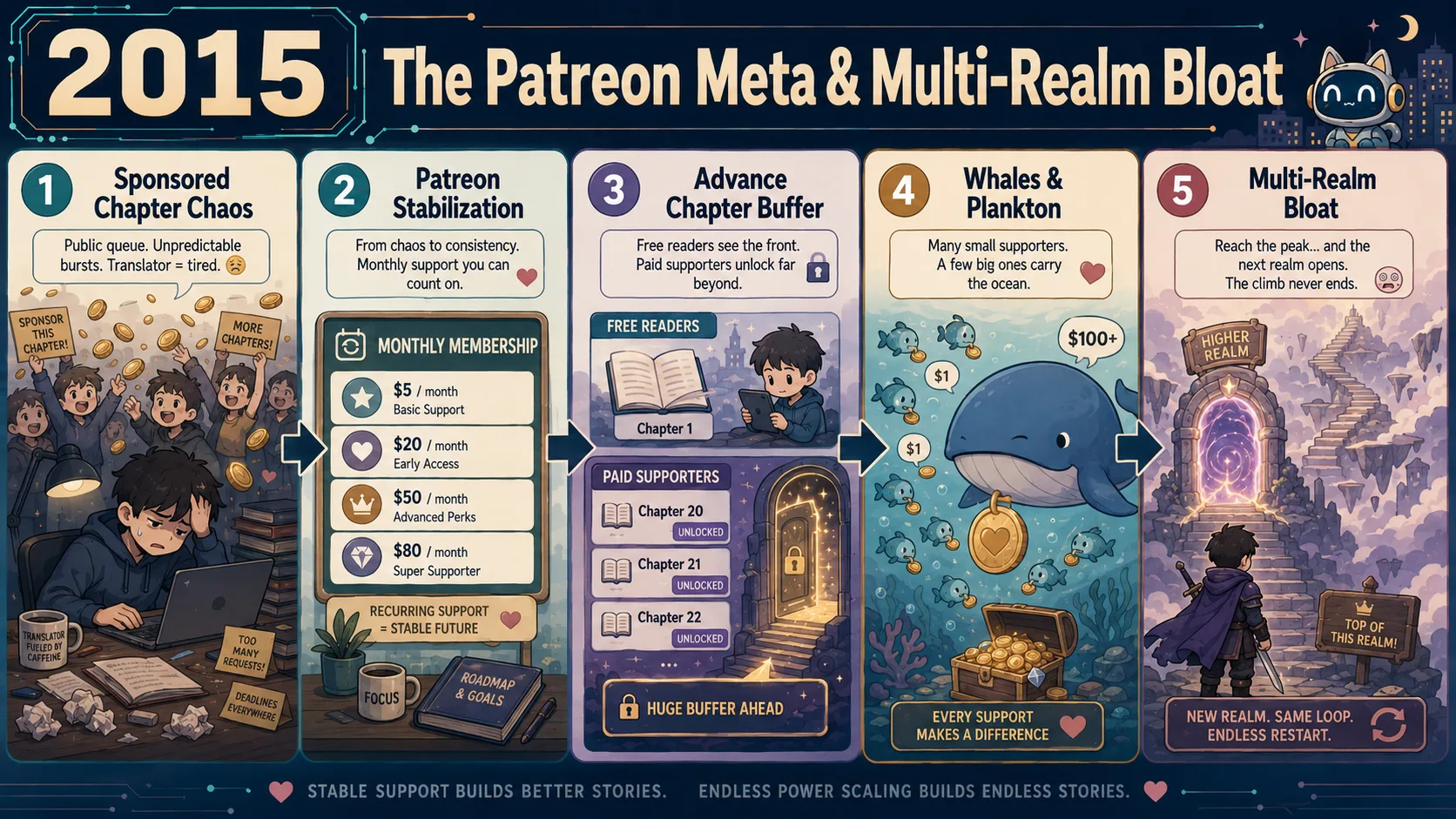
This dynamic birthed the Sponsored Chapter Queue—arguably the most elegant and destructive labor mechanism in the history of the web fiction gray market.
The math was incredibly simple:
- The Baseline: The translator promised one free chapter every 24 hours.
- The Bribe: For every $50 to $80 donated cumulatively to the PayPal tip jar, the translator was contractually obligated to stay awake and deliver an extra chapter that very same day.
The readers, completely devoid of impulse control when faced with daily cliffhangers, completely obliterated the queue. A popular translator could easily wake up to find eight hundred dollars sitting in their PayPal account, meaning they suddenly owed the internet ten bonus chapters on top of their regular daily output.
—
Part 3: Toxic Philanthropy and Physical Collapse
When examined purely on a financial spreadsheet, the Sponsored Queue looks like a miracle. Independent artists in their early twenties were clearing $8,000 to $15,000 a month in completely tax-free PayPal donations without a traditional publisher acting as a middleman.
But examining the queue as a financial victory completely ignores the agonizing biological reality of the labor. Translating a dense, 2,500-word Chinese chapter into localized English takes roughly three to five hours of intense mental focus.
If a translator suddenly owed the queue four bonus chapters, they were staring down a grueling twenty-hour shift of raw data processing. If they failed to deliver the chapters immediately, the exact same readers who had just showered them with money would violently turn on them.
The money shifted the power dynamic. It mutated the relationship from a polite creator/fan dynamic into a hyper-toxic, employer/slave relationship.
“I’m begging you guys, please stop donating to the queue for a few days. I genuinely cannot keep up. I owe you eight sponsored chapters right now and my wrists physically hurt so much I can barely type. If you donate right now, you are literally just paying to give me a panic attack.”
— Archived Translator Announcement Post, Late 2015
This was the terrifying reality of the Golden Handcuffs. Translators were physically destroying themselves. They developed severe carpal tunnel syndrome, dropped out of university classes, and isolated themselves from their real-life relationships purely to feed the queue.
They felt completely paralyzed. Walking away from the keyboard meant walking away from an annualized salary of over $120,000 while still in college. They were terrified to lose the money, but physically incapable of sustaining the speed required to earn it. The massive, unregulated financial success of the Genesis Era was actively built on the extreme psychological burnout of its workforce.
—
Part 4: The Patreon Pivot (Seeking Sanctuary)
The sheer toxicity of the “Queue Debt” eventually forced an ecosystem-wide pivot. Translators realized that the unpredictable volatility of PayPal donations was going to literally kill them. They needed a way to monetize their massive audience without owing unpredictable jolts of physical labor at three in the morning.
They found their sanctuary in Patreon.
Instead of asking the audience to pay for spontaneous bonus chapters, the translators began desperately looking for ways to formalize the relationship. In late 2015, they began their preliminary migration to Patreon.
At this early stage, Patreon was not yet the highly rigid “Advanced Chapter” machine it would become in 2016. In 2015, it was utilized primarily as a massive, recurring tip-jar. Translators would set up monthly subscription tiers and promise that if the overall Patreon income hit a certain milestone (e.g., “$5,000 a month”), they would permanently increase their baseline release rate from 7 chapters a week to 10 chapters a week.
While it didn’t eliminate the brutal labor demands, this early Patreon pivot completely revolutionized the mental health of the creator class:
- Decoupled Labor: If the translator got sick, the Patreon readers didn’t violently revolt. As long as the distance between the free readers and the paid readers remained static, the paid readers felt they were getting their money’s worth.
- Predictable Income: Translators transitioned from hoping whales would drop $50 on a cliffhanger, to relying on a perfectly stable, predictable $12,000 deposit on the first of every month.
By pushing their most dedicated readers into locked VIP Discord servers and securing stable subscriptions, the independent translators finally built a sustainable, highly lucrative business model.
Unfortunately, they built it on an intellectual property completely owned by a Chinese corporation that was very rapidly realizing just how much money they were leaving on the Western table.
—
Part 5: The Quality vs. Quantity Schism
As the Sponsored Queue demanded increasingly impossible output speeds, a deep ideological fracture formed within the volunteer translator community: the battle between pristine localization and raw velocity.
In the early days of 2015, a translation was expected to be a work of art. Translators would spend hours debating the exact English equivalent of a specific Daoist concept or martial arts technique. They provided massive, multi-paragraph footnotes at the bottom of every chapter explaining the historical context of Chinese idioms.
But the readers who were funding the Sponsored Queue did not care about the historical context of the Han Dynasty. They cared about the protagonist leveling up and slapping the antagonist.
This created immense friction. Translators who refused to compromise on prose quality found themselves falling drastically behind the financial curve. If “Translator A” produced two beautifully localized chapters a week, they made $100 in donations. If “Translator B” produced fourteen rough, literal, slightly-clunky chapters a week, they made $3,000 in donations.
The audience’s wallet spoke with terrifying clarity: Volume was superior to Art.
This economic realization forced highly skilled translators to actively downgrade the quality of their own work simply to keep up with the market demand, further compounding the deep psychological burnout of the era.
—
Part 6: The Identity Crisis — When the Hobby Becomes the Job
There is a specific, quiet horror that arrives when you cross the threshold between creating for passion and creating for survival. The early translators encountered this psychological earthquake with almost no preparation.
In the beginning, translating Martial God Asura or Against the Gods felt like a genuine calling. The translator was part diplomat, part artist. They were bridging an enormous cultural gap. When readers left gushing comments saying the prose made them feel something they hadn’t felt in years, the dopamine hit was enormous. The work felt meaningful.
But the moment the PayPal notifications started rolling in — $50, $80, $200 in a single afternoon — the psychological architecture of the work irreparably shifted.
The translator was no longer creating. They were producing.
The distinction is brutal and precise. A creator works until the work is done. A producer works until the customer is satisfied. And 15,000 customers are never satisfied.
Many of the first-generation translators report a specific moment of dissociation — sitting at the keyboard at 1:00 AM, mechanically processing their fourth consecutive chapter of the day, staring at a paragraph about the emotional complexity of a character’s spiritual breakthrough, and feeling absolutely nothing. The story that had consumed them with genuine passion six months ago had become a widget on an assembly line.
“I realized sometime around month eight that I hadn’t actually enjoyed reading my own translation in weeks. I was reading purely to find the start point for the next chapter. The story I genuinely loved had become my second job, and I didn’t even know when that happened. I was twenty-one years old, making more money than my father, and I was absolutely miserable.”
— Archived Wuxiaworld Translator AMA, Late 2016
The burnout was compounded by the complete social isolation the labor demanded. Translating at a level that satisfied a massive daily audience required eight to twelve hours of concentrated linguistic focus. That left almost no time for university coursework, physical exercise, or real-world social interaction. The translators’ entire human social life gradually migrated into the Discord servers and comment sections of their own novels — a deeply unhealthy loop where the only people they regularly talked to were the same audience creating the demand that was destroying them.
This wasn’t a bug in the system. It was the inevitable, predictable output of an industry built on the exploitation of passion. And it set an absolutely critical precedent: the first generation of web fiction creators were systematically burned out, not by a corporation’s deliberate cruelty, but by the simple, unregulated mathematics of audience demand meeting individual human limitation.
Every modern author who has ever felt the grinding weight of a ‘daily update’ obligation is feeling the direct generational echo of this exact burnout.
—
Part 7: Actionable Takeaways for the Modern Author
The burnout of the 2015 translation era established the foundational rules of internet serialization. If you are an independent author building a Patreon or Webnovel audience today, you must respect the psychological architecture that shattered the early pioneers.
1. The Peril of “Labor Debt” Monetization
The Sponsored Queue is a cautionary tale for modern Patreon creators. If you lock physical, reactive labor behind a paywall (e.g., “If we hit $5,000 a month, I will write 5 extra chapters this week”), you are actively engineering your own burnout. The internet has infinite money, but you do not have infinite wrists. Always monetize exclusively through Time Gates (Advance chapters) or Status (Discord roles), never through reactive labor quotas.
2. Guarding the ‘Buffer’
The early translators died because they allowed the Queue to drain their chapter stockpile to absolute zero. If you are writing a web serial today, you must ruthlessly defend a minimum twenty-chapter backlog. If your Patreon tier offers “15 advance chapters,” you cannot physically begin publishing until you have 35 chapters in the vault. The buffer is the only thing protecting your nervous system from the algorithm.
3. Empathy Dies Where Money Begins
The moment a reader gives you money, they subconsciously restructure their relationship with you. They stop viewing you as a passionate hobbyist and start viewing you as a professional vendor who owes them a product. You must establish incredibly rigid, unbending release schedules to protect yourself from the psychological weight of their expectations. Do not rely on their mercy; rely strictly on the schedule you set.
*(With the mental toll of the labor established, we must now examine the mathematical engine behind the fiction itself. In Chapter 03: The Passion Economy, we break down why the audience was so perfectly wired to spend $15,000 a month on translations in the first place).*
0 Comments