

2015 – 11 – The Grey Market Legal Immunity
by EternalibChapter 11: The Grey Market Legal Immunity—Building an Empire on Stolen Land
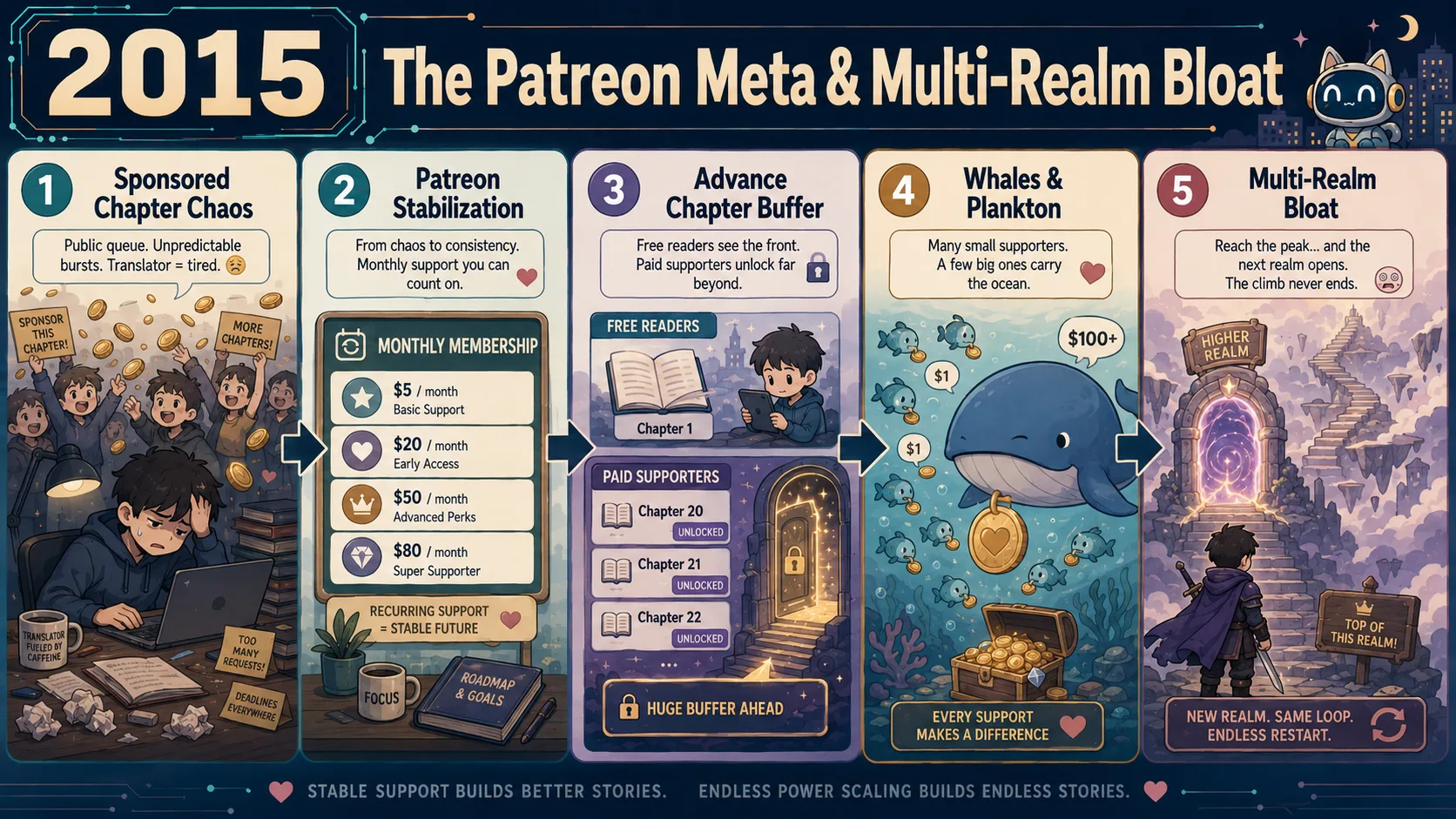
If you look at the explosive growth of the independent translation scene in 2015, the most baffling question is not how they managed to build such a massive audience. The question is how they managed to operate a multi-million-dollar industry, in broad daylight, using completely stolen intellectual property, without being immediately crushed by international copyright lawsuits.
The English web fiction ecosystem did not grow in a vacuum. It grew inside a highly specific, temporary legal loophole. The translators were operating entirely in the gray market, and their temporary immunity from prosecution created a false sense of invincibility that would ultimately lead to their catastrophic downfall two years later.
—
Part 1: The ‘Fan-Fiction’ Defense
To understand the psychology of the early translation boom, you have to understand the Fan-Fiction Exemption.
In Western internet culture, fan-fiction operates under an unspoken, fragile truce with copyright holders. Authors like J.K. Rowling or George R.R. Martin generally allowed fans to write thousands of free, derivative stories featuring their characters on sites like Archive of Our Own (AO3). As long as the fans were not charging money for the stories, the corporate lawyers looked the other way. It was considered harmless, passionate community building.
The early web-fiction translators incorrectly applied this exact legal logic to their own work.
They did not view themselves as corporate pirates. They viewed themselves as benevolent cultural ambassadors. They were taking obscure Chinese web novels that the Western market literally did not know existed, painstakingly translating them into English, and offering them to the internet entirely for free. They genuinely believed that because they were operating out of pure passion on amateur WordPress blogs, they were protected by the Fan-Fiction Exemption.
“Why would Qidian be mad? We are literally giving their authors free international marketing. Nobody in America knew who I Eat Tomatoes was until we translated his work. If Qidian ever decides to actually sell English copies, we’ve already built a massive, hyped-up customer base for them. They should be thanking us.”
— Archived Wuxiaworld User Comment, Mid-2015
The fatal flaw in this logic was the definition of “derivative work.” Writing a story about Harry Potter going to a coffee shop is derivative fan-fiction. Taking an author’s exact, word-for-word 3,000-chapter novel and translating it into a different language is not fan-fiction. It is direct, literal Intellectual Property Theft.
But in 2015, nobody cared. The Chinese copyright holders were geographically isolated, and the translators were ideologically protected by their own passion.
—
Part 2: The Monetization Paradox
The Fan-Fiction defense completely shattered the moment real money entered the ecosystem.
As detailed in earlier chapters, the sheer volume of organic web traffic breaking their servers forced the independent translators to monetize. They could no longer operate entirely for free; they had to pay Amazon Web Services (AWS) invoices. This led to the introduction of Google AdSense banners, PayPal tip jars, and the astronomically lucrative Sponsored Chapter Queue.
Suddenly, the independent translation scene was no longer a hobby. Top translators were clearing $10,000 to $15,000 a month in completely tax-free PayPal donations. Wuxiaworld and GravityTales were generating massive, enterprise-level AdSense revenue.
This created a terrifying legal paradox: The community was generating millions of dollars in localized Western revenue using Chinese intellectual property, and exactly zero percent of that revenue was flowing back to the original authors or publishers.
This was the exact definition of a highly illegal gray market. The translators knew it, but the money was simply too good to stop. They effectively stuck their heads in the sand, hoping that the geographical and linguistic barrier between the United States and China was thick enough to protect them from corporate scrutiny.
—
Part 3: The Ignorance of the Sleeping Dragon
So why didn’t Qidian immediately sue them in 2015? Why did the gray market survive long enough to build a massive monopoly?
The answer is corporate ignorance. China Literature (the Tencent-backed conglomerate that owned Qidian) was an absolute titan of the Asian publishing industry. They possessed an infinite legal war chest. If they wanted to shut down Wuxiaworld, they could have filed a barrage of Digital Millennium Copyright Act (DMCA) takedown notices and bankrupted the independent translators in a week.
But they didn’t, because they fundamentally did not understand the value of the Western market.
In 2015, the idea that American, European, and South American readers would aggressively consume Chinese Cultivation fantasy was considered completely absurd by Chinese publishing executives. They viewed the English translations as a bizarre, microscopic novelty. They had absolutely no internal infrastructure to monetize the English-speaking demographic, so they simply ignored it.
They allowed the independent translators to operate freely because they didn’t believe the market was worth the legal fees required to conquer it.
This corporate apathy allowed the independent ecosystem to thrive. Wuxiaworld and GravityTales grew into massive, dominant hubs. The translators formalized their incomes through Patreon. The audience became mathematically addicted to the daily serialized pacing. The gray market solidified into an actual, functional economy.
—
Part 4: The Data Trail and the Inevitable Awakening
But you cannot hide a multi-million-dollar industry on the internet forever.
The very success of the independent hubs generated an enormous, completely public data trail. Wuxiaworld’s Alexa traffic rankings skyrocketed into the global top 1,500. The Patreon earnings of top translators were public information. The massive, hyper-active Discord servers and Reddit communities were entirely visible to anyone who knew how to use Google.
By the end of 2015, the Chinese publishing executives were finally beginning to review this data. They were looking at the sheer volume of PayPal transactions and AdSense impressions, and they were running the math. They realized with absolute horror that they were bleeding millions of dollars in untracked international revenue.
The gray market immunity was officially expiring. The corporate administration realized that instead of allowing rogue American college students to profit off their stolen IP, they could simply launch an official English platform, violently absorb the existing readership, and capture one hundred percent of the profit internally.
The independent translators had successfully built the empire. Now, the actual owners of the land were coming to collect the rent.
—
Part 5: The DMCA Test Case — When the First Letter Arrived
For the majority of 2015, the gray market immunity felt absolute. The Chinese publishers were geographically distant, legally uninterested, and culturally ignorant of the scale of the western audience. The translators operated in an almost surreal state of legal impunity — generating extraordinary sums of money, openly, under their real names, on publicly indexed websites.
Then, sometime in mid-to-late 2015, the first DMCA takedown notices began to appear.
They did not come from Qidian or Tencent directly. They came from smaller, less prominent Chinese publishers — the ones whose licensing deals were less complicated, whose legal teams were more aggressive, and whose authors had been quietly watching the western traffic reports with mounting fury.
The mechanics of a DMCA notice are precise. A copyright holder files a formal claim identifying infringing content hosted on a server. Amazon Web Services, which hosted the majority of the translation blogs, was legally required to comply within a defined window. They did not negotiate or arbitrate. They simply pulled the plug on the hosting account.
One translator arrived home from a university lecture to find their entire website — two years of work, 800 translated chapters, their reader comments, their donation links, everything — replaced by a blank error page. No warning. No grace period.
Their forum post describing the experience spread through the community like a detonation.
“I got home and the site was gone. Not hacked — gone. AWS sent a termination email with the DMCA case number attached. I emailed back. They said they couldn’t discuss active copyright claims. I don’t have a lawyer. I don’t have $10,000. I have a case number and a blank server. Two years. Gone.”
— Archived Wuxiaworld Community Forum, Mid-2015
The response from the community was loud and furious — and completely impotent. There were mass Reddit posts condemning the unnamed publisher. There were donation drives to help the affected translator with legal fees. There was organized discussion about whether ‘fan-work exemptions’ could be legally argued.
But the most terrifying element of the takedown wasn’t the loss of the server; it was the financial freeze. When the DMCA notice was filed, it didn’t just target the AWS server. It was forwarded to Patreon. Patreon’s legal compliance team operated on a policy of immediate suspension. The translator’s account was frozen. The thousands of dollars sitting in escrow, waiting for the monthly payout, were completely inaccessible. The translator was essentially financially excommunicated from the internet pending a legal review they could not afford to fight.
Behind the noise, every single major translator on Wuxiaworld and GravityTales privately ran the same calculation: If they can do this to them, they can do this to me. The DMCA test case shattered the gray market’s mythology of invincibility. A translator could be making $15,000 a month on Tuesday, and have absolutely zero access to that money on Wednesday because a junior lawyer in Beijing sent an automated email. This set in motion a quiet, private panic that would shape the entire strategy of the ecosystem for the following two years.
RWX’s decision to fly to China and negotiate formal licensing agreements was not the bold, visionary act it was publicly framed as. It was the rational response of a man who had watched a colleague’s two-year project disappear overnight and decided he needed a legal document before it happened to him.
—
Part 6: Actionable Takeaways for the Modern Author
The gray market era is a brutal lesson in IP management and platform dependency. For a modern web-serial author, the 2015 illusion of legal immunity provides terrifying guidelines for surviving the corporate internet.
1. “Fair Use” is a Myth in Serialization
If you are writing LitRPG or Progression Fantasy on Royal Road, you must be extremely careful with your intellectual property inspiration. Writing a story “heavily inspired” by a specific anime or video game is fine. But explicitly using copyrighted terminology, brand names, or direct character clones is a legal time bomb. Do not assume you are protected because you are an independent creator. The moment your Patreon hits $2,000 a month, corporate algorithms will flag your content, and you will lose everything.
2. You Do Not Own Your Platform
The independent translators believed they owned their audience because they built it. They were wrong. They only owned the URL; they did not own the product keeping the audience there. If you are an author on Webnovel today, you must recognize that you do not own your readership. You are renting access to Webnovel’s algorithm. If you violate a contract or fail to hit your word-count quotas, the platform will silently bury your novel and replace you with a clone. You must actively build off-platform architecture (Discord, Mailing Lists) to truly “own” your fans.
3. The Danger of Gray Market Verification
The 2015 translation boom proved that independent creators are excellent at taking the initial financial risk to verify a new market trend. The moment you prove a specific niche (e.g., “Otome Game Villainess”) is highly lucrative, massive corporate entities will instantly pivot their resources to flood that exact niche, outspending you in marketing and burying your original work. You must establish a highly distinct, original voice that a corporate content mill cannot replicate, or you will simply be the beta-tester for your own replacement.
*(While the legal threat loomed in the distance, the actual literature being translated was undergoing a massive shift in tone. In Chapter 12: The Wuxia Shift, we analyze why the audience began to violently reject traditional martial arts in favor of absolute, reality-breaking Cultivation).*
0 Comments