

2015 – 15 – The Patreon Tip-Jar Meta
by EternalibChapter 15: The Patreon Tip-Jar Meta—Structuring the Whale
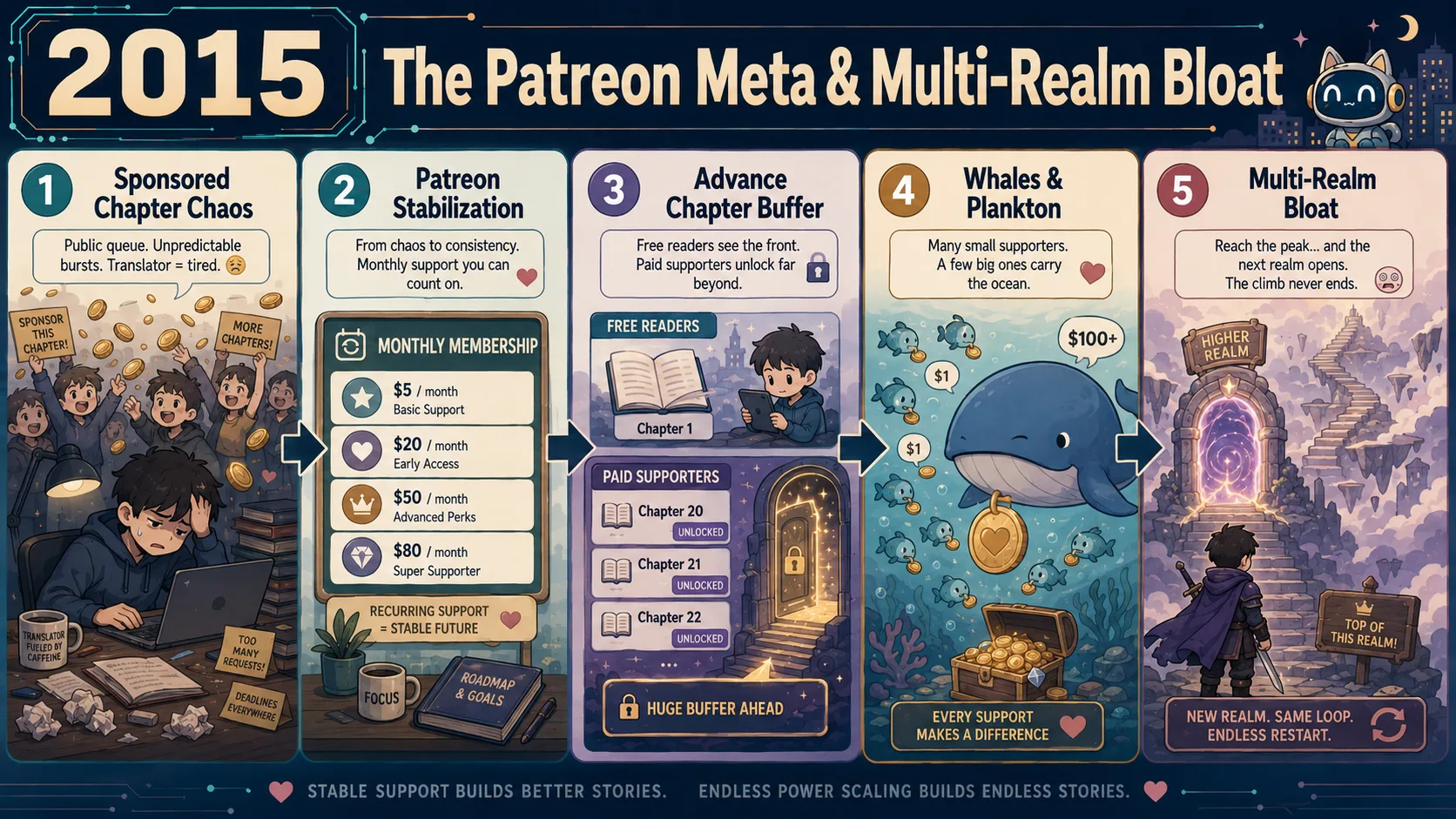
If you study the evolution of digital economics, the web-fiction community of 2015 represents one of the most fascinating micro-economies on the internet. In the span of twelve months, independent translators transitioned from begging for loose change in a digital hat to operating highly optimized, mathematically rigorous subscription services generating millions of dollars in untracked revenue.
This transition was not driven by corporate marketing seminars. It was driven entirely by traumatized college students desperately trying to figure out how to extract maximum capital from a highly addicted audience without dying of exhaustion in the process.
The resulting structure—the Patreon Advance Chapter Meta—became the absolute foundation of the modern web-fiction economy. If an author makes a living writing on Royal Road or Webnovel today, they are utilizing the exact economic blueprint drafted during the Genesis Era.
—
Part 1: The Chaos of the Tip-Jar
As explored heavily in earlier chapters, the original monetization engine of the translation era was the Sponsored Chapter Queue. Readers dumped massive, one-off PayPal donations into a collective tip jar to force the translator to stay awake and release an extra chapter.
The Queue was phenomenally lucrative, but it possessed two catastrophic structural flaws:
1. Labor Reactivity: It forced the translator into an unpredictable, physically destructive labor loop. (If the audience drops $500 at 3:00 AM, the translator owes ten chapters by breakfast).
2. Revenue Volatility: It provided absolutely zero financial stability. A translator might make $6,000 in July during an exciting tournament arc, and then plummet to $800 in August because the Chinese author transitioned to a boring, twenty-chapter political negotiation arc.
You cannot sign a lease on an apartment or hire an editor if your income fluctuates by 80% month-to-month based entirely on how exciting a cliffhanger is. The independent translators desperately needed a way to transition the chaotic energy of the PayPal tip-jar into Monthly Recurring Revenue (MRR).
They found their salvation in a relatively new platform called Patreon.
—
Part 2: The Invention of the ‘Advance Chapter’
Initially, translators used Patreon incorrectly. They simply treated it as a monthly tip-jar, offering vague, un-scalable rewards like “For $5 a month, I will put your name at the bottom of the chapter!”
The readers completely ignored this. The progressive fantasy audience was biologically addicted to plot progression; they did not care about having their name on a website. They only cared about consuming the story faster than everyone else.
The breakthrough occurred when a translator realized they could monetize Access instead of Speed.
This birthed the Advance Chapter Tier system. The mechanics were flawlessly simple and required absolutely zero extra labor from the translator:
- The Baseline: The translator writes and publishes Chapter 100 on their public, free WordPress site.
- The Vault: The translator has secretly already written up to Chapter 110, but they hide those chapters behind the Patreon paywall.
- The Offer: If a reader pays $10 a month, they get access to the Patreon vault. They get to read Chapter 110 immediately.
The genius of this system is that the translator is still only required to translate one chapter a day. Tomorrow, the free readers get Chapter 101. The paid readers get Chapter 111. The distance between the two groups remains permanently fixed.
When the Advance Chapter model was first introduced, there was massive, immediate backlash from the free readership. The comment sections were flooded with accusations of “greed” and “paywalling.” Readers who had been accustomed to resolving cliffhangers immediately via the communal tip-jar suddenly felt like second-class citizens. They argued that holding translated chapters “hostage” behind a monthly subscription was a betrayal of the original volunteer spirit of the translation community.
However, the translators held their ground, and the backlash eventually subsided because of one undeniable fact: the free readers were still getting one free chapter every single day. The baseline product had not changed; the premium product had simply been formalized. The translators escaped the horrific, reactive treadmill of the Sponsored Queue, but still managed to charge the audience a premium for the privilege of standing closer to the finish line.
—
Part 3: Architecting the Tiers (Plankton vs. Whales)
Once the Advance Chapter model was proven, the independent translators began ruthlessly optimizing the mathematics of their Patreon tiers to extract maximum capital from different psychological demographics.
They recognized that the audience was split into two distinct financial groups: The Plankton and The Whales.
The Plankton (The $1 to $5 Tiers)
The vast majority of the audience were high school or college students with very little disposable income. However, there were hundreds of thousands of them. To capture this demographic, translators created the $1 or $5 tiers, offering perhaps 2 or 5 advance chapters.
The goal here was volume. Getting 2,000 readers to casually part with $5 a month generated a massive, perfectly stable baseline income of $10,000. Because the price point was so low, the “churn rate” (the percentage of people who cancel their subscription every month) was practically zero. The Plankton essentially forgot they were paying it.
The Whales (The $50 to $100 Tiers)
This is where the true, aggressive monetization occurred. The translators recognized that the exact same readers who were casually dropping $300 into the Sponsored PayPal Queue to resolve a cliffhanger still existed, and they needed a VIP outlet for their lack of impulse control.
Translators engineered massive, highly expensive tiers. For $50 or even $100 a month, a reader might get 20 or 30 advance chapters.
“I looked at my Patreon analytics last month. I have 1,500 people paying $5, and 80 people paying $50. Those 80 people are generating almost half of my entire monthly income. It completely changed how I translate. I don’t care if the $5 people complain about a slow chapter, but if the $50 VIP Discord server gets restless, I will literally stay up all night to fix it.”
— Leaked Wuxiaworld VIP Discord Log, Early 2016
This dual-pronged strategy was a masterclass in behavioral economics. It extracted the massive, stable floor from the casual readers, while successfully trapping the extreme, high-value addicts at the top of the pyramid.
—
Part 4: The Irony of Success
By the end of 2015, the top independent translation groups had completely mastered the Patreon meta. They were operating incredibly efficient, highly scalable subscription businesses. Translators like RWX and GGP were managing platforms that generated revenue eclipsing mid-sized Western media startups.
But this massive, highly visible financial success was the exact beacon that doomed them.
When the executives at Tencent (China Literature) finally decided to analyze the Western market, they did not have to guess if a subscription model would work. They simply logged onto Patreon, looked at the public earnings of the top translators clearing $30,000 a month, and observed the perfect blueprint for the Webnovel Spirit Stone micro-transaction system.
The independent translators had successfully built the perfect financial trap. But they were about to become the bait.
—
Part 5: The Qidian Reconnaissance — Reading the Blueprint
The 2015 Patreon experiment was a massive, unintentional gift to Tencent’s product strategy team. And the translators handed it over completely voluntarily.
Patreon’s core monetization data is not fully public, but significant data was visible to anyone willing to look. The platform displayed creator tier names, tier pricing, and a rough patron count band (e.g., “200 to 500 patrons”). With basic arithmetic, any analyst could construct a reliable revenue estimate. The Webnovel product team didn’t need to hack anything. They simply opened a browser, searched for the top 20 Chinese novel translation projects on Patreon, and ran the math.
What that spreadsheet revealed would have been electrifying to a corporate product strategist:
- Top translators (15–20 projects) were generating between $15,000 and $40,000 per month each.
- The majority of that revenue was concentrated in two to three specific tiers per creator — typically a low-volume $5 entry tier and a high-volume $10–15 mid-tier.
- The Advance Chapter mechanism required zero incremental content production above the baseline daily release. The translator was not working harder to earn more; they were simply controlling access to a backlog they already possessed.
- The aggregated monthly revenue across the entire independent ecosystem was conservatively $500,000 to $1.5 million per month — flowing entirely to unofficial translators, from content that legally belonged to Qidian.
The picture was extraordinarily clear. The western market was not a theoretical opportunity. It was a validated, functioning, revenue-generating product ecosystem. It simply had the wrong owners.
To the corporate executives in Beijing, these Patreon earnings were not viewed as an inspiring grassroots success story; they were viewed as a catastrophic failure of IP protection. Every single dollar a western reader pledged to a translator was perceived as a dollar stolen directly from Tencent’s corporate treasury. The sheer scale of the independent revenue—millions of dollars generated from stolen assets—absolutely infuriated the publishing titan and accelerated their timeline for international expansion.
“When I look at what Webnovel launched in 2017 — the Spirit Stones, the advance chapter privilege tiers, the VIP subscriber model — I see our Patreon pages. They literally took our tier structure. The $1 supporter tier is the Plankton tier. The $50 whale tier is the Privilege Pass. They didn’t invent anything. They just hired lawyers to take it back.”
— Former Major Translation Group Administrator, 2019 Interview
The tragedy of the Patreon Tip-Jar Meta is that its very success was an act of corporate reconnaissance. Every dollar that passed through those Patreon accounts was simultaneously a proof of concept that Tencent’s analysts were logging, archiving, and feeding back to their product development team.
The translators were not just beta-testing a market. They were writing the specification document for the paywall system that would eventually destroy them.
—
Part 6: Actionable Takeaways for the Modern Author
The 2015 Patreon meta established the exact mathematics required to survive as an independent author today. If you are launching a Patreon or a Ream page for your web serial, you must strictly follow the architectural laws established during the Genesis Era.
1. The 3-Tier Sweet Spot
Never overwhelm the reader with too many choices, and never leave money on the table. The mathematically proven optimal Patreon structure for a serialized novel is three distinct tiers:
- The Tip Jar ($3): Offers a Discord role and maybe 1 advance chapter. Designed entirely to capture volume and goodwill with zero friction.
- The Standard ($10): Offers 10 advance chapters. This is where 70% of your audience should naturally settle.
- The Whale Trap ($25 – $50): Offers 20 to 30 advance chapters and massive VIP Discord access. You must include this tier, even if you think nobody will buy it. The internet always contains Whales.
2. Guarding the Buffer
As discussed in Chapter 02, the Advance Chapter model only works if you actually possess the backlog. If your highest tier promises 20 advance chapters, you must physically write 40 chapters before you even launch the Patreon. The moment your buffer drops below your highest tier offering, you are officially in “debt” to your Whales, and the psychological horror of the Sponsored Queue will instantly resume.
3. The Power of ‘Sunk Cost’
The secret brilliance of the Advance Chapter model is that it weaponizes the Sunk Cost Fallacy. If a reader is paying $15 a month to be 15 chapters ahead of the public release, they cannot cancel their subscription without suffering through a 15-day “content drought” while the free release schedule catches up to where they left off. The psychological pain of that drought is so severe that readers will maintain their subscription for months, even if they aren’t actively reading the novel, simply to avoid losing their place in line.
*(While the financial architecture became heavily structured, the actual literature began to spiral completely out of control. In Chapter 16: The Multi-Realm Bloat, we analyze how the demand for infinite escalation permanently broke the narrative stakes of Cultivation fantasy).*
0 Comments