

2016 – 02 – The NovelUpdates Discovery Engine
by EternalibChapter 22: The NovelUpdates Discovery Engine—The Traffic Hub
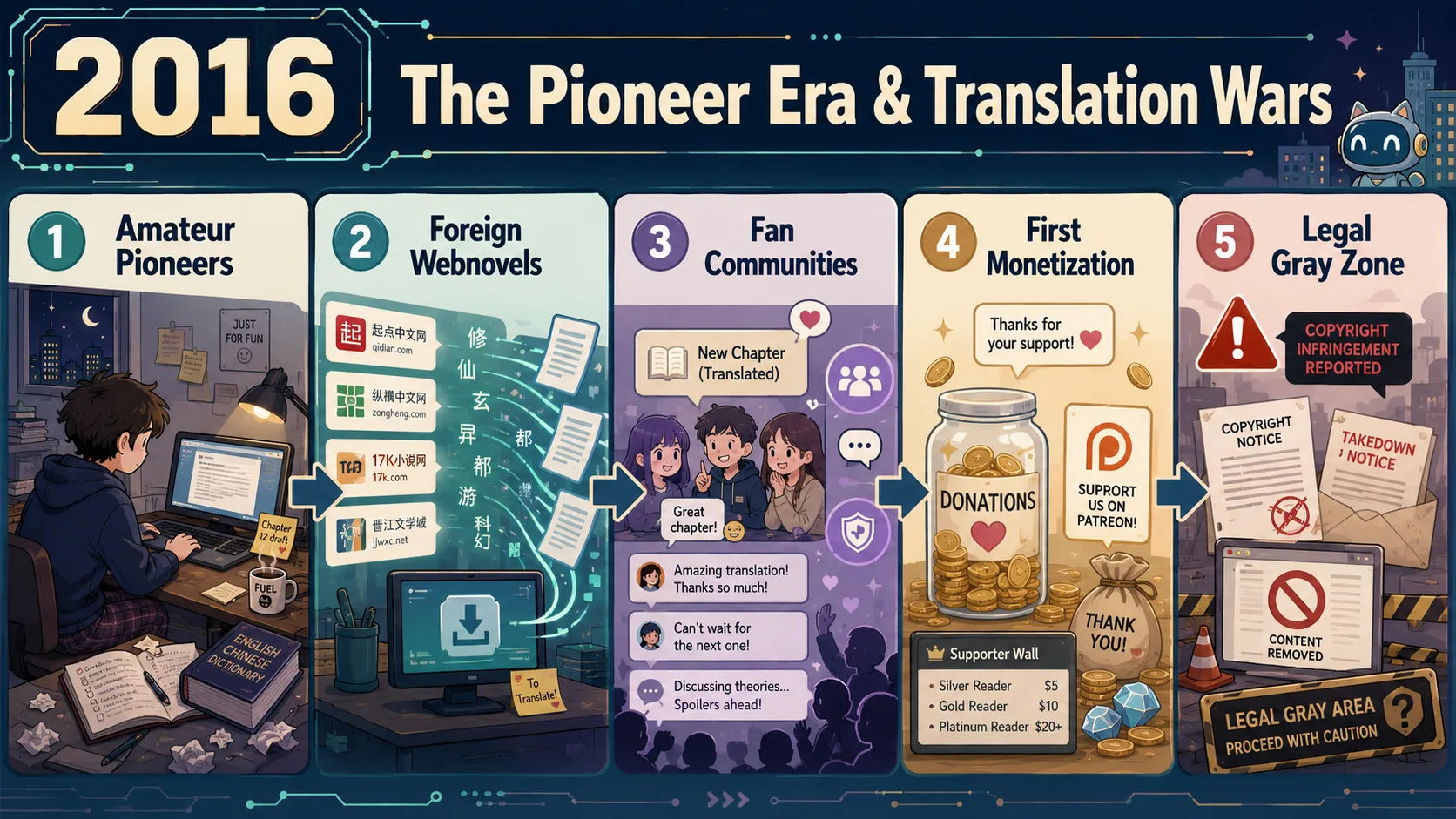
With the rapid deployment of the Patreon Hybrid Model (as detailed in Chapter 21), independent creators successfully secured their financial survival against the Aggregators and the corporate monolith of Webnovel.com. They had built an impregnable fortress of VIP content.
However, a fortress is entirely useless if no one knows where it is.
By mid-2016, the destruction of the old “Gentleman’s Agreement” and the shattering of Wuxiaworld’s central authority during the Wuxiaworld War had completely atomized the web fiction audience. Readers were suddenly tracking fifty different novels hosted across fifty different personal WordPress blogs, while actively dodging hundreds of malicious pirate domains. The ecosystem had become a dark, impenetrable forest.
The readers desperately needed a map. The independent translators, entirely dependent on Patreon conversions, desperately needed a billboard.
This mutual necessity birthed the single most important piece of non-reading infrastructure in the entire history of serialized web fiction: NovelUpdates.com (NU).
The launch and subsequent total domination of NovelUpdates did not merely organize the chaotic translation scene; it fundamentally altered the mathematical realities of how a novel achieved algorithmic success. It centralized the entire western readership into a single, highly quantifiable hub, paving the way for the ruthless optimization metas that would dictate author behavior for the next decade.
This is the story of how one developer successfully indexed an entire cultural movement, and how that index became the absolute dictator of the 2016 translation economy.
—
Part 1: The Fragmentation Crisis
To understand the absolute necessity of NovelUpdates, one must understand the psychological friction and profound exhaustion of being a web novel reader in the immediate aftermath of the corporate invasion.
During the 2015 Genesis Era, discovering a new novel was relatively simple: you went to Wuxiaworld or GravityTales and clicked on whatever was on the front page. But as the corporate poaching began (detailed in Chapter 24), those central hubs fractured. Independent translators, terrified of DMCA strikes or corporate interference, scattered across the internet, building their own highly isolated, custom-built websites to host their Patreons.
For the reader, this created a logistical nightmare. Tracking daily updates was no longer a hobby; it was a grueling administrative task.
Readers were forced to operate massive, complex Excel spreadsheets, manually logging the chapters they had read and cross-referencing them against dozens of different websites every single morning. If an independent translator decided to change their domain name to evade a corporate scraper bot, or simply migrated from WordPress to a custom site, they would instantly lose 40% of their readership simply because the readers couldn’t figure out where the novel had relocated.
The community desperately attempted to solve this discoverability crisis using Reddit. Subreddits like r/LightNovels and r/NovelTranslations functioned as makeshift update directories. Translators would post a link to their new chapter on Reddit, hoping readers would see it before it was pushed off the front page by other posts.
But Reddit was a fundamentally flawed tool for long-term serialization tracking. Its algorithm was explicitly designed for short-term virality, not library management. If a translator posted a link to Chapter 500 of a Chinese Xianxia novel, it might get 1,000 upvotes from highly dedicated fans, but a new reader browsing Reddit would have absolutely no context for what the novel was about, what its genres were, or where to start reading.
The industry had hit a critical, fatal bottleneck. The supply of translated and original novels was exploding exponentially due to the financial lure of the Patreon Hybrid Model, but the discoverability infrastructure was entirely broken. An author could write the greatest Cultivation novel in history, but if they didn’t have the SEO budget to outrank the Pirate Aggregators on Google, they would mathematically starve to death in obscurity.
—
Part 2: Tony, Baka-Tsuki, and the Great Index Pivot
It is a crucial historical nuance that NovelUpdates was not actually built in 2016 as a direct response to the corporate invasion. Its origins date back to 2015.
Enter Tony, an independent developer and avid reader who originally recognized a fragmentation crisis happening in a completely different demographic: The Japanese Light Novel (LN) community. Prior to 2016, the Japanese LN translation scene (centered around hubs like Baka-Tsuki) was a disorganized mess of forum posts and dead links. Tony built NovelUpdates.com to index these Japanese novels, launching with a deceptively simple premise: it did not host any actual translated chapters. It simply provided the hyperlink to the independent translator’s website.
But as the Japanese LN scene stagnated and the Chinese Cultivation explosion completely hijacked the western audience in 2016, NovelUpdates was perfectly positioned to absorb the shockwave. The independent Chinese and Korean translators, fleeing the corporate warfare of Webnovel.com, flooded into Tony’s Japanese LN directory.
Tony had built a map for a quiet village, and suddenly ten million refugees moved in. But the architecture he built around those hyperlinks was revolutionary, and it perfectly bypassed the SEO stranglehold of the corporate giants and the pirate Aggregators.
The Granular Tagging System
The absolute genius of NovelUpdates was its obsessive, infinitely granular tagging system.
Prior to NU, if a reader wanted to find a new novel, they had to ask for recommendations on Reddit, relying on frustratingly vague genre descriptions like “Fantasy,” “Action,” or “Martial Arts.” Tony implemented a tagging system that broke the novels down to their molecular narrative components. A reader could filter the database to find exactly what they were looking for, combining up to fifty different specific tropes.
They could search for:
* Protagonist Strong from the Start
* Arrogant Young Master
* Betrayal
* Academy Setting
* Cold Protagonist
* Polygamy
This tagging system completely altered the psychology of how novels were consumed. Readers stopped reading novels based on the translator’s reputation or the branding of the hosting site. They began treating the NovelUpdates database like a highly specific restaurant menu. They knew exactly what hyper-specific narrative flavor they wanted (e.g., “I want a novel where the protagonist is betrayed by his lover, reincarnates into the past, and uses future knowledge to build a business empire”), and NovelUpdates provided the exact hyper-filtered list of novels that matched that exact chemical craving.
The RSS Reading List
The second revolutionary feature was the personalized “Reading List.”
A user could create a free account on NovelUpdates and manually add novels to their library. The site’s automated bots would scrape the RSS feeds of thousands of different independent translator websites. The absolute second a translator published a new chapter on their personal WordPress blog, NovelUpdates would instantly update its main feed and send a notification to every single user who had the novel in their Reading List.
The complex Excel spreadsheets were instantly rendered obsolete. A reader could track fifty different novels, hosted across fifty different domains, updated at wildly different time zones, from a single, beautifully centralized dashboard.
—
Part 3: The King-Maker Algorithm
The community adoption of NovelUpdates was instantaneous and absolute. Within months of its launch, it completely cannibalized Reddit and Google Search as the primary discovery engine for web fiction. If you were a reader in 2016, NovelUpdates was your homepage.
But for the independent creators, the launch of NovelUpdates was a terrifying paradigm shift.
Because Tony successfully centralized the entire western readership onto a single domain, NovelUpdates essentially became the sole gatekeeper of organic traffic. The mathematical reality of the 2016 economy became brutally, painfully simple: If your novel was not indexed and highly ranked on NovelUpdates, your Patreon would not grow. You did not exist.
This centralized power created the first true “Algorithmic Meta” of the independent era. Translators quickly realized that they were no longer writing for the reader; they were optimizing for the NovelUpdates algorithm.
The “Latest Release” Churn
The homepage of NovelUpdates featured a rapidly updating list of the “Latest Releases.” Every time a translator posted a chapter link, their novel would briefly appear at the absolute top of the homepage, instantly visible to hundreds of thousands of highly targeted daily visitors.
Translators analyzed the analytics and discovered a crucial algorithmic truth: The key to massive traffic growth was not translating one massive, 5,000-word, highly polished chapter a week. That would only put their novel on the front page once.
The key to algorithmic dominance was translating five, smaller, 1,000-word chapters a week, and strictly scheduling them to drop at peak readership hours (usually 5:00 PM EST). By spreading the chapters out, the translator ensured their novel hit the top of the NovelUpdates homepage every single day.
This realization permanently altered the pacing of web fiction. It forced translators into exhausting, daily release schedules simply to maintain algorithmic visibility, creating the foundation for the “Translation Speed Wars” (which we will explore in a subsequent chapter).
“I used to drop my three chapters every Sunday night. My traffic was terrible. Another translator told me to just take those exact same three chapters, chop them in half, and post one half every single day at 6 PM. I did it. I didn’t translate a single extra word. My traffic quadrupled in four days. NovelUpdates literally trained us to write shorter chapters just to game the front page.”
— Archived Translator Discord Log, November 2016
—
Part 4: The Ad-Sense Monopoly and the Consolidation of Wealth
While NovelUpdates provided an invaluable free service to the community, rescuing it from the fragmentation crisis, it is crucial to recognize the massive economic implications of its architecture.
By centralizing the entire readership without actually hosting any of the heavy, server-crashing chapter content, NovelUpdates engineered a mathematically flawless business model. Tony did not have to pay translators. He did not have to pay for the massive bandwidth required to host millions of words of text. He simply hosted the hyperlinks and the index.
But because millions of users visited that index every single day, repeatedly refreshing the homepage to see if their favorite novel had updated, NovelUpdates became one of the most lucrative advertising real estates in the entire web fiction ecosystem. The site was plastered with Google AdSense banners. Every time a reader refreshed the page, NovelUpdates generated revenue.
Furthermore, the existence of NovelUpdates hyper-accelerated the wealth of the top-tier independent translators, widening the gap between the elite and the amateurs.
Before NU, an independent translator had to slowly build an audience through word-of-mouth over several months. With NU, if an experienced translator picked up a highly rated, highly anticipated Chinese novel and dropped the first chapter, they would instantly receive 20,000 clicks from the NovelUpdates directory on day one.
This immediate, massive influx of traffic allowed savvy translators to set up their Patreon “Advanced Chapter” tiers immediately, achieving $5,000-a-month incomes within weeks of launching a new project.
Let’s look at the hard math of an optimized NovelUpdates launch in late 2016:
* Day 1 Launch: Translator drops 5 chapters of a highly anticipated novel.
* NU Front Page Exposure: Generates 25,000 organic clicks from curious readers browsing the “Latest Release” list.
* Patreon Funnel: Translator locks Chapters 6 through 15 behind a $10 Patreon Tier.
* Conversion Rate: 2% of the 25,000 readers hit the cliffhanger on Chapter 5 and pay $10 to read ahead.
* Day 1 Income: 500 Patrons x $10 = $5,000 MRR (Monthly Recurring Revenue).
NovelUpdates acted as a massive financial megaphone, amplifying the successes of the top translators to unprecedented heights. It provided the exact infrastructure the independents needed to rival the corporate salaries offered by Webnovel.com. But in doing so, it created a hyper-competitive, deeply cutthroat environment where visibility was everything, and obscurity meant financial death.
—
Part 4.1: The Architecture of the SEO Monopoly
To fully understand the gravity of NovelUpdates in 2016, we must examine the specific Search Engine Optimization (SEO) war it single-handedly won against Webnovel.com.
When Tencent backed Webnovel.com, their primary strategy was to establish a digital monopoly. They believed that by throwing tens of millions of dollars into Google AdWords, they could essentially buy the top search result for every single Chinese novel name in existence. If a reader typed “Read Coiling Dragon” into Google, Webnovel.com wanted to be the only link that mattered.
However, they failed to account for the unique architecture of NovelUpdates. NovelUpdates was not just a list of links; it was a deeply structured, user-generated relational database.
Every single novel page on NovelUpdates contained:
1. Alternative Names: The English title, the Pinyin title, the raw Chinese characters, the Korean Hangul, and fan-made abbreviations (e.g., ‘CD’ for Coiling Dragon, ‘ATG’ for Against the Gods).
2. Granular Metadata: Hyper-specific tags generated by thousands of users constantly updating the page.
3. Massive User Reviews: Thousands of words of user-generated content in the form of highly detailed, opinionated reviews.
Because Google’s algorithm heavily rewards structured data, organic keyword density, and constant user interaction, NovelUpdates became an SEO juggernaut. It was practically immune to corporate SEO manipulation. Even if Webnovel.com bought an ad at the top of the search results, the organic, top-ranked result beneath it was always the NovelUpdates directory page.
This meant that NovelUpdates functioned as an impenetrable digital shield for the independent community. It guaranteed that a reader searching for a novel would land in an ecosystem controlled by the community, rather than a corporate walled garden. If Tony had not built NovelUpdates with such rigid database architecture, the independent translators would have been algorithmically starved of organic traffic by mid-2017.
Part 4.2: The Psychological Addiction of the “Refresh”
The dominance of NovelUpdates was not purely algorithmic; it was profoundly psychological. In the 2015-2016 era, web fiction was fundamentally different from traditional publishing because it operated on the exact same psychological mechanics as a slot machine.
When a reader purchased a traditional paperback novel, they received the entire dopamine payload at once. They could read the book at their leisure. The transaction was complete.
But web fiction is serialized. The dopamine is fractured into 2,000-word daily doses. And NovelUpdates built the ultimate casino floor for this addiction.
The “Latest Release” feed on the homepage was not just a directory; it was a variable reward schedule. A reader could check the site at 2:00 PM and see nothing of interest. They could refresh the page at 2:15 PM and suddenly see that their absolute favorite novel had just dropped three chapters due to a sponsored queue mass-release.
This unpredictability triggered a massive dopamine release in the reader’s brain. NovelUpdates became the second most visited website for its users, eclipsed only by their email clients. The compulsion to refresh the “Latest Release” page bordered on the pathological. Translators began noticing in their analytics that the vast majority of their traffic spikes occurred within seconds of their link hitting the NovelUpdates homepage.
This trained an entire generation of readers to consume fiction not as a focused, long-form activity, but as a fractured, hyper-anxious reflex. The reader was no longer checking to see if a story had updated; they were checking to see if they had won the digital lottery.
Part 4.3: The Data Weaponization of Tags
The most defining feature of NovelUpdates was its granular tagging system. Unlike traditional publishers who categorized books in broad, useless genres like “Fantasy” or “Sci-Fi,” the NovelUpdates community generated hundreds of hyper-specific micro-genres.
Tags like: Betrayal, Dense Protagonist, Fast Learner, Female Master, Hidden Weapons, Lack of Common Sense, Level System, and Ruthless Protagonist.
In 2016, this tagging system functioned as a flawless consumer-filtering mechanism. But by 2018, this exact tagging database became the training data for the algorithmic revolution.
When Western authors on Royal Road began analyzing why certain Chinese novels were massively successful, they did not read the novels. They scraped the NovelUpdates tagging data. They reverse-engineered the exact combination of tags that generated the highest average user ratings and the highest daily traffic.
They realized that a novel tagged with Weak to Strong, Ruthless Protagonist, and Betrayal mathematically outperformed a novel tagged with Strong to Strong and Naive Protagonist.
This was the birth of Algorithmic Writing. Authors were no longer writing stories based on artistic inspiration; they were writing stories engineered specifically to satisfy a highly optimized cluster of NovelUpdates tags. They were building narratives out of prefabricated, data-tested Lego blocks.
The tagging system, which was originally designed simply to help readers find books they liked, had inadvertently become the blueprint for the industrialization of the entire genre. It proved that in the web fiction ecosystem, the trope is infinitely more important than the prose.
Part 4.4: The Rise of the Anti-Recommendation
An unintended consequence of NovelUpdates’ deeply centralized review system was the power of the “Anti-Recommendation.”
Because the community was hyper-invested and deeply cynical, the reviews on NovelUpdates were notoriously brutal. A 3.5-star rating on NovelUpdates was considered a death sentence, whereas a 3.5-star rating on Amazon is considered acceptable.
Translators and authors quickly realized that a specific type of negative review could actually drive massive amounts of traffic. A 1-star review complaining that “The protagonist is a complete psychopath who murders anyone who disrespects him without hesitation” would instantly attract thousands of readers who were specifically looking for an unapologetically evil, ruthless protagonist.
This inverted the traditional marketing dynamic. Authors began intentionally injecting highly polarizing, controversial tropes into their early chapters specifically to trigger these outrage reviews on NovelUpdates. The outrage generated visibility, and visibility generated Patreon conversions.
The NovelUpdates review section became a battleground of weaponized sentiment, where both positive and negative reviews were equally effective at driving traffic, so long as the review clearly identified the core tropes of the novel. The only true failure on NovelUpdates was a review that said, “It was boring and nothing happened.”
Part 5: Actionable Takeaways for the Modern Author
The launch and domination of NovelUpdates provides critical, timeless lessons for modern authors attempting to navigate algorithmic platforms like Royal Road, Scribble Hub, or Amazon Kindle in 2026.
1. Tropes are the True Currency
The NovelUpdates granular tagging system conclusively proved that readers do not search for “good writing.” They search for specific narrative tropes. As an author, you must view your tropes as your primary marketing keywords. If you are writing a LitRPG, you must clearly signal to the algorithm (and the readers) exactly what flavors you are providing (e.g., Weak-to-Strong, Necromancer, Town-Building, System Administrator). If you refuse to use recognizable tropes because you want to be “purely original” and “defy categorization,” the algorithm will not know how to index you. You will remain entirely invisible to the readers who actively want to give you money.
2. Visibility Requires Frequency
The “Latest Release” churn on NovelUpdates established a universal truth for serialized media: frequency beats volume. The algorithm prioritizes recency over length. It is vastly more beneficial for your algorithmic growth on Royal Road to post one 2,000-word chapter every day for five days than to post one massive 10,000-word chapter once a week. You must optimize your release schedule to maximize your appearances on the platform’s ‘Recently Updated’ feeds.
3. Centralization Breeds Monopolies
When a community successfully centralizes onto a single platform (whether it is NovelUpdates, Royal Road, or Amazon), that platform instantly becomes the sole dictator of success. You must intimately understand the specific, cold mathematical mechanics of that platform’s ranking system. You are not writing in a vacuum; you are writing for an algorithm. If Royal Road’s “Trending” list requires a sudden burst of followers within a 48-hour window, your entire launch strategy must be engineered to farm that specific metric.
4. Build Your Own Map
NovelUpdates saved the independent ecosystem because it provided a map that Webnovel did not control. However, if NovelUpdates ever went offline, or altered its algorithm to ban Patreon links, the translators would have been instantly bankrupted. As a modern author, your email newsletter or private Discord server is your personal NovelUpdates. It is the only map you own. You must constantly funnel your readers off the public algorithm and into your private ecosystem, ensuring that if Royal Road changes its rules tomorrow, you can still tell your readers where to find your next chapter.
*(Discovery was no longer a matter of luck; it was a matter of data. But where there is data, there are trolls. As authors began to realize the power of the NovelUpdates ranking, a new and toxic weapon was forged. In Chapter 23: The Review Bombing Meta, we look at the first great rating war of the western community).*
0 Comments