

2016 – 08 – The Aggregator Virus
by EternalibChapter 28: The Aggregator Virus—The Industrialization of Piracy
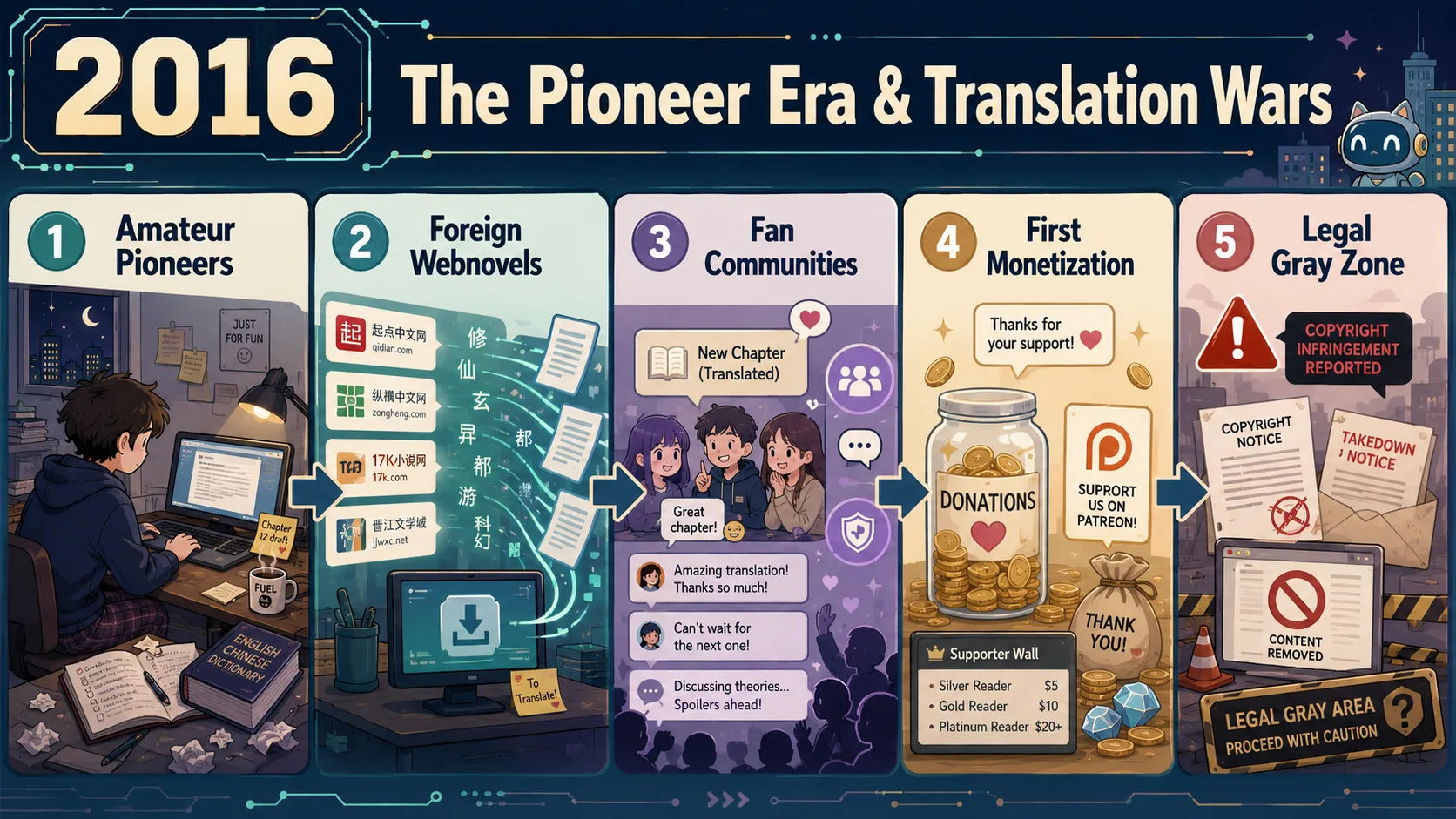
By the end of 2016, the web fiction economy was overflowing with capital. Top-tier translation hubs were clearing six-figure monthly revenues, and the “Patreon Meta” was at its absolute peak. But as the “Legal” industry professionalized its infrastructure (Chapter 26) and expanded its genre library (Chapter 27), it inadvertently created the perfect conditions for a devastating digital parasite: The Aggregator Site.
Piracy had always existed in the web novel scene, but in 2015, it was primitive. It consisted of fans copy-pasting chapters into forum threads or sharing PDFs on Google Drive. In 2016, however, piracy became an industrial-scale, highly automated, and incredibly lucrative business. This was the era of the Aggregator Virus, the period where scrap-and-repost sites like KissLightNovels, BoxNovel, and LightNovelPub emerged to siphon millions of dollars and billions of pageviews away from the original creators.
—
Part 1: The SEO Hijack
The most terrifying weapon in the aggregator arsenal wasn’t the theft of the content; it was the SEO Hijack.
Because the original translation hubs were often small, independent operations with limited technical expertise, their websites were poorly optimized for search engines. They frequently used messy URL structures and slow-loading WordPress backends.
The aggregator sites, however, were built by professional Shadow Developers who specialized in high-velocity SEO and algorithmic exploitation. These weren’t fans; they were opportunistic tech entrepreneurs, often based in Southeast Asia or Eastern Europe, who saw the web fiction explosion as a “Low-Hanging Fruit” for ad revenue. They didn’t just copy the text; they used “Headless Browsers” to scrape the content the millisecond it was posted, often beating the translator’s own RSS feeds.
These Shadow Developers understood the “Google Dance” better than any fan-site admin. They optimized for “LCP” (Largest Contentful Paint), used lightweight “CDN” delivery systems, and weaponized “Backlinking” networks to boost their authority. They would create thousands of fake “Review” sites that all linked back to the aggregator, tricking Google’s algorithm into believing that the pirate site was the most authoritative source for the novel.
By late 2016, a surreal and infuriating reality had set in: If a new reader searched for I Shall Seal the Heavens, the first result on Google wouldn’t be Wuxiaworld (the site paying for the translation). It would be a pirate aggregator. This wasn’t just a minor technical glitch; it was a systemic failure of the internet’s search infrastructure to distinguish between a creator and a parasite. The aggregators were successfully “hijacking” the entry point of the entire industry. They were stealing the “Fresh Blood” before the readers even knew that the “Official” sites existed. For many readers, the pirate site was the official site.
“I spent three months and $5,000 on a consultant to fix our site’s loading speed. We got it down to 2 seconds. The next day, a site called ‘LightNovelFree.cc’ launched. It loaded in 0.5 seconds, had every single one of our 1,500 chapters, and was already outranking us for the main title keywords. It felt like I was fighting a ghost. Every time I blocked an IP, they just rotated to a new proxy and kept scraping. They were faster, cleaner, and better at Google than we were. It was soul-crushing.”
— Former Admin of a mid-sized 2016 Translation Hub
—
Part 2: The Convenience Trap
The hubs attempted to fight the aggregators by appealing to the community’s morals. They posted long manifestos about “Supporting the Translators” and “Respecting the Original Authors.”
These appeals almost entirely failed due to the Convenience Trap.
The aggregator sites often provided a significantly better reading experience than the official hubs. While a translator’s blog might be cluttered with intrusive “Support me on Patreon” pop-ups, messy sidebar widgets, and poorly formatted text, the aggregators offered a clean, standardized, and ad-free (or ad-light) mobile interface.
Crucially, the aggregators were Multi-Hub Platforms. A reader could find novels from Wuxiaworld, Gravity Tales, Volare, and a dozen independent WordPress blogs all in one single app. To the addicted reader, convenience was a more powerful force than ethics. Why would they maintain ten different bookmarks and ten different accounts on ten different websites when they could just use one single pirate site that had everything? The aggregators proved that in the digital age, User Experience is the ultimate weapon. By providing a more frictionless product, the pirates successfully commodified the labor of thousands of translators.
—
Part 3: The Geopolitical Shield
When the hubs attempted to issue DMCA takedown notices to the aggregators, they ran into a brick wall of Geopolitical Immunity.
The majority of these massive aggregator sites were hosted on servers located in Vietnam, Russia, or Ukraine. These jurisdictions were notoriously indifferent to Western intellectual property laws, especially when the IP in question was a translation of a Chinese novel that didn’t even have a formal Western license.
The aggregators operated with total impunity. If a site was successfully taken down by a Google de-indexing request, they would simply “clone” the entire database—which contained tens of thousands of novels—and relaunch on a new domain (.cc, .to, .xyz) within twenty-four hours. It was a digital “Whack-a-Mole” game that the hubs could never win. The legal cost of fighting a pirate site in Ho Chi Minh City from a law office in California was astronomical. The translators were physically and legally incapable of defending their borders. The “Wild West” had become a lawless wasteland where the fastest scraper won.
—
Part 4: The Captcha Wars
As the frustration grew, the hubs resorted to technical warfare, sparking the era of the Captcha Wars.
Translators began implementing aggressive anti-scraping measures. They used invisible “honeypot” text that only scrapers could see (which would then flag the scraper’s IP). They used JavaScript obfuscation to hide the text of the chapter from automated bots. And most famously, they began locking their chapters behind massive, annoying “Captcha” walls.
Before a reader could read a chapter on an official site, they had to solve a puzzle or click a “verify” button. This was a disaster for the “Legal” industry. While the scrapers eventually found ways to bypass these measures (often by hiring low-cost “Click Farms” to solve captchas in bulk), the legitimate readers were the ones who suffered. The reading experience on official sites became slow, frustrating, and technical. The aggregators, meanwhile, remained clean and easy to use. The hubs were inadvertently driving their own audience into the arms of the pirates by making their own websites unusable in a desperate attempt to protect their content.
—
Part 5: The “Scraper Proof” Strategy—The Rise of Community Gating
By late 2016, the hubs realized that they couldn’t stop the scraping of the text. So they shifted their strategy to Community Gating.
They began moving the “Value” of the novel away from the raw text and toward the “Live Experience.” This included:
1. VIP Discord Roles: Giving Patreon supporters access to private channels where they could chat directly with the translator.
2. Live Chapter Releases: Releasing chapters at a specific, announced time so the most addicted fans could read them “Live” before the scrapers could catch up.
3. Interactive Elements: Allowing supporters to vote on character names, plot directions, or which novel should be translated next.
The goal was to make the reader feel like they were part of a “Club,” rather than just a consumer of a “Product.” You could pirate the text, but you couldn’t pirate the community. This remains the primary defensive strategy for independent authors today. The text is just the “Gateway Drug”; the community is the “Retention Engine.”
—
Part 6: The Ransom Meta—Pirates Monetizing Pirates
The final, and perhaps most insulting, evolution of the Aggregator Virus was the Ransom Meta. By late 2016, some of the larger pirate sites had become so confident in their dominance that they started launching their own “Premium” features.
They weren’t just stealing the content; they were selling it back to the audience.
These pirate sites launched “Pro” memberships for $5 a month that promised “No Ads” and “Faster Chapter Loads.” They were effectively running a parallel, shadow-Patreon economy on top of the translators’ work. They even started “Ransoming” specific series—if a novel was particularly popular, they would hide the latest chapters behind a pirate-paywall for 24 hours, forcing the most desperate readers to pay the pirates for content that the pirates had stolen for free.
This was the ultimate systemic failure. The pirates had created a more efficient, centralized, and profitable monetization model than the actual creators. It proved that in the digital world, the one who controls the UI controls the money. It was a dark lesson that the corporate giants would take to heart when they finally launched their official platforms in 2017.
“I realized the industry was broken when I saw a guy in a Discord server complaining that the pirate site’s ‘Subscription’ had gone up from $3 to $5. He wasn’t even subscribed to the actual translator’s Patreon. He was paying the thief to make it easier to read the stolen goods. We had built the house, but the pirates had successfully taken over the front door and were charging admission.”
— Former Lead Editor for a 2016 Independent Translation Group
—
Part 7: The “Honeypot” Wars—A Desperate Counter-Strike
As a final act of desperation, some translation hubs launched the Honeypot Wars. They realized that the aggregators were using fully automated bots to pull content, so they started poisoning the well.
Translators would intentionally release “Fake” versions of a highly anticipated chapter. These honeypots would contain 2,000 words of complete gibberish, or in some hilarious cases, the lyrics to Rick Astley’s Never Gonna Give You Up repeated for fifty pages. Because the bots were unthinking, they would scrape the fake chapter and push it to the aggregator’s millions of readers.
For a brief moment, the official sites had the upper hand. The aggregators were flooded with complaints from angry readers who had just paid $5 for a “Premium” pirate experience only to get rick-rolled. However, the victory was short-lived. The aggregators simply improved their AI filters, and the “Honeypot” strategy ended up confusing the legitimate readers who were also accidentally seeing the fake chapters on the official sites. It was a war of attrition where the only casualty was the sanity of the reader.
—
Actionable Takeaways for the Modern Author
The Aggregator Virus proved that piracy is almost always a service problem. If you provide a better, more convenient experience than the pirates, the majority of your audience will pay you.
1. Optimize for Frictionless Consumption
Your website or reading app must be faster and cleaner than the pirate aggregators. If a reader has to jump through hoops (captchas, intrusive ads, multiple login screens) to read your work, you are literally training them to pirate your content. Remove the friction, and you remove the incentive to steal. In the modern era, the reader’s time is more valuable than their money. Respect their time, and they will respect your copyright.
2. SEO is a Defensive Requirement
Don’t let aggregators own the search results for your own title. Invest in basic SEO—clean URLs, meta-descriptions, and fast-loading pages. If you don’t own the “Top Spot” on Google for your own book, you are handing your organic traffic directly to a pirate. Use tools like Google Search Console to monitor who is outranking you and why. SEO is not “Marketing”; it is “Property Protection.”
3. Build “Un-Scrapable” Value
The raw text of your story will always be easy to pirate. To survive, you must build value that cannot be copied-and-pasted. This includes direct access to you (the creator) via Discord, exclusive “Behind-the-Scenes” lore, and interactive community events. Make your readers feel like they are “Sponsors” of an artist, not just “Buyers” of a book. A scraper can steal your words, but they cannot steal the parasocial bond you build with your audience.
4. Convenience is the Ultimate Currency
The aggregators won because they offered a “Hub” experience. As an author, try to make your presence as centralized as possible. If you publish on multiple platforms, ensure they all link back to a single “Source of Truth.” If you make it easy for readers to find and pay you, they usually will. Never give the reader an excuse to say: “I couldn’t find the official site.”
5. Be Wary of Aggressive Anti-Piracy Measures
The “Captcha Wars” proved that punishing your legitimate readers to spite the pirates is a losing strategy. Every “Verify” button you add is a potential point of exit for a reader. Focus on making your official experience so good that the reader wants to be there, rather than making the pirate experience so bad that they have to be there.
*(The aggregators siphoned millions, but they couldn’t stop the sheer volume of content. However, the internal culture of the translation hubs was beginning to rot from the inside. As the hubs became corporations, the “Ego Wars” between celebrity translators began to threaten the stability of the entire ecosystem. In Chapter 29: The Cult of Personality, we explore the rise of the Translator Star and the first major schisms of 2017).*
Part 4.1: The Anatomy of a Scraper Bot
To understand why the “Aggregator Virus” nearly destroyed the independent web fiction economy in 2016, one must first understand the brutal, flawless simplicity of the technology that powered it.
A scraper bot is not a complex artificial intelligence. It is a primitive, highly efficient Python script (often utilizing libraries like BeautifulSoup or Selenium). These scripts were programmed to monitor the RSS feeds of major translation hubs and the “Latest Release” page of NovelUpdates.
The absolute millisecond a legitimate translator clicked “Publish” on a new chapter, the bot received the ping. Within three seconds, the bot navigated to the URL, parsed the HTML Document Object Model (DOM), identified the <div class="chapter-content"> tag, ripped the raw text, and instantly published it to a massive, automated pirate database hosted on bulletproof servers in Russia or Southeast Asia.
The aggregator site required zero human oversight. A single server running twenty Python scripts could steal the daily labor of five hundred independent translators, accumulating millions of words of highly addictive fiction every single day, completely free of charge.
Part 4.2: The Ad-Arbitrage Black Market
The aggregators did not steal this content out of malice; they stole it because of the staggering profitability of the Ad-Arbitrage Meta.
Legitimate translation hubs relied on Google AdSense. Google AdSense requires strict compliance with copyright laws and enforces a baseline standard of user experience (e.g., no malicious pop-ups, no invisible ad layers).
The aggregator sites operated completely outside the Google ecosystem. Because they were already engaged in massive, blatant copyright infringement, they had absolutely no reason to play by the rules of polite advertising. They partnered with shadow ad-networks that trafficked in malicious, highly aggressive advertising.
When a reader visited an aggregator site, they were subjected to:
1. The Invisible Overlay: The entire screen was covered in an invisible, zero-opacity button. The first time the reader tried to scroll down to read the stolen chapter, they unknowingly clicked the invisible ad, triggering a pop-under tab.
2. The Ransomware Redirect: Aggregators frequently allowed ads that actively hijacked the mobile browser, vibrating the user’s phone and displaying a fake “Your iPhone is infected with a Virus!” warning, attempting to force the user to download malware.
3. The NSFW Barrage: Completely unregulated, highly explicit adult advertisements were plastered alongside the stolen text.
These malicious ad networks paid exponentially higher CPMs (Cost Per Mille) than Google AdSense. A legitimate translator might earn $2.00 per thousand views through Google. The aggregator, utilizing malicious pop-unders and invisible overlays, might earn $15.00 per thousand views.
The aggregators were making significantly more money off the stolen chapters than the original translators were making from the legitimate release.
Part 4.3: The SEO Hijacking
The true devastation of the Aggregator Virus was not just the theft of the content, but the theft of the Search Engine Optimization (SEO) ranking.
Because the aggregator sites accumulated millions of words of text, covering thousands of different novels, they became massive authorities in the eyes of the Google Search algorithm. When a casual reader typed “Read I Shall Seal the Heavens Chapter 400” into Google, the legitimate translator’s website often appeared on page two. The first page was entirely dominated by five different aggregator sites.
The aggregators had successfully hijacked the top of the funnel. A vast majority of the “Plankton” readership (the free readers) had no idea they were reading on a pirate site. They simply clicked the first link on Google, closed the malicious pop-ups out of habit, and read the chapter. They never saw the translator’s Patreon link. They never joined the translator’s Discord.
The independent translators were completely severed from their own audience.
Part 4.4: The Destruction of the Ad-Revenue Meta
The Aggregator Virus fundamentally destroyed the viability of the “Ad-Revenue Meta” for independent creators.
Prior to 2016, a translator could justify translating a novel for free simply by relying on the AdSense revenue generated by the massive traffic. But the aggregators siphoned off 60% to 80% of the organic search traffic. The ad revenue for legitimate sites plummeted.
This crisis was the absolute catalyst that forced the entire industry to adopt the Patreon Hybrid Model (Chapter 21). The translators realized that they could not beat the aggregators at the SEO game, and they could not protect the raw text from the scraper bots. The only asset the aggregators could not steal was Time.
By locking the newest chapters behind the Patreon paywall, the translators successfully hid the text from the scraper bots for the duration of the exclusivity window. The aggregators were relegated to stealing the delayed, public chapters.
The aggregator virus proved that in the digital age, raw data (the text) is fundamentally impossible to protect. The only way for an independent creator to survive is to monetize the community, the exclusivity, and the parasocial relationship—the intangibles that a Python script cannot scrape.
0 Comments