
2016 – 10 – The Early Qidian Beta
by EternalibChapter 30: The Early Qidian Beta—The Corporate Culture Shock
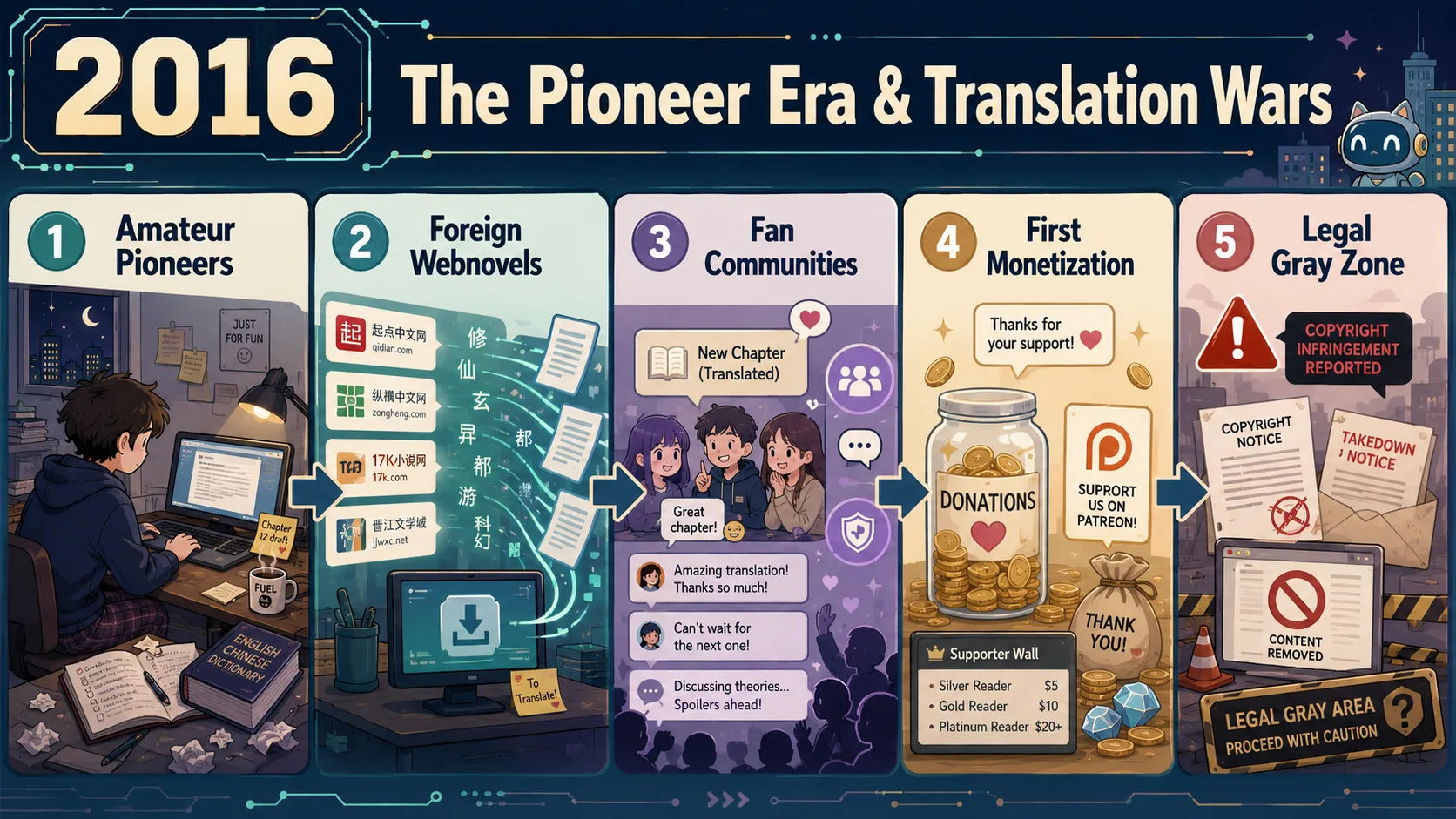
In late 2016, while the western translation hubs were fighting over celebrity translators (Chapter 29) and battling pirate scrapers (Chapter 28), a sleeping giant was finally opening its eyes. Qidian—the massive Chinese web fiction subsidiary of Tencent—launched its international beta, later known as Webnovel.
This was the most significant event in the history of the industry. It was the moment that “Community Culture” collided with “Corporate Logic” at high velocity.
For two years, the western scene had been a loose, chaotic, and highly personal ecosystem built on the backs of fan-translators and Patreon “donations.” Qidian’s entry was an attempt to replace that messy community with a sterile, professional, and hyper-monetized corporate machine. The resulting Corporate Culture Shock would trigger a multi-year rebellion that permanently altered the relationship between readers, translators, and platforms.
—
Part 1: The “Spirit Stone” Shock
The first and most violent shock was the introduction of the Spirit Stone.
Until late 2016, the western economy was built on “The Donor Model.” Readers “donated” on Patreon to unlock advance chapters, but the underlying text was ostensibly free. It was a system built on “Toxic Philanthropy”—the idea that you were supporting a person, not buying a product.
Qidian replaced this with a Transactional Model. They introduced a proprietary virtual currency called “Spirit Stones.” If you wanted to read a chapter, you had to spend stones. You could earn a few stones by watching ads or checking in daily, but if you were a binge-reader, you had to buy them with real money.
Let’s look at the Math of the Spirit Stone. On Patreon, a reader could pay $5 a month and get 10-20 “Advance Chapters” of their favorite novel. It was a flat, predictable fee. In the Qidian model, a chapter might cost 10-15 Spirit Stones. To read a single 3,000-chapter novel like True Martial World, a reader would have to spend hundreds of dollars. The “Micro” in microtransaction was a lie; it was a “Macro-transaction” broken into invisible, addictive pieces. This was the birth of the Paywall.
The community’s reaction was one of pure, unadulterated outrage. To the fans, “Spirit Stones” felt like a gacha game mechanic being forced into their favorite hobby. They didn’t see it as a way to “Support the Author”; they saw it as a corporate “Pay-to-Read” tax. This single feature created a rift that would drive thousands of readers toward the pirate aggregators, purely out of spite for the corporate model. The fans felt that the “Passion Economy” had been liquidated and sold back to them in 10-cent increments.
“I did the math. To finish reading the novel I’ve been following for two years, I would have to spend $450 on Spirit Stones. I can buy a PlayStation 4 for that much money. On Patreon, I was paying the translator $5 a month and I felt like a hero. Now, I feel like a whale in a mobile game. Qidian didn’t just bring the books; they brought the Chinese ‘Whale Meta’ to the west, and I’m not playing.”
— Archived Forum Post from r/novelupdates, January 2017
—
Part 2: The UI Arrogance
The second shock was the Platform Itself.
As we explored in Chapter 26, the western hubs had spent 2016 building custom site engines that were designed specifically for the western reader’s aesthetic—clean, dark-mode-focused, and mobile-responsive.
Qidian’s initial beta app was a direct port of their Chinese mobile application. It was cluttered, filled with “Game-y” notifications, and had a UI that felt alien to western sensibilities. It was a “Corporate UI” designed for “Users,” not a “Community Blog” designed for “Readers.” The arrogance of the launch was palpable. Qidian assumed that because they were the “Official Source” and owned the original IP, the western audience would immediately abandon the fan-sites and flock to the corporate app. They underestimated the power of the parasocial bond (Chapter 29). Readers didn’t care about “Officialness”; they cared about their relationship with the translator and the community they had built in the comment sections of the independent hubs.
—
Part 3: The “Official” Hostility
The most damaging aspect of the early beta was the Corporate Hostility toward the existing fan-base.
Qidian didn’t enter the market as a partner; they entered as a conqueror. They began issuing “Cease and Desist” notices to independent translators who were working on Qidian-owned properties. They demanded that all translations be moved to their platform, often offering the original translators “pittance” contracts that stripped them of their Patreon income and their creative autonomy.
This hostility turned the early Webnovel beta into a war zone. The “Comment Section Riots” were legendary. Every official announcement from Qidian was met with thousands of angry comments. The corporate titan was trying to manage a community of passionate fans as if they were a spreadsheet of compliant users, and the fans were fighting back with everything they had.
Perhaps the most cruel weapon in the corporate arsenal was the Translation Freeze. When a hub refused to hand over a novel, Qidian would use their legal power to prevent that novel from being translated anywhere else. Popular series were suddenly frozen in time, with no new chapters for six months or a year as the legal teams battled in the background. The readers were the collateral damage in this war of egos. They were caught in a “No Man’s Land” where their favorite story was being used as a bargaining chip by billionaire corporations. This hostage-taking of the narrative itself was the moment many fans realized that the “Golden Age” of fan-driven content was truly dead. It was no longer about the story; it was about the IP.
—
Part 4: The Translation “Standardization”
Finally, we must look at the impact of the Corporate Editorial Standard.
Qidian wanted to “Institutionalize” translation. They didn’t want Star Translators with “After-Chapter Notes” and personal opinions. They wanted a standardized, “Neutral” translation style that could be easily managed by a corporate editor.
This led to the “Sanitization” of the text. The cultural puns, the meta-commentary, and the personal flair that had made the 2015-2016 era so vibrant were stripped away. The translations became technically accurate but emotionally hollow. This was the final nail in the coffin for the “Wild West.” The corporate model was designed for scale, not for connection. By removing the “Star” from the translation, Qidian successfully built a platform that could host 10,000 novels, but they lost the soul of the community in the process.
—
Part 5: The “Translator Hostage” Meta—The Death of Autonomy
The final, and most chilling, part of the early Qidian beta was the introduction of the Exclusive Labor Contract.
In the independent hub era, a translator owned their work. If they were unhappy with a site, they could leave. Qidian’s contracts fundamentally changed this. They introduced clauses that essentially turned the translator into a “Service Provider” rather than an “Artist.”
If a translator signed with Qidian, they often had to hand over the “Rights” to their translation entirely. The company could, at any moment, replace the translator with someone else—or even an automated machine translation—if the translator wasn’t meeting a “Daily Quota.”
This created the Translator Hostage situation. Translators were forced to choose between “Legal Legitimacy” (joining Qidian) or “Financial Independence” (staying with the hubs and risking a lawsuit). Those who joined Qidian often found themselves on a “Digital Treadmill,” forced to output 15,000 words a week under the threat of having their novel “Transferred” to a different team. The “Love for the Story” was replaced by the “Fear of the Contract.” It was the ultimate professionalization of the industry, but it came at the cost of the very passion that had birthed it.
“I read the contract they offered me and I cried. It said they could take my novel away from me if I missed more than two days of releases. I’ve been translating this book for three years. I’ve sacrificed my social life, my health, and my sleep for this community. And now, they wanted me to sign a paper that said I was ‘Interchangeable Labor.’ They didn’t want my translation; they wanted a machine that looked like me.”
— Confession from an Independent Translator, February 2017
—
Part 6: The “Official” Support—The Corporate Lure
Despite the massive backlash, Qidian did have one powerful tool that the independent hubs could never match: Direct Access to the Original Authors.
They began a clever “Stockholm Syndrome” marketing campaign. They brought popular Chinese authors to the west (digitally) to thank the “Official” translators and to condemn the “Pirate” hubs. They told the translators that by joining Qidian, they were finally becoming “Legal” and “Professional.”
This lure was effective for many. Translators who were tired of living in a legal gray area and who wanted a stable, corporate salary began to defect. They were promised a future where they could become “Senior Editors” or “Regional Managers.” Qidian wasn’t just offering a job; they were offering a career path in a multi-billion dollar conglomerate. This created a profound split in the translator community. You were either a “Community Hero” (Independent) or a “Professional Success” (Corporate). The bridge between the two was burning, and Qidian was the one holding the torch.
—
Part 7: The NDA Gag Orders—The Silence Before the Storm
While the public face of the Qidian beta was chaotic, the private reality for the participating translators was defined by the NDA Gag Order.
As part of the initial recruitment drive, Qidian forced its new translators to sign Non-Disclosure Agreements that were unprecedented in the fan-community. They were forbidden from discussing their pay rates, their upcoming titles, or even the internal “Technical Glitches” of the app.
This created a “Wall of Silence” that further alienated the independent hubs. Translators who were once open books on the forums suddenly went silent. When asked why their novel had moved to the official app, they could only offer a sterile, corporate-approved “standard response.” This lack of transparency fueled the community’s “Conspiracy Theories.” Fans began to believe that their favorite translators were being “coerced” or “threatened” (which was sometimes true in a professional sense). The NDAs turned the early corporate era into a “Cold War” where the most valuable information was kept in the shadows, destroying the “Open-Source” spirit that had defined the 2015 Genesis.
—
Actionable Takeaways for the Modern Author
The Early Qidian Beta proved that you cannot buy community loyalty with “Officialness.” Respect and trust are the only currencies that matter in a serialized economy.
1. Community-First vs. Transaction-First
If you are launching a platform or a new series in 2026, don’t lead with the paywall. Lead with the value. Build a community that wants to pay you, rather than a system that forces them to pay. A reader who pays out of love is a long-term customer; a reader who pays out of necessity will leave the second a pirate alternative appears. In the modern web fiction landscape, “Transactional Friction” is the number one killer of momentum.
2. User Experience is a Cultural Statement
Your UI is not just a technical choice; it’s a statement about how you view your audience. A cluttered, ad-heavy, and “gamified” interface tells the reader that you view them as a “User” to be exploited. A clean, respectful, and reader-focused interface tells them you view them as a “Guest” to be welcomed. Never sacrifice the reader’s comfort for a short-term boost in “Ad impressions” or “Coin clicks.”
3. The “Spirit Stone” Lesson—Transparency Over Obfuscation
Be careful with virtual currencies. They can feel “Scammy” and “Dishonest” to a western audience. If you use a monetization model, keep it transparent. Monthly subscriptions or “Pay-What-You-Want” models are generally viewed with much more trust than “Microtransaction” models that obfuscate the actual cost of the content. A reader who knows exactly what they are spending is a reader who feels in control.
4. Don’t Fight the Fans—Partner With Them
If you are an IP owner, the fans who are “Pirating” your work through translation are your greatest marketing asset. Instead of issuing C&Ds, find ways to bring them into the fold as legitimate partners. Treat the “Amateur” scene as a talent scout, not a competitor. The 2016 corporate war proved that it is always cheaper to cooperate with a fan-base than it is to try and conquer it.
5. Own Your Autonomy—The “Gag Order” Warning
The NDA wars of 2016 teach us that transparency is your most powerful community-building tool. If a platform requires you to hide the truth from your readers (about pay, quality, or rights), they are asking you to destroy your “Trust Asset.” In 2026, where “Authenticity” is the only thing fans will pay for, never sign a contract that forces you to lie to your supporters.
*(The corporate giant had arrived, and while the fans were in open revolt, the actual content was undergoing its own transformation. As the hubs and the platforms stabilized, the ‘Experimental’ phase of web fiction ended. In Chapter 31: The Genre Hardening, we explore how the algorithm began to dictate the actual stories, turning ‘Art’ into a series of rigid trope-checklists).*
Part 4.1: The Technological Shock and Awe
When China Literature finally deployed the beta version of Webnovel.com (then referred to internally as the Qidian International portal) in late 2016, the initial reaction from the Western independent community was a mixture of deep anxiety and absolute technological shock.
For two years, the independent scene had survived on duct-taped WordPress installations, clunky PayPal donation pools, and chaotic forum threads. The UX (User Experience) of reading a web novel in 2015 was miserable.
The Webnovel.com beta was a revelation of corporate engineering.
It was a fully integrated, seamless mobile application. It featured native dark mode, perfectly formatted typography, offline reading caches, and a frictionless, heavily gamified microtransaction system. It did not rely on clunky third-party Patreon webhooks; the economy was built directly into the reading experience.
The Gamification of Reading
The true terrifying genius of the Qidian Beta was its psychological engineering. The Western independent sites asked for a flat monthly subscription. Qidian introduced the “Spirit Stone” (later just “Coin”) meta.
They fractured the currency. A reader did not pay $1.00 for a chapter. They paid $5.00 for 500 Spirit Stones, and a chapter cost 12 Spirit Stones. This basic abstraction completely severed the reader’s understanding of how much money they were actually spending.
Furthermore, the app actively rewarded the reader for opening the application. You received “Fast Passes” and free Spirit Stones simply for logging in daily, voting for a novel, or leaving a comment. This trained the reader to view the Webnovel app not just as a library, but as a daily chore checklist—a behavioral loop indistinguishable from a mobile Gacha game.
The independent translators realized instantly that they were technologically outgunned. They were fighting a multi-billion-dollar corporation that had spent a decade perfecting the psychology of digital addiction in the Chinese market.
Part 4.2: The Targeted Assimilation (The Poaching Meta)
Qidian did not attempt to crush the Western community immediately; they attempted to buy it.
Tencent’s executives understood that the “Cult of Personality” (Chapter 29) was the primary driver of traffic. If Qidian simply launched a sterile app with new translators, the Western audience would ignore it out of loyalty to their “Sect Leaders.”
Therefore, Qidian initiated a ruthless, highly targeted assimilation campaign. They reached out privately to the top 1% of independent translators—the ones running massive Patreon accounts and commanding tens of thousands of daily readers on Wuxiaworld and Gravity Tales.
Qidian offered them legitimate, iron-clad contracts. They offered base salaries, massive bonuses for completing chapters on time, and completely legal authorization to translate the novels.
The Ethical Collapse
This triggered a massive moral crisis within the independent community.
To the translators, the offer was a golden ticket. They could stop looking over their shoulder for a DMCA takedown. They could transition from operating an illegal pirate ring into a legitimate, corporate-sponsored career.
But to the audience (and the rival independent hubs), this was high treason. When a top translator announced they were leaving the independent WordPress site to officially join Webnovel.com, the community reaction was incredibly toxic. The “Sect Leaders” were branded as corporate sellouts who had betrayed the “free internet.”
This targeted poaching successfully decapitated the independent leadership. Qidian systematically absorbed the most talented, most efficient, and most popular translators in the ecosystem. The independent hubs (Wuxiaworld, Gravity) were forced to scramble, desperately trying to negotiate their own licensing deals with Qidian just to survive the corporate vacuum.
The Wild West era was officially over. The era of corporate consolidation had begun, and the independent creators were forced to either sign the contract, or face the DMCA.
0 Comments