2016 – 12 – The Great Realignment
by EternalibChapter 32: The Great Realignment—The Treaty of the Hubs
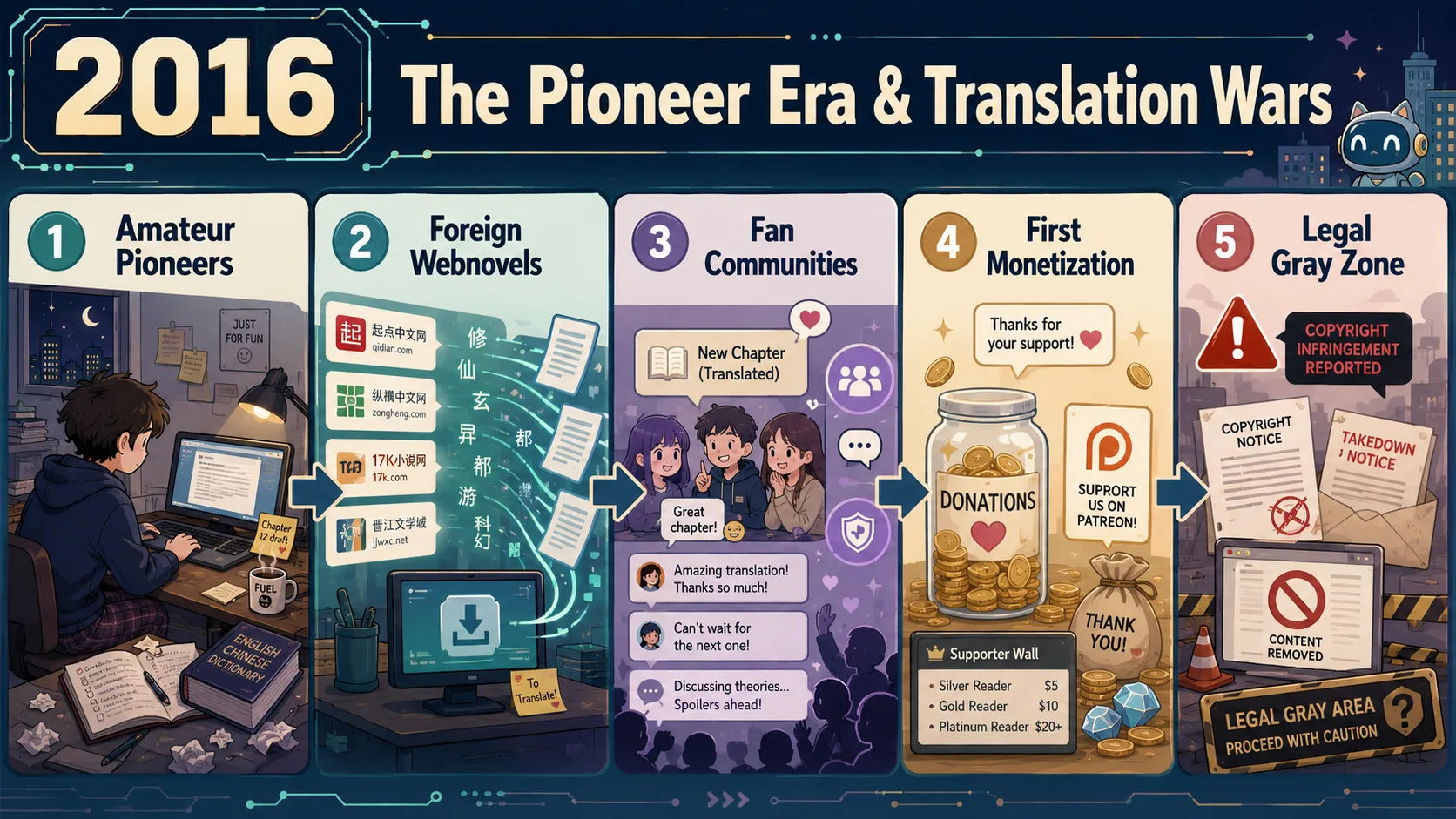
As the calendar turned toward the final months of 2016, the atmosphere in the web fiction community was thick with a sense of impending doom. The “Corporate Culture Shock” of the Qidian beta (Chapter 30) had proven one thing beyond any doubt: the era of the independent “City-State” was over.
If Wuxiaworld, Gravity Tales, and Volare remained isolated, they would be picked off one by one by the corporate titan from the East.
This realization triggered The Great Realignment, a series of secret negotiations, frantic mergers, and defensive alliances that transformed the industry from a collection of rival fan-hubs into a consolidated block of corporate power. It was the “Treaty of Westphalia” for web fiction—the moment that independent kings realized they needed an empire to survive.
—
Part 1: The End of the “Hub Wars”
For most of 2015 and early 2016, the relationship between the major hubs was defined by fierce, often petty, rivalry. They fought over translators, they fought over “Release Speeds,” and they fought for the attention of the NovelUpdates forums.
By December 2016, that rivalry had become a luxury they could no longer afford.
The major site owners—RWX (Wuxiaworld), GGP (Gravity Tales), and etvolare (Volare)—began a series of secret “Summit Meetings.” The goal was simple: Survival. They realized that they were all sitting on a gold mine of IP and community trust, but they were individually defenseless against a company like Tencent, which had deeper pockets and a total legal claim to the original Chinese texts.
The “Hub Wars” were officially over. The rhetoric on the forums shifted overnight from “Our site is better than yours” to “We must stand together as a community.” This wasn’t just a change in PR; it was a fundamental shift in the industry’s DNA. The competition was no longer between hubs; it was between the “Community” (the independent hubs) and the “Corporation” (Qidian).
—
Part 2: The Logic of Consolidation
The realignment wasn’t just about emotional solidarity; it was a hard-nosed economic calculation. To survive 2017, the hubs needed to solve three massive problems:
1. Legal Defense Funds: Fighting a copyright battle against a billion-dollar conglomerate required legal teams that a solo WordPress site couldn’t afford. By consolidating, the hubs could pool their revenue to hire the intellectual property lawyers necessary to negotiate “Master Licenses.”
2. Infrastructure Scaling: As we saw in Chapter 26, the cost of custom engines and DDoS protection was skyrocketing. A unified platform could share the cost of a single development team rather than three different ones.
3. Bargaining Power: Qidian wanted to swallow the western market. If they had to negotiate with ten different hubs, they could use “Divide and Conquer” tactics. If they had to negotiate with a unified block that controlled 90% of the western traffic, the hubs had a “Nuclear Option” of total boycott.
This was the birth of The Mega-Hub Logic. The goal was to become “Too Big to Fail.” If Wuxiaworld and Gravity Tales presented a unified front, Qidian would be forced to treat them as legitimate business partners rather than just rogue fan-sites.
—
Part 3: The Secret Mergers and the “Master License”
The most significant event of the Great Realignment was the pursuit of the Master License.
Behind the scenes, the hubs were no longer just translating chapters; they were negotiating for the right to exist. They were trying to secure formal, legal permission from Qidian and other Chinese platforms to continue their operations in exchange for a revenue share.
This led to the industry’s first Secret Mergers. Smaller, independent hubs that had been popular in early 2016 were quietly absorbed by the “Big Three.” These smaller sites realized that they had zero bargaining power on their own. They traded their independence for a spot under the “Protective Umbrella” of a major hub.
The “Wild West” was being fenced off. By the end of 2016, the vast majority of “High-Traffic” novels were concentrated on just three or four websites. The “Long Tail” was being severed, and the “Monopoly Era” was beginning. The “Fan-Hub” was dying, and the “Publishing House” was being born.
But what was a hub actually Worth? In late 2016, we saw the first rudimentary “Site Valuations.” A hub’s value wasn’t calculated based on its profit, but on its “Active User Monthly” (MAU) and its “Back-Catalog.” A site with 1,000 completed chapters of a popular series was worth significantly more than a site with 10 current, ongoing hits. Why? Because the back-catalog was an SEO magnet. It was passive income. A merger in 2016 was essentially a “Land Grab”—the major hubs were buying up the “Real Estate” of the internet so that they could own the search results for every major keyword in the genre.
“We were offered $50,000 for our site. At the time, that felt like winning the lottery. We were just a bunch of college kids running a blog. We didn’t realize that our site was generating 2 million page views a month and was worth ten times that in ad revenue alone. We sold our ‘Kingdom’ for the price of a mid-range car because we were scared of the corporate lawyers. Looking back, we were the first wave of ‘IP Colonialism’ in the web fiction world.”
— Former Admin of a 2016 Splinter Hub
—
Part 4: The Community’s Suspicion
The Great Realignment was not met with universal praise. The readers, who had been trained to love the “Independent Underdog” spirit of the hubs, began to feel a deep sense of Corporate Suspicion.
They saw the secret meetings, the sudden mergers, and the professionalization of the UIs as a betrayal of the original fan-spirit. They feared that the hubs were becoming “Qidian-Lite.” This led to the first major “Splintering” of the audience. A segment of the most hardcore fans began to look for the “Next Wild West”—they moved away from the major hubs and toward smaller, more “Anarchic” communities like Royal Road or independent Korean translation blogs.
—
Part 5: The “Corporate Shield” Meta
The final result of the realignment was the creation of the Corporate Shield.
By late 2016, the major hubs had successfully transformed themselves into “Shields” for their translators. In 2015, a solo translator lived in constant fear of a DMCA notice (Chapter 18). By the end of 2016, a translator at Wuxiaworld felt safe. They knew that if a legal threat came, it would hit the hub’s legal team, not their personal bank account. This safety came at a price: Autonomy. To get the shield, the translator had to sign a contract, follow the hub’s editorial standards, and give up a significant percentage of their Patreon revenue.
—
Part 6: The “Ghost Hub” Phenomenon—The Zombie Sites of 2016
A dark byproduct of the realignment was the rise of the Ghost Hub. When a major site acquired a smaller rival, they didn’t always shut it down. Instead, they would keep the old domain active but “Gut” the staff.
The original translators were moved to the parent site, but the “Ghost Hub” would continue to post automated “Update” messages or recycle old content to keep the SEO authority alive. These sites became “Zombie Platforms”—they looked active to a casual reader searching Google, but they were actually just shells used to funnel traffic toward the parent corporation.
This was the first instance of Algorithmic Deception in the industry. The hubs were realizing that “Traffic” was a physical asset that could be harvested, even if the “Community” that had created that traffic was long gone. It was a cold, calculated move that proved the industry had fully transitioned from a “People-First” hobby to a “Data-First” business. The readers were no longer “Members”; they were “Yield to be Harvested.”
By the end of 2016, these “Ghost Hubs” littered the search results like digital ruins. They served as a grim reminder that in the world of venture-capital-backed web fiction, the brand is immortal but the people are disposable. The Great Realignment didn’t just merge sites; it erased histories.
Consider the case of “Aria Translations,” a mid-sized hub that focused on niche Korean romance-fantasy. In July 2016, they were acquired by a larger entity. For the readers, nothing seemed to change for three months. The site layout remained the same, and “Aria” (the persona of the lead translator) continued to post cheerful updates. However, investigative fans on Reddit eventually discovered that the real Aria had left the industry weeks after the acquisition. The “Updates” were being written by a marketing intern at the parent company, using a style-guide to mimic Aria’s voice. When the truth came out, the community felt a sense of violation that went beyond mere piracy. It was an identity theft of the community’s trust. Aria Translations became a “Ghost Hub,” a hollow skin being worn by a corporation to extract the last few drops of ad-revenue from a dying fandom.
—
Part 4.1: The Exodus from Wuxia to Xianxia
The “Great Realignment” of 2016 was not just a legal shift; it was a profound shift in the very genre framework that the Western audience was consuming. Prior to 2016, “Wuxia” (Martial Heroes) was the dominant export. These stories, often rooted in historical Chinese fiction (like the works of Jin Yong), focused on martial arts, honor, and complex political intrigue. The power ceilings were relatively low—a master martial artist could jump over a wall or break a boulder, but they could not destroy a planet.
However, as the audience’s demand for infinite progression scaled, Wuxia proved completely inadequate. The narrative structure of Wuxia inherently required the protagonist to eventually face a mortal limit.
This resulted in the massive realignment toward “Xianxia” (Immortal Heroes) and “Xuanhuan” (Mysterious Fantasy).
In Xianxia, the power ceiling was completely removed. The protagonist did not just want to be the best martial artist in the province; they wanted to cultivate their internal energy (Qi) to the point where they could physically transcend mortality, shatter the void, ascend to a higher dimensional realm, and literally punch a galaxy in half.
The Escalation of the Power Ceiling
This realignment was driven entirely by the psychological demands of the serialization format. If a novel is designed to run for 3,000 chapters and generate $30,000 a month in Patreon revenue, the author cannot have the protagonist achieve their ultimate goal in Chapter 200.
The author must continually create new, exponentially larger goals.
In a Xianxia novel, the protagonist might spend the first 300 chapters conquering their home continent. The reader feels a sense of ultimate victory. But in Chapter 301, the author introduces a “Higher Realm,” revealing that the protagonist’s entire continent is actually just a tiny speck of dust in the grand cosmos, and the protagonist is once again the weakest person in the universe.
This loop—conquer a realm, ascend to a higher realm where you are weak again, conquer that realm—became the defining narrative structure of the Great Realignment. It was the only way to sustain a daily release schedule for three years without concluding the story.
Part 4.2: The Demographic Shift: The “Progression Fantasy” Monolith
As the Xianxia loop became the industry standard, it caused a massive demographic shift in the Western readership.
Initially, the translation community attracted readers interested in Chinese culture, mythology, and diverse narrative structures. But as the genre hardened into the endless power-escalation loop, those readers were driven out. They were replaced by a new, highly specific demographic: The “Progression Fantasy” reader.
This demographic was fundamentally different. They were primarily young, male, and deeply conditioned by the progression mechanics of video games. They did not care about the nuance of Daoist philosophy; they cared about the mathematical efficiency of the protagonist’s leveling speed.
They read fiction not for emotional resonance or thematic depth, but for the visceral, power-fantasy dopamine hit of watching a protagonist brutally dominate their enemies and acquire new skills.
The Optimization of the “Face-Slapping” Trope
This demographic shift solidified the absolute dominance of the “Face-Slapping” trope.
In the Xianxia context, “Face” refers to social standing and pride. The “Face-Slapping” trope is a hyper-optimized narrative sequence where an arrogant, aristocratic antagonist severely underestimates the protagonist, insults them publicly, and attempts to ruin their life. The protagonist then reveals their hidden power, completely humiliates the antagonist, destroys the antagonist’s entire family lineage, and takes their resources.
The Progression Fantasy demographic became addicted to this specific sequence. Authors realized that if they spaced out the “Face-Slapping” moments to occur exactly once every fifteen chapters, they could perfectly string the audience along, maximizing Patreon conversions during the tension-building phases and retaining the audience during the cathartic release.
Part 4.3: The Eradication of the Tragic Arc
The most profound consequence of this demographic realignment was the complete eradication of tragedy as a viable narrative tool.
In traditional literature, a protagonist must suffer profound losses to grow. In the web fiction ecosystem of 2016, if a protagonist suffered a profound loss, the readership revolted.
If an author wrote an arc where the protagonist’s mentor was killed, or where the protagonist lost a major battle and was forced to retreat, the NovelUpdates rating would instantly tank. The readers viewed any setback as a failure of the power fantasy. They did not want to read about a protagonist struggling with trauma or defeat; they wanted to read about a protagonist who was always five steps ahead, always in control, and always capable of crushing their enemies.
The Rise of the “Gary Stu” / “Mary Sue” Mandate
This created a bizarre ecosystem where the “Flawless Protagonist” (traditionally viewed as a hallmark of terrible writing) became the absolute, mandatory standard.
The protagonist had to be exceptionally talented, ruthlessly pragmatic, entirely immune to psychological trauma, and incredibly lucky. Any character flaw that actually hindered the protagonist’s progression was viewed by the audience as “filler” or “frustrating writing.”
The Great Realignment finalized the transition of web fiction from a literary pursuit into a highly optimized, heavily sanitized dopamine delivery system. The audience demanded total invincibility, and the authors, completely dependent on the algorithmic whims of Patreon and NovelUpdates, complied.
Part 4.4: The Western Imitation and Royal Road’s Ascendancy
While the Great Realignment was happening in the translated Chinese space, it was actively being mirrored and perfected by Western authors on Royal Road.
The Western authors saw the massive financial success of the Xianxia model, but they also saw its flaws: the clunky translations, the confusing cultural idioms, and the eventual bloat of the 3,000-chapter epics.
They began writing “Original English Fiction” (OEL) that distilled the Xianxia model down to its absolute core components. They took the endless power escalation, the gamified progression, and the invincible, pragmatic protagonist, and they grafted it onto Western Fantasy tropes (dragons, wizards, medieval knights).
This was the birth of the “Western Progression Fantasy” movement (which would later spawn massive hits like Cradle by Will Wight or Mother of Learning).
The Western authors had a massive competitive advantage. They didn’t have to wait for a Chinese author to write a chapter and a translator to translate it. They could write directly to their audience. They could interact with their Discord servers in native English. They could perfectly tailor their “Face-Slapping” arcs to the exact psychological profile of the Western teenager.
By the end of 2016, the Great Realignment was complete. The translation scene had paved the highway, but the Original English authors were now driving the fastest cars on it. The focus of the industry slowly began to shift away from Wuxiaworld and NovelUpdates, and squarely onto Royal Road, where the next generation of independent mega-stars was being born.
Actionable Takeaways for the Modern Author
The Great Realignment proved that isolation is a death sentence in a maturing market. To survive the “Corporate Phase” of an industry, you must build alliances.
1. The “Safety in Numbers” Strategy
If you are an independent author in 2026, don’t try to fight the platforms alone. Join an “Author Collective” or a “Marketing Circle.” By pooling your resources (and your mailing lists) with other authors in your genre, you can achieve the “Scale” necessary to survive the algorithm’s whims. A collective of ten mid-list authors is significantly harder for a platform to ignore than ten isolated individuals.
2. The “Umbrella” Logic—Autonomy vs. Security
There are times when it is better to be a “Small Fish in a Big Pond” than a “Big Fish in a Drying Puddle.” If a major platform or publisher offers you a spot under their “Protective Umbrella,” weigh the cost of your autonomy against the value of their “Shield.” In a world of aggressive copyright and AI scrapers, a legal and technical shield is worth more than a 10% higher revenue share. Never sacrifice your legal safety for a few extra pennies of royalties.
3. Maintain the “Soul” While Scaling
As you professionalize your “Brand,” be careful not to lose the “Humanity” that made you popular in the first place. Your audience wants to support a Person, not a Corporation. Even if you have a team of editors, assistants, and lawyers, your public face should remain as authentic and “Underdog” as possible. The “Corporate Suspicion” of 2016 is still very much alive today. Use your newsletter to pull back the curtain and show your readers that you are still the same person who started the journey.
4. Bargaining Power is Built on Traffic and Data Ownership
The only reason the hubs survived the realignment is because they controlled the Traffic. Qidian needed their readers. As an author, your mailing list and your direct community are your “Bargaining Power.” If you own the relationship with the reader, the platforms are forced to negotiate with you. If the platform owns the relationship, you are just an interchangeable content provider. Always prioritize building your own “Platform” over relying on someone else’s.
5. Recognize the “Zombie” Signs
In your own career, be wary of partnerships that feel like “Ghost Hubs.” If a publisher or platform is more interested in your “Back-Catalog” than your future work, they are likely just trying to harvest your SEO authority. Only partner with organizations that are invested in your voice, not just your yield. Your back-catalog is your retirement fund; don’t sell it for a “Ghost” of its actual value.
*(The hubs had consolidated, and the ‘Big Three’ were now the masters of the western scene. But as they built their corporate towers, the foundation of the ‘Solo Blog’ was crumbling. In Chapter 33: The Death of the Independent Blog, we explore how the technical requirements of 2016 made it physically impossible for a single person to host a novel on their own).*
0 Comments